


The modern workplace paradox is a familiar one: an open-plan design intended for connection that results in distraction, and formal meeting rooms that stifle the very creativity they are meant to capture. Spontaneous brainstorming becomes a logistical challenge, and the most innovative ideas remain unspoken, lost in the corridors between siloed desks. The friction between the need for focus and the desire for interaction is palpable, leaving teams unable to perform at their best.
As we look towards 2026, the demand for genuine, fluid teamwork requires a more profound approach. The solution lies not in another configuration of desks, but in transformative office fit out ideas for collaboration that breathe life into the very fabric of the building. It’s time to move beyond static architecture and embrace spaces that actively encourage engagement, turning passive walls into the most productive members of your team.
This guide moves beyond conventional furniture to explore 11 innovative concepts designed to transform your vertical real estate. Prepare to discover how interactive, magnetic, and writable surfaces can create bespoke zones for every style of teamwork—from impromptu huddles to deep-focus creative sessions. You will gain a blueprint for a workspace that not only inspires but also delivers a tangible return on investment, fostering a culture of innovation that is quite literally built into your walls.
Key Takeaways
- Understand the key principles of a truly collaborative workspace, moving beyond outdated layouts to designs that support modern hybrid teams.
- Explore a curated list of office fit out ideas for collaboration that transform your walls into functional zones for brainstorming, planning, and showcasing work.
- Learn a strategic approach to weave collaborative zones across your entire workspace, turning corridors and breakout areas into opportunities for innovation.
- Uncover the foundational element that makes these ideas possible: transforming static walls into dynamic, interactive surfaces for seamless teamwork.
Beyond the Boardroom: Redefining Collaboration in the Hybrid Era
The modern workplace is a fluid landscape, a delicate balance between colleagues at their home desks and those within the office walls. This hybrid reality presents a transformative challenge: how do we cultivate genuine teamwork when the team is physically divided? The answer lies not in reverting to old paradigms but in fundamentally rethinking the purpose of the office itself. The most innovative office fit out ideas for collaboration are born from this new necessity, moving beyond static architecture to create truly dynamic environments.
To move forward, we must first understand what is collaboration at its core: a process of two or more people working together to achieve a shared goal. For 2026, a collaborative space is not merely a room; it is an intelligent ecosystem of diverse, purpose-built zones designed to support this process. It is about creating a destination that empowers connection, sparks creativity, and seamlessly integrates both physical and digital participants.
The Problem with Static Spaces
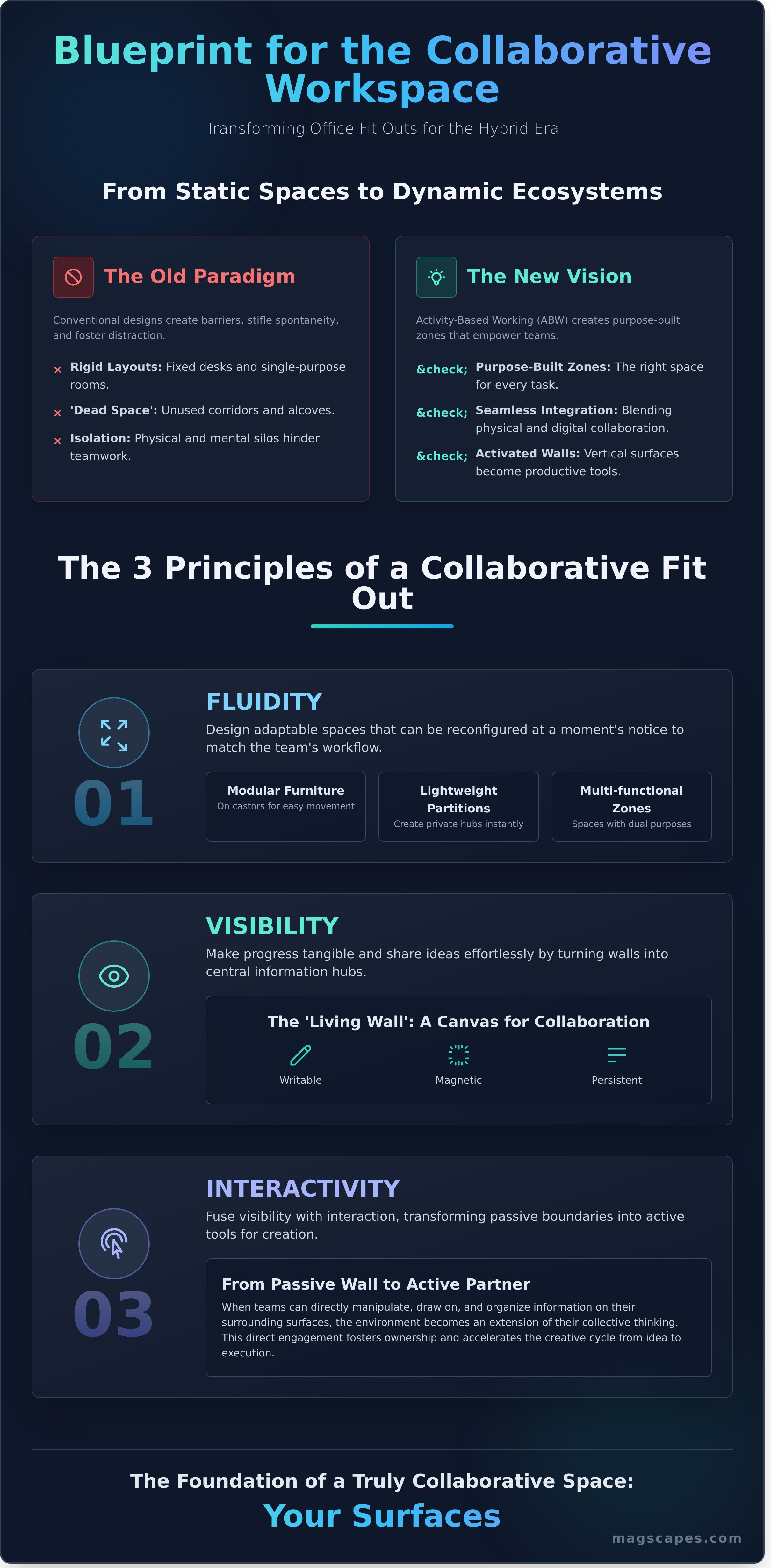
Conventional office design, with its rigid boardrooms and seas of uniform desks, often creates more barriers than breakthroughs. These single-purpose environments can stifle the very spontaneity that fuels innovation. Corridors, alcoves, and unused walls become 'dead space'—architectural voids serving no functional purpose. A high-density layout might look busy, but it rarely translates into a truly collaborative culture; more often, it fosters distraction and isolation, hindering deep, meaningful interaction.
Activity-Based Working (ABW) as a Foundation
This new vision finds its foundation in Activity-Based Working (ABW). ABW is a design philosophy that empowers employees to select the most appropriate setting for their immediate task—be it a quiet pod for focused work, a casual lounge for brainstorming, or a tech-enabled huddle room for a hybrid meeting. By embracing ABW, we shift the focus from 'where you sit' to 'what you need to achieve.' The following ideas provide a blueprint for designing these essential, high-performance zones.
The 3 Principles of a Truly Collaborative Office Fit Out
Beyond aesthetics, a truly transformative office design is built upon a strategic foundation. To cultivate an environment where ideas flow as freely as people, three core principles must guide your approach: Fluidity, Visibility, and Interactivity. These aren't just buzzwords; they are the architectural pillars that support everything from scheduled sprints to the serendipitous 'collisions' that spark innovation. By weaving these concepts into the very fabric of your space, you create an ecosystem that actively encourages connection and shared purpose.
Designing for Fluidity
A collaborative workspace must be as agile as the teams who use it. Fluidity is the principle of creating adaptable environments that can be reconfigured at a moment's notice. This is achieved through high-performance modular furniture on castors and lightweight acoustic partitions that allow a project team to create a semi-private hub in minutes. The design also embraces multi-functional zones; imagine a central café with bespoke joinery that seamlessly transitions from a casual lunch spot into a dynamic presentation area. The goal is to design intuitive pathways and remove physical barriers, encouraging movement and creating a natural flow between different modes of work.
Achieving Visibility with Interactive Surfaces
Collaboration thrives when progress is seen and shared. While glass walls and open sightlines can foster a sense of transparency, it's crucial to balance this with the need for focus, as extensive research on open-plan offices has shown that constant exposure can sometimes hinder deep work. The solution lies in making work itself visible. Instead of confining project plans to fleeting digital screens, bring them to life on large, persistent physical displays. This is the essence of the 'living wall'—a dynamic, magnetic, and writable surface that becomes a central canvas for a team's journey. It’s a space where ideas, timelines, and inspiration are not just stored but are actively displayed, inviting engagement and making progress a tangible, shared experience.
By embedding these interactive tools directly into the environment, you fuse visibility with interactivity. Walls cease to be passive boundaries and become active participants in the creative process. This fusion of principles provides the most effective office fit out ideas for collaboration, creating a responsive and intelligent workplace that empowers your team to connect, create, and innovate with unparalleled ease.
11 Actionable Fit Out Ideas to Activate Your Walls
The walls of your office are no longer mere structural boundaries; they are your largest untapped asset. By reimagining these vertical surfaces, you can create dynamic hubs for interaction, transforming passive partitions into active canvases for innovation. These transformative office fit out ideas for collaboration move beyond static paint and pictures, activating your space with functional, multi-layered surfaces that invite engagement at every turn. Here are 11 ways to bring your walls to life.
For Brainstorming & Ideation
- The 360-Degree Idea Wall: Envelop a creative room with floor-to-ceiling magnetic and dry-erase wallcoverings. This provides an unrestricted, seamless canvas for teams to capture every thought without limitation, perfect for high-energy workshops.
- The Analogue-Digital Hub: Integrate a large interactive screen within a wider magnetic, writable wall. This allows teams to blend digital research with physical notes and sketches, creating a powerful synergy in meeting rooms or innovation labs.
- Pop-Up Brainstorm Nooks: Activate underutilised corridors or alcoves with magnetic panels. These impromptu zones encourage spontaneous collaboration, turning transitional spaces into destinations for quick problem-solving.
- The Tactile Mood Board: Use bespoke printed magnetic graphics on a feature wall in a design studio. Teams can physically arrange and layer images, swatches, and text, making creative direction a tangible, hands-on process.
For Project Planning & Management
- The Kanban Corridor: Transform a high-traffic hallway into a living project timeline. Using magnetic, writable surfaces with custom overlays allows entire departments to see project progression at a glance, fostering transparency and accountability.
- The Agile Team War Room: Dedicate a space with fully reconfigurable magnetic charts and timelines. This empowers agile teams to adapt their planning walls for each sprint, making the environment as flexible as their methodology.
- The Architectural Plan Wall: In design or construction offices, a magnetic wall allows for the damage-free display of large-format drawings. Review, annotate, and overlay plans without resorting to pins or tape, preserving critical documents.
- The Interactive Onboarding Wall: Create a welcoming space for new hires using magnetic profiles and graphics to visualise team structures, company timelines, and key contacts, making orientation a dynamic and engaging experience.
For Presenting & Showcasing
- The Dynamic Brand Welcome Wall: Greet visitors with an ever-evolving brand story in your reception area. Changeable magnetic graphics allow you to showcase new projects, celebrate team achievements, or update seasonal messaging with effortless elegance.
- The Client Pitch Room: Elevate presentations by turning the walls into an interactive part of the pitch. Write key figures, draw diagrams, and attach physical concept boards directly to the wall to create a compelling, multi-dimensional narrative.
- The Data Visualisation Wall: Make performance metrics visible in common areas or boardrooms. A magnetic and writable surface allows teams to display printed charts alongside handwritten updates, turning data into a daily conversation.
Integrating Collaborative Zones Throughout the Office
True collaboration is not confined to a single room; it is a fluid, dynamic process that should be encouraged to flourish in every corner of the workspace. The most transformative office fit out ideas for collaboration move beyond the boardroom, weaving functional touchpoints into the very fabric of the building. This approach is not the exclusive domain of sprawling tech campuses; it’s a scalable strategy that leverages underutilised surfaces to maximise creative potential in any floor plan, turning every wall into a potential asset.
This holistic view of the office environment means considering every surface. Beyond the interactive walls discussed here, elements like furniture finishes and window treatments play a crucial role in defining zones, managing light, and supporting the overall design aesthetic. Revitalizing existing desks with durable wraps or applying films to glass partitions for privacy are cost-effective ways to support an agile workspace. For those exploring these kinds of surface transformations, you can discover Decords for inspiration and professional solutions.
Transforming Breakout Areas
Elevate your breakout zones from passive rest stops to active hubs of innovation. Moving beyond sofas and coffee tables, consider integrating a floor-to-ceiling magnetic and writable wall. This transforms the space into an impromptu forum for problem-solving, where a casual conversation can instantly become a productive brainstorming session. Enhance this with bespoke magnetic graphics that reflect your brand's personality while providing functional templates, turning a simple wall into a dynamic, interactive canvas. You can even designate a 'tech-free' zone with a simple writable surface to encourage focused, human-to-human dialogue away from screen distractions.
Reimagining Corridors & Transit Spaces
Often viewed as mere transit routes, corridors hold immense, untapped potential. By treating these spaces as 'collision points,' you can foster spontaneous information sharing and cross-departmental interaction. Install magnetic noticeboards for organic updates or long, linear writable surfaces for teams to map out customer journeys and project timelines as they move through the office. These high-traffic areas are also the perfect place to showcase company values or celebrate project milestones with high-quality, easily updatable magnetic prints—creating a living gallery that evolves with your business. This is one of the most effective office fit out ideas for collaboration because it makes innovation visible and part of the daily journey. See how leading companies are transforming their spaces with interactive walls.
The Foundation of a Collaborative Space: Your Surfaces
Throughout this exploration of forward-thinking office design, a central theme emerges: dynamic collaboration requires dynamic surfaces. The innovative breakout zones, agile project walls, and interactive hubs we've discussed are not just concepts; they are tangible environments built upon a functional foundation. This is where the wall itself is transformed from a static boundary into a living, interactive canvas. MagScapes provides the enabling technology to bring these ambitious office fit out ideas for collaboration to life.
By reimagining the potential of vertical surfaces, we unlock new dimensions of creativity and productivity. High-performance wallcoverings provide a sophisticated, integrated alternative to cumbersome whiteboards and impermanent paint solutions, forming the very fabric of a modern, collaborative workspace.
Why Choose High-Performance Wallcoverings?
Moving beyond consumer-grade options is essential for a professional environment designed for longevity and impact. Unlike paints that can stain, ghost, or chip, our commercial-grade systems are engineered for constant interaction and are built to endure the demands of a busy workplace. The key advantages are clear:
- Unrivalled Durability: Our wallcoverings are specifically designed for high-traffic commercial use, ensuring a pristine, high-performance finish that lasts for years.
- Seamless Finish: Imagine entire walls of pure, uninterrupted functionality. Create floor-to-ceiling magnetic and writable spaces without the visual clutter of joints, seams, or frames.
- Aesthetic Integration: Why choose one function when you can have them all? Our systems allow you to combine writable, magnetic, and custom-printed finishes into a single, cohesive, and beautiful surface. Explore the possibilities of fully functional writable magnetic walls.
Bringing Your Vision to Life with MagScapes
MagScapes is more than a supplier; we are a partner for architects, designers, and businesses dedicated to creating extraordinary spaces. Our integrated system provides the tools to execute your most creative office fit out ideas for collaboration with precision and elegance.
With MagWrite™, you can install a flawless, high-gloss, dry-erase surface of any size, perfect for brainstorming and visual thinking. For a truly bespoke touch, MagPrint™ allows you to embed your branding, custom graphics, or subtle patterns directly onto a magnetic base, turning feature walls into powerful communication tools. This complete system is supported by a curated collection of high-strength magnets and accessories, ensuring every element works in perfect harmony. Begin designing your unique space by exploring our options for custom magnetic wall graphics.
To transform your workspace into a hub of innovation, visit us at magscapes.com and discover how our surfaces can become the foundation for your vision.
Your Walls: The Canvas for Future Collaboration
As we look towards 2026, it's clear that fostering genuine teamwork is no longer confined to scheduled meetings in a single room. The future of the workplace is built on a foundation of flexibility, human-centric design, and the seamless integration of technology. The most impactful office fit out ideas for collaboration transform every corner of the office—from corridors to breakout zones—into a dynamic opportunity for connection and innovation.
Of course, a world-class collaborative space is only as effective as the team working within it. For businesses in fast-paced sectors like digital commerce, finding talent that thrives in such dynamic environments is the other half of the equation. As you design the ideal physical workspace, you can also explore E-commerce Recruitment to find the specialists who will bring it to life.
The foundation of this dynamic environment lies in your surfaces. At MagScapes, we help you activate these vertical planes, turning static walls into living, interactive canvases for creativity. With our patented magnetic technology, manufactured with precision in the UK, we provide high-performance, bespoke solutions trusted by leading architects and global brands. It's time to move beyond the conventional.
Reimagine your surfaces. Contact our specialists to discuss your project.
Your journey to a truly collaborative workspace begins now.
Frequently Asked Questions
How do you encourage employees to actually use collaborative spaces?
To inspire genuine engagement, collaborative spaces must be designed with intention and appeal. Success lies in creating environments that are not only functional but also inviting. This involves integrating comfortable, flexible furniture, ensuring intuitive access to technology, and providing dynamic surfaces that encourage interaction. A space with a floor-to-ceiling magnetic and writable wall, for instance, becomes a natural focal point for spontaneous creativity, drawing teams in far more effectively than a sterile, uninspired room.
What is the difference between a collaboration space and a meeting room?
The core distinction lies in purpose and flexibility. A traditional meeting room is a formal, enclosed space designed for scheduled, agenda-driven discussions. In contrast, a collaboration space is typically more open and informal, engineered to foster spontaneous interaction, ad-hoc brainstorming, and creative co-working. While a meeting room is structured for presentation, a collaboration zone is a dynamic environment built for participation and the fluid exchange of ideas.
How can I incorporate collaboration zones into a small office?
In a compact setting, the key is multi-functionality. Instead of dedicating entire rooms, think in terms of transforming existing areas. Utilise vertical space by converting a hallway or an open-plan wall into an interactive hub with magnetic, writable wallcoverings. Introduce modular furniture that can be easily reconfigured for group work or individual focus. This approach creates agile, purposeful zones without demanding a large footprint, making every square metre work harder.
Are writable walls better than traditional whiteboards?
Writable walls represent a significant evolution from traditional whiteboards. Where a whiteboard is a framed, finite object that can disrupt a room's aesthetic, a fully writable wall is an integrated architectural feature. It offers a boundless, seamless canvas for ideas, encouraging expansive thinking without physical constraints. This transforms the entire surface into a functional and sophisticated tool that enhances, rather than detracts from, your interior design vision.
How do you balance collaborative spaces with the need for quiet, focused work?
A successful modern office is a carefully balanced ecosystem of different zones. The solution lies in thoughtful spatial planning and acoustic intelligence. Create clear distinctions using acoustic partitions, dedicated quiet zones, or enclosed pods for deep focus. High-performance wallcoverings can also contribute to sound dampening. By providing a spectrum of environments—from vibrant, buzzing hubs to tranquil retreats—you empower employees to choose the space that best suits their immediate task.
What role does technology play in a collaborative office fit out?
Technology is the invisible framework that enables seamless collaboration, especially for hybrid teams. An effective fit out integrates technology so it feels intuitive, not intrusive. This includes wireless screen sharing, high-fidelity video conferencing equipment, and user-friendly booking systems for shared spaces. When digital tools work in perfect harmony with the physical environment—such as an interactive screen alongside a magnetic project wall—the potential for innovation is truly unlocked.
How much of an office should be dedicated to collaborative spaces?
There is no universal percentage; the ideal ratio depends entirely on your company's unique workflow and culture. However, the trend is a clear shift away from desk-centric layouts. Many forward-thinking UK businesses now allocate 40-50% of their floor space to a diverse mix of collaborative and social areas. The best approach is to analyse your team's specific needs to create a bespoke balance between spaces for individual focus and those for group synergy, which is central to effective office fit out ideas for collaboration.
Can you make an existing wall magnetic and writable?
Absolutely. Transforming a standard wall into a high-performance, interactive surface is a core principle of modern design and one of our specialities. This can be achieved by applying innovative wallcoverings, such as a ferrous-based liner that makes the surface magnetic, which is then finished with a high-quality dry-erase layer. This process is one of the most transformative office fit out ideas for collaboration, converting any passive vertical surface into a dynamic canvas for creativity without structural work.