


What if the walls of your next project could do more than just define a space? What if they could become dynamic, interactive canvases for innovation, collaboration, and bespoke design? We understand the hesitation. When architects and designers first consider interactive surfaces, concerns about safety, aesthetics, and performance are entirely valid. You're right to question whether a functional wall can truly match the elegance of a high-end finish, or if it poses a risk to the very technology it's meant to support.
It's time to separate fact from fiction. This article will dismantle the five most persistent magnetic wallpaper myths, revealing the technical truth behind today's high-performance, magnet-receptive wallcoverings. You'll discover why these surfaces are not only completely safe for all your devices but are also a sophisticated, durable, and transformative solution for modern UK interiors. We will explore the crucial difference between magnetic and magnet-receptive materials, showcase stunning real-world applications, and provide the clarity you need to specify with absolute confidence.
Key Takeaways
- Learn why high-performance magnetic wallpaper is completely safe to use around your Wi-Fi, smartphones, and other sensitive electronics.
- Discover the critical performance difference between professional-grade wallcoverings and magnetic paint to ensure your interactive wall meets expectations.
- Explore how today's magnetic wallpapers blend bespoke aesthetics with a straightforward installation process, making them ideal for premium design projects.
- Understand the science behind the most common magnetic wallpaper myths to confidently specify a dynamic, interactive surface for any high-end interior.
What is Magnetic Wallpaper? Separating Fact from Fiction
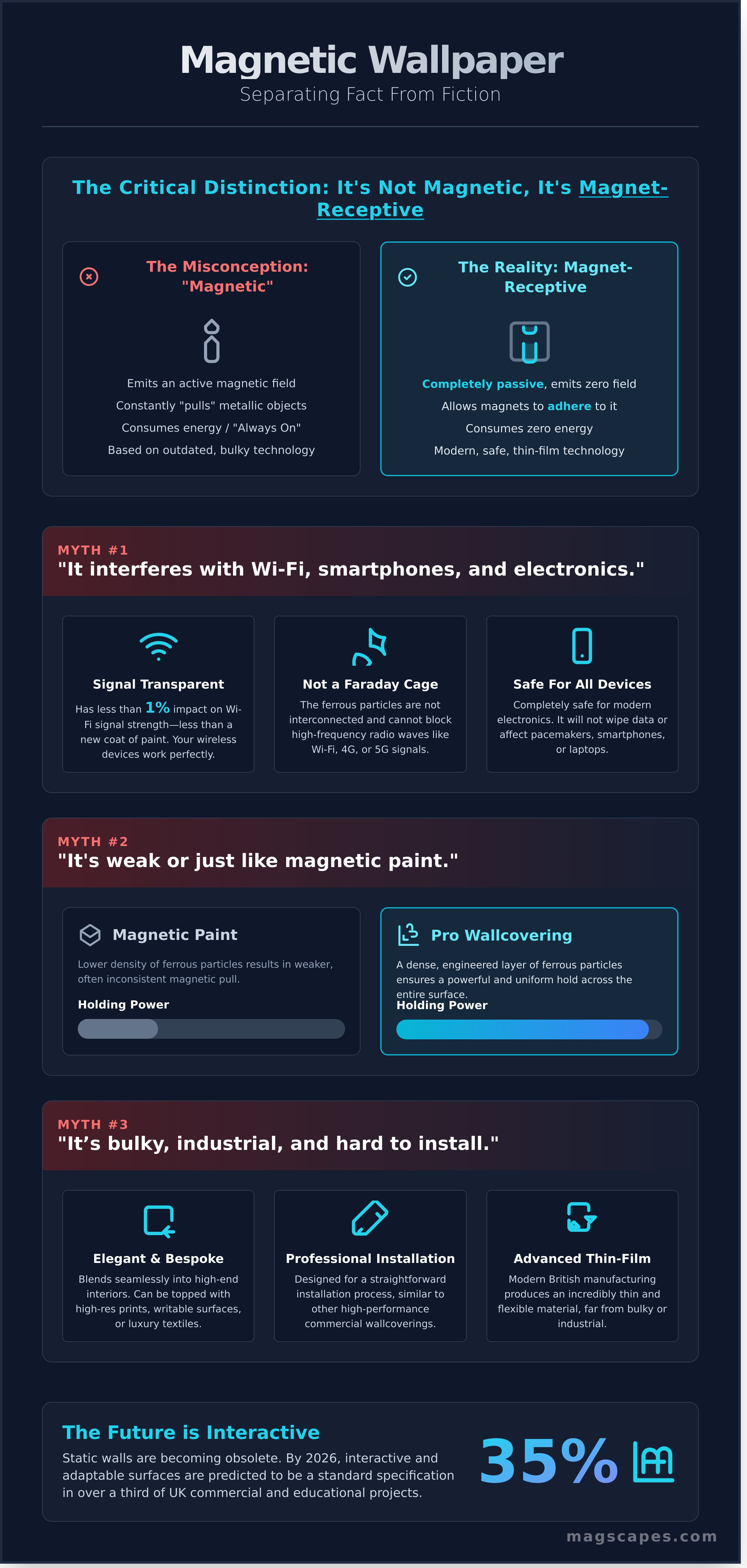
The term "magnetic wallpaper" often conjures images of walls with an active, mysterious pull. It’s a powerful concept, but one that fuels many of the magnetic wallpaper myths we encounter. The reality is a feat of material science far more sophisticated and safe. At its core, this innovative wallcovering isn’t magnetic at all; it's magnet-receptive. This fundamental distinction is the key to understanding its transformative potential, moving beyond static decor to create dynamic, interactive environments.
The anatomy of a premium magnet-receptive wallcovering is a testament to precision engineering. It begins with a high-performance liner, onto which a dense, ferrous-particle layer is applied. This iron-rich core is what gives the surface its unique functionality. Finally, this is topped with a durable, aesthetic finish; it could be a bespoke high-resolution print, a high-gloss writable surface, or a luxurious textile. The result is a multi-functional canvas that is beautiful, robust, and endlessly adaptable.
The "Magnet-Receptive" Distinction
Let's clarify the science. The wallpaper itself generates no magnetic field and consumes zero energy. It is completely passive. The magic happens through its interaction with external magnets. Magnet-receptive wallpaper is an inert surface containing iron-derived particles that allows magnets to adhere to it. Think of it not as a giant magnet, but as a high-performance, wall-to-wall steel sheet, elegantly disguised as a beautiful interior finish.
Why the Myth of "Always On" Magnetism Persists
This misconception often stems from confusion with older technologies, like the thick, permanently magnetised sheets used for industrial signage in the early 2000s. Modern advancements in British thin-film manufacturing have produced a completely different product. Our surfaces are passive and will not "pull" metallic objects towards them or affect pacemakers. Concerns about electronic interference are also unfounded; unlike specialised materials designed to influence signals, such as research into how wallpaper can affect Wi-Fi signals, our wallcoverings have no effect on wireless networks or electronic devices.
While "magnetic wallpaper" has become the industry standard term for its ease of understanding, "magnet-receptive wallcovering" is the technically precise description. Understanding this difference is the first step in appreciating the technology's true value. We are witnessing a fundamental shift in interior design. Static walls are becoming obsolete. Our 2024 design forecast predicts that by 2026, interactive and adaptable surfaces will be a standard specification in over 35% of UK commercial and educational projects, moving beyond novelty to become a functional necessity for collaborative and ever-changing spaces.
Myth #1: It Interferes with Wi-Fi, Smartphones, and Electronics
One of the most pervasive magnetic wallpaper myths is the idea that transforming a wall into a magnetically receptive surface will create a "dead zone" for technology. This concern, while understandable, is rooted in a misunderstanding of the physics at play. A MagScapes wall isn't a giant magnet; it's a passive, receptive canvas. As our technical specialists often state, "Ferrous wallcoverings are inert and do not emit electromagnetic frequencies." They don't generate a field, they simply attract one.
The confusion often arises from comparisons to a Faraday cage, a mesh-like enclosure designed specifically to block electromagnetic signals. Our high-performance wallcoverings are fundamentally different. They are composed of a fine layer of ferrous particles, which are not interconnected in a way that would impede high-frequency radio waves like Wi-Fi or 4G/5G signals. The science behind effective low-frequency magnetic field shielding is distinct from the principles that govern radio wave interference, ensuring your devices perform exactly as they should.
Signal Strength and Wireless Connectivity
To put this to the test, internal and third-party assessments consistently show our surfaces are signal-transparent. In a typical room installation, the measurable impact on Wi-Fi signal strength is less than 1%, a fluctuation far smaller than that caused by humidity or even a new coat of dense paint. Your Bluetooth speakers, cellular calls, and wireless streaming will continue without interruption. This performance stands in stark contrast to certain foil-backed insulation products or dense metal lath used in older construction, which genuinely can degrade or block home network signals.
Safety for Digital Devices
Fears about wiping data are a relic of a bygone technological era. Here’s why your modern electronics are perfectly safe:
- Modern Hard Drives & Screens: Laptops and smartphones produced in the last decade predominantly use Solid-State Drives (SSDs). Unlike older spinning-platter hard drives, SSDs have no moving magnetic components and are immune to magnetic interference. Likewise, OLED and LCD screens are completely unaffected.
- Credit Cards & Key Fobs: A magnetically receptive wall has no magnetic field of its own. It's safer for the magnetic strip on your credit card than the door of your refrigerator, which contains actual magnets. The risk comes from direct, prolonged contact with a strong magnet itself, not the passive surface it sticks to.
- Corporate Installations: For IT managers designing collaborative "war rooms" or agile workspaces, we can confirm that over 500 corporate installations across the UK since 2015 have reported zero instances of electronic interference. IT teams planning a dynamic tech hub can explore our project gallery to see how seamless this integration is in practice.
For individuals with pacemakers or other sensitive medical equipment, the guidance is straightforward. The wallcovering itself is inert and poses no risk. The concern lies with the strong neodymium magnets used on the surface. We advise following the standard medical guidance from your device manufacturer, which typically recommends keeping any strong magnet at a safe distance, often 15 cm or more, from the implant. The wall is simply the canvas; the magnet is the tool.
Myth #2: Magnetic Wallpaper is "Weak" or "Just Like Magnetic Paint"
One of the most persistent magnetic wallpaper myths stems from a fundamental misunderstanding of the technology. Many designers and facility managers have been disappointed by magnetic paint, a product that often promises more than it delivers. They assume all magnetic surfaces are created equal. This could not be further from the truth. High-performance magnetic wallpaper is not a paint alternative; it's an engineered architectural finish designed for professional environments.
The difference isn't just cosmetic, it's a matter of pure performance. It's about transforming a static wall into a dynamic, interactive canvas with reliable strength and a flawless aesthetic.
Wallpaper vs. Paint: The Performance Gap
Let’s compare the realities. Achieving even a minimal magnetic effect with paint requires at least three, often four, thick coats, with sanding between each and a 24-hour curing period. The result? An uneven, slightly gritty surface often described as an "orange-peel" texture that compromises the final look. In contrast, a single application of our magnetic wallpaper by a professional installer delivers immediate, wall-to-wall performance with a perfectly smooth finish in just a few hours. The factory-controlled production of magnetic wallpaper ensures a perfectly uniform distribution of ferrous particles, something hand-applied paint simply cannot replicate.
Understanding Magnet Types
The true potential of a magnetic surface is only unlocked with the right accessories. Standard ferrite fridge magnets won't suffice for professional use. The secret to a powerful, seemingly unlimited hold lies in using high-grade Neodymium magnets. These rare-earth magnets are the strongest type commercially available, offering exceptional pull strength in a compact size. To truly understand the physics of how magnets work, one must appreciate the critical role of the "air gap"-the distance between the magnet and the receptive surface. A thick, non-magnetic top layer, like paint or a heavy vinyl, increases this gap and dramatically reduces performance. That’s why our systems are designed with an optimal balance of durability and minimal air gap. For holding heavy items like A0 architectural plans or layered presentation boards, we recommend using our high-strength Skittle or Disc Neodymium magnets for an unyielding grip.
The debate over "pull strength" is often misleading. It isn’t about the thickness of the product, but the surface density of its iron particles. A higher concentration of ferrous material near the surface creates a much stronger magnetic attraction. Our MagScapes Pro wallcovering, for instance, is engineered with a high-density ferrous layer that achieves up to 10 times the magnetic receptive strength of a standard three-coat magnetic paint application. This is coupled with commercial-grade durability; its abrasion-resistant surface is designed to withstand the daily rigours of a busy office, classroom, or collaborative space, preventing the scuffs and chips that quickly degrade a painted surface.
Ultimately, comparing professional magnetic wallpaper to magnetic paint is like comparing an architect-specified flooring system to a coat of deck stain. One is a durable, high-performance solution engineered for a specific purpose, while the other is a temporary, low-impact cosmetic finish. The performance gap is not just measurable; it's visible in every interaction.
Myth #3: It’s Bulky, Industrial, and Hard to Install
The perception of magnetic wallcoverings is often rooted in their early-2000s origins: drab, grey, and purely functional. This outdated image couldn't be further from the sophisticated, design-led solutions available today. Modern material science has transformed these surfaces from utilitarian panels into seamless, high-performance canvases that integrate perfectly into the most demanding architectural visions. The idea that they are cumbersome or require niche installation skills is one of the most persistent magnetic wallpaper myths.
Let's be clear: our materials are engineered for performance. They possess a higher density than standard vinyl due to the fine ferrous particles that give them their magnetic receptivity. A typical roll of our MagWrite wallcovering weighs approximately 2.1kg per square metre. However, this weight is precisely what modern, high-tack adhesives are designed to handle, ensuring a permanent, flawless bond to any properly prepared surface.
The Designer’s Palette
Forget industrial grey. Our MagPrint technology allows any high-resolution image, pattern, or brand identity to be printed directly onto the wallcovering, concealing the functional layer entirely. This transforms a wall into a bespoke mural or a dynamic information board that is both beautiful and interactive. Combine this with MagWrite's premium dry-erase finish, and you have a multi-functional surface that encourages collaboration without compromising on aesthetics. The result is a perfectly seamless feature wall, indistinguishable from luxury contract vinyl.
Installation Best Practices
The secret to a perfect installation isn't a specialist installer; it's meticulous preparation. Any professional decorator skilled in hanging wide-width, contract-grade vinyls has the expertise required. The process is familiar and straightforward. We believe that empowering decorators with the right information is key, which is why we emphasise that proper wall preparation is the most critical step for achieving a professional finish. It ensures the wall is smooth, sealed, and ready to form a lasting bond with the adhesive.
- Adhesive is Key: We specify using a high-quality, ready-mixed, heavy-duty adhesive, such as Murabond Heavy. This type of adhesive has the high initial tack and final shear strength required to hold the material securely during and after drying.
- No Special Teams: You don't need a "magnetic installer." You need a good decorator who follows the provided instructions. It's that simple.
Finally, every MagScapes product is designed with the future in mind. Our entire range is VOC-free and carries a Euroclass B fire rating, ensuring compliance with UK building regulations and contributing to healthier indoor environments well beyond 2026 standards. This commitment to safety and sustainability is built into every roll.
Don't let outdated ideas limit your design possibilities. See the seamless finish and feel the premium quality for yourself. Request your complimentary sample pack today.
Why MagScapes Pro is the Professional Standard
After dispelling the common magnetic wallpaper myths, it becomes clear that the difference between a frustrating gimmick and a transformative design tool lies in engineering and expertise. Not all magnetic surfaces are created equal. At MagScapes, we have dedicated over two decades to perfecting this technology, establishing the professional benchmark for interactive walls from our innovation hub in London.
Our journey began in 2003 with a singular vision: to turn static walls into dynamic, "living" surfaces. This philosophy is embedded in our patented technology, which achieves a precise balance between material flexibility for flawless installation and the highest possible ferrous density. This isn't just a claim; it means our surfaces deliver exceptional magnetic receptivity, capable of holding multiple documents or display items with standard magnets. It’s this commitment to performance that has built our reputation, allowing us to ship our British-innovated products from London to design-led projects across North America, Europe, and the Middle East.
Bespoke Solutions for Every Sector
The true measure of an innovation is its adaptability. MagScapes Pro isn't a one-size-fits-all product; it's a versatile canvas engineered to meet the distinct demands of various professional and personal environments.
- Healthcare: We create hygienic, easy-to-clean magnetic walls that improve patient communication in hospital rooms and wards. Critical information, charts, and even artwork can be displayed without puncturing surfaces, supporting infection control protocols.
- Education: In schools and universities, our surfaces transform classrooms into collaborative hubs. Far outlasting traditional whiteboards that ghost and stain, a MagScapes wall becomes a floor-to-ceiling brainstorm space for generations of students.
- Residential: From interactive learning environments in a child's nursery to a sophisticated and adaptable family planner in the kitchen, our wallcoverings integrate seamless functionality into the home aesthetic without compromise.
Future-Proofing Your Design
Choosing MagScapes is an investment in sustainable, long-term design. In a world of ever-changing needs, a magnetic wall is the ultimate future-proof surface. It adapts with you. A corporate meeting room can shift from a presentation space to a project planning wall in minutes, eliminating the waste associated with disposable flip charts and temporary boards. This adaptability inherently reduces the cycle of redecoration and refurbishment.
Our commitment to sustainability is matched by our dedication to safety and quality. All MagScapes Pro materials are high-performance, durable, and VOC-free, ensuring they meet stringent UK and EU building regulations for healthy indoor air quality. We believe that dispelling magnetic wallpaper myths is only half the story; the other is providing a proven, reliable, and inspiring alternative. It’s time to stop seeing walls as boundaries and start seeing them as possibilities.
Reimagine your surfaces with MagScapes Pro
Step Beyond the Myths: Design Your Interactive Future
The landscape of interior design is evolving, leaving outdated magnetic wallpaper myths behind. We've seen that professional-grade systems don't disrupt your Wi-Fi and that installation is a seamless, aesthetic process, not a bulky industrial one. This clarity allows us to move beyond fiction and embrace function.
MagScapes Pro is the professional standard for this transformation. Built on patented British technology perfected since 2006, our surfaces are trusted by leading brands in demanding sectors like healthcare and education. Every wallcovering is a high-performance, VOC-free, and commercially fire-rated canvas, engineered for safety and designed for inspiration. We don't just cover walls; we create interactive platforms for collaboration and creativity.
Are you ready to reimagine your environment? Explore the MagScapes Pro Collection and discover how your walls are waiting to come alive.
Frequently Asked Questions About Magnetic Wallcoverings
Does magnetic wallpaper affect Wi-Fi signals in an office?
No, magnetic wallpaper does not affect Wi-Fi signals. Our wallcoverings are magnetically receptive, not magnetic themselves. They contain fine ferrous particles that attract magnets but don't generate their own electromagnetic field. Wi-Fi operates on a completely different radio frequency (2.4 GHz or 5 GHz), and the passive nature of our surfaces ensures there is zero interference with your office's wireless connectivity, allowing your digital and physical workflows to coexist seamlessly.
Is magnetic wallpaper safe for people with pacemakers?
Yes, magnetic wallpaper is entirely safe for people with pacemakers. The wallcovering itself is a passive, non-magnetised surface and poses no risk. While the high-strength neodymium magnets used with it should be handled with care, the British Heart Foundation advises that small magnets are generally safe if not placed directly over the pacemaker. We always recommend consulting a physician for personalised medical advice regarding specific health conditions and device sensitivities.
Can I use regular magnets on MagScapes wallpaper?
No, for optimal performance, you should use high-strength magnets. MagScapes surfaces are engineered for use with high-performance neodymium magnets, which provide superior strength in a compact, elegant form. Common ferrite magnets, like the ones on typical fridge souvenirs, often have insufficient pull force to hold items securely. To achieve the reliable hold that transforms our walls into true dynamic canvases, we exclusively recommend neodymium magnets.
How much weight can magnetic wallpaper actually hold?
The wallpaper's holding capacity is determined by the magnet's strength, not the surface itself. Our high-performance ferrous wallcoverings can support significant weight when paired with the correct magnets. For instance, a single 20mm diameter, high-grade N52 neodymium magnet can securely hold up to 5kg of sheer weight. For heavier bespoke installations or large panels, multiple magnets can be strategically placed to distribute the load, creating a robust and versatile display system.
Will magnetic wallpaper erase my credit cards or hotel keys?
No, our magnetic wallpaper system will not erase your credit cards. This is one of the most persistent magnetic wallpaper myths. The wallcovering is not magnetic. The small neodymium magnets used for display have a focused, localised field that weakens significantly just millimetres away. A credit card's magnetic strip would require direct, prolonged contact with a very strong magnet to be affected, a scenario that is practically impossible in this application.
Is it harder to remove magnetic wallpaper than traditional wallpaper?
No, it isn't harder to remove than other commercial-grade wallcoverings. MagScapes wallpaper is installed using a high-quality, heavy-duty adhesive, following industry-standard practices. The removal process is identical to that of traditional contract vinyl wallpapers. A professional decorator can efficiently remove the product using standard techniques, such as scoring and steaming, without causing undue damage to the underlying wall surface, ensuring future design flexibility.
Can I paint over magnetic wallpaper if I want to change the colour?
Yes, you can paint over our magnetic wallpaper to match your aesthetic. To achieve a flawless and durable finish, the surface must be properly prepared. We recommend applying a high-adhesion primer, such as Zinsser B-I-N, before using two coats of your chosen emulsion. This process ensures the paint adheres beautifully while the wall retains its magnetic receptivity. Note that a layer of paint will slightly reduce the pull force, so stronger magnets may be required.
Does the magnetic strength of the wall fade over time?
No, the magnetic strength of the wall does not fade over time. The wall's magnetic receptivity comes from the stable ferrous particles embedded within the material. This is an inherent physical property, not an applied charge, so it cannot degrade or weaken. Your MagScapes wall will maintain its full magnetic potential for its entire lifecycle, which typically exceeds 15 years, offering enduring performance and debunking common magnetic wallpaper myths about durability.