


A single pixel of error on your monitor can become a ten-centimetre flaw when expanded across a corporate atrium or a boutique hotel lobby. It’s a sobering reality for designers who realise that 82% of large-format print failures originate during the file preparation stage, making precise artwork specifications for printing your most vital tool. You understand that a bespoke wallcovering is more than just decor; it’s a functional, living canvas that must withstand the scrutiny of close-up interaction. Yet, the leap from a 27-inch screen to a six-metre installation often brings a lingering fear of low-resolution blur or unexpected CMYK colour shifts.
This guide provides a definitive technical framework to eliminate the uncertainty of scaling massive surfaces and managing complex colour profiles. We promise to equip you with the technical mastery required to ensure your creative vision remains as sharp and vibrant as the digital proof. You will gain a clear checklist for preparing flawless files, specifically tailored for the unique requirements of our MagPrint surfaces, ensuring your next project is both a technical triumph and a transformative aesthetic experience.
Key Takeaways
- Understand why architectural scale requires heightened technical scrutiny to ensure your bespoke wallcoverings maintain a sharp, immersive aesthetic.
- Master the essential artwork specifications for printing large-format murals, focusing on the critical balance between resolution, colour modes, and file formats.
- Learn the strategic advantages of vector graphics for visionary designs, ensuring flawless scalability without the loss of detail associated with raster images.
- Discover how to implement precise bleed and safe zones to protect your design’s integrity across expansive, high-performance magnetic surfaces.
- Gain insight into the collaborative MagPrint process that transforms digital concepts into interactive, living walls with professional-grade precision.
The Importance of Precise Artwork Specifications for Printing Wallcoverings
Scaling a design from a 15-inch laptop screen to a 10-metre architectural facade creates a unique set of technical challenges. Traditional print projects, such as brochures or posters, often mask minor file imperfections. Wallcoverings do the opposite. They magnify every pixel, compression artefact, and colour shift. This transition from a backlit digital display to a physical, interactive surface requires a rigorous approach to Image resolution and file construction to ensure the final result feels like a premium interior element rather than an oversized photocopy.
By 2026, the demand for immersive, high-fidelity environments will make technical precision a non-negotiable standard for architects and interior designers. Getting the artwork specifications for printing right at the start of a project prevents the £1,500 to £5,000 costs typically associated with material waste and emergency site re-visits. It transforms a static boundary into a "living wall" that invites engagement and withstands the scrutiny of close-up interaction in professional settings.
To better understand the fundamental requirements for large-format files, watch this helpful video:
Bridging the Gap Between Design and Manufacture
Bespoke wallcoverings require a collaborative exchange of technical data. We don't just act as a print house; we serve as a sophisticated consultant at the intersection of form and function. This partnership is vital because different materials, such as ferrous magnetic liners or VOC-free textiles, react uniquely to ink saturation. Establishing 100% clarity on colour profiles and bleed margins during the design phase ensures that the final manufacture aligns perfectly with the creative vision, avoiding the 15% colour variance often seen in unmanaged workflows.
The Aesthetic Impact of Technical Precision
High-resolution files are the backbone of a premium brand persona. In collaborative or educational spaces, sharp graphics aren't merely decorative; they're functional. Research from 2024 indicates that clear, high-contrast visual aids in learning environments can improve information retention by up to 22%. When your artwork specifications for printing are precise, your feature wall remains crisp and professional even when viewed from a distance of 40cm. This level of detail ensures the surface remains a transformative canvas that encourages touch, movement, and creative expression without the distraction of blurred edges or pixelation.
Resolution and Colour: Achieving Technical Excellence in Print
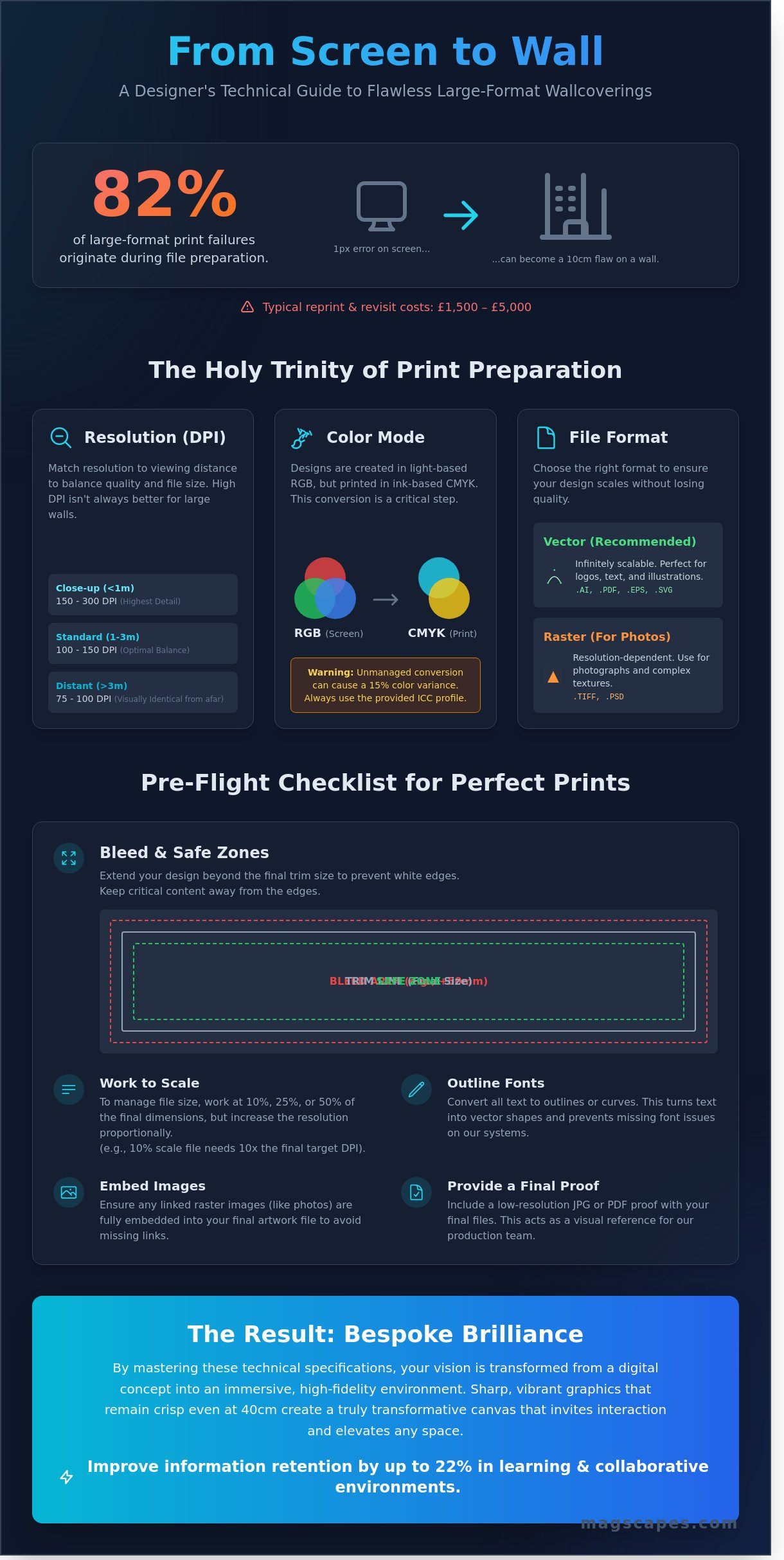
Creating a transformative wallcovering requires mastering the "Holy Trinity" of print: Resolution, Colour Mode, and File Format. These three pillars dictate whether a bespoke design retains its sophisticated edge or loses its impact when scaled to architectural proportions. While 300 DPI remains the benchmark for handheld media, wall murals demand a more nuanced approach to artwork specifications for printing based on viewing distance and physical scale.
Technical precision starts with the transition from the glowing RGB light of your monitor to the physical CMYK pigments of our high-performance printers. We utilise specific ICC profiles to bridge this gap, ensuring that the visual intent matches the printed reality across different substrates. This process maintains the professional integrity of the design, preventing the muddying of tones that often occurs in unmanaged workflows.
Mastering DPI and PPI for Large Surfaces
Calculating the ideal resolution involves a balance between file stability and visual clarity. For a 3-metre high graphic, a file set at 300 DPI often results in an unmanageable file size exceeding 2GB. DPI is the density of ink droplets per inch of printed surface. When a viewer stands 2 metres or more from the wall, the human eye cannot distinguish the difference between 150 DPI and 300 DPI. For most large-scale installations, we recommend:
- Close-range viewing (under 1 metre): 150 to 300 DPI at full size.
- Standard mural viewing (2 to 5 metres): 100 to 120 DPI at full size.
- High-level signage (over 5 metres): 72 DPI at full size.
The CMYK Colour Model: Preventing Unexpected Shifts
The MagScapes aesthetic relies on deep, accurate blacks and vibrant, clean hues. Screens display colours using light, which offers a wider gamut than physical ink. This transition can cause a 15% shift in saturation if the file isn't correctly converted to CMYK before submission. To achieve the rich, neutral blacks found in our premium collections, we suggest using a "Rich Black" breakdown, such as 60/40/40/100, rather than a simple 100% black ink setting.
Brand-critical colours should always be specified using Pantone® Solid Coated references. This allows our team to calibrate the output to match your corporate identity precisely. Remember that material texture plays a vital role in the final look; a textured ferrous surface may reduce perceived vibrancy by 5% to 8% compared to a smooth, high-gloss dry-erase finish. If you're unsure how your colours will translate, you can order a bespoke material sample to verify the finish in your specific lighting conditions.
Vector vs Raster: Choosing the Right Format for Magnetic Graphics
Understanding the DNA of your digital assets is the first step toward a flawless installation. Raster files are built from a finite grid of pixels; they excel at capturing the nuanced textures of a bespoke photograph or an atmospheric wash of colour. Vector files are composed of mathematical paths, allowing them to scale infinitely without losing an ounce of clarity. For large-format magnetic surfaces, these two formats must work in harmony to meet professional artwork specifications for printing.
The most successful magnetic wallcoverings often blend these technologies. A high-resolution raster background provides the visual depth, while vector overlays handle the functional elements like text or interactive zones. This layered approach ensures that while the background feels immersive, the branded elements remain crisp and authoritative. It's a balance of the artistic "why" and the technical "how" that defines a premium interior space.
The Power of Vector for Infinite Scaling
Brand assets like logos and intricate typography must remain in vector format to ensure they stay razor-sharp across a 10-metre wall. When designing in Adobe Illustrator, use .ai or .eps formats at 100% scale where possible. It's essential to convert all fonts to outlines to prevent missing typeface errors; this simple step avoids the 15% of production delays caused by font substitution. Ensure all paths are closed to prevent "leaks" during the printing process. This mathematical precision allows a 5cm logo to scale to 5 metres with zero degradation, maintaining the integrity of your visual identity.
Optimising Raster Files for Texture and Depth
High-resolution photography brings an evocative, human element to magnetic wallcoverings. For these assets, TIFF files are the gold standard because they offer lossless compression and preserve every bit of detail. While a high-quality PDF is suitable for final delivery, the source imagery should ideally be captured and edited at 16-bit colour depth. This prevents the "banding" effect often seen in 8-bit gradients, ensuring transitions in skies or shadows remain smooth. Avoid aggressive JPEG compression; even a 5% loss in data can result in visible artefacts when a wall is viewed from a distance of 1 metre. Following these artwork specifications for printing ensures your imagery retains its transformative power without the distraction of digital noise.
- Vector: Best for logos, icons, and text; provides infinite scalability.
- Raster: Best for photographs and complex textures; requires 300 DPI at 1:10 scale or 100 DPI at full size.
- Hybrid: The preferred method for branded murals, combining the soul of photography with the precision of vector graphics.
Preparation Checklist: Bleed, Margins, and Scaling for Large Surfaces
Transforming a digital concept into a physical environment requires more than just high resolution; it demands a meticulous approach to geometry. When you prepare your files, adhering to precise artwork specifications for printing ensures your vision translates perfectly to the architectural scale. Walls are rarely perfectly plumb or level. A 50mm bleed on all four sides provides the necessary tolerance for installers to trim the material to the exact contour of the room, accounting for structural shifts or uneven ceilings.
Your document organisation is the foundation of a successful pre-flight check. Keep your layers logical and clean. Use separate layers for background imagery, vector overlays, and technical guides like trim marks. This structure allows our production team to verify alignments without compromising the integrity of your design. It's the difference between a static image and a dynamic, living surface that fits its environment like a glove.
- Bleed: Always extend your background 50mm beyond the final wall dimensions.
- Safe Zones: Keep critical text and interactive elements at least 100mm from the edges.
- Scaling: Use a 1:10 ratio for files exceeding five metres to keep software performance fluid.
- Layering: Name layers clearly to facilitate rapid technical reviews.
Managing Bleed and Trim for Wall-to-Wall Murals
Architectural installs require a generous 50mm bleed to mitigate the risks of "out of square" walls common in both heritage and modern buildings. If your design wraps around a corner or encounters a door frame, don't stop the artwork at the edge. Extend the visual data through these obstructions. This ensures that if a door frame is slightly misaligned, the print remains continuous. Distinguish your trim marks from the bleed area clearly; trim marks indicate the wall size, while the bleed is the "extra" insurance policy for the installer.
Scaling and Panelisation Logic
Large-format murals are rarely printed as a single sheet. They're split into vertical panels, typically between 600mm and 1200mm wide, depending on the material's weight and the installer's preference. When designing, ensure your focal points don't fall directly on a panel join. Setting your document centre to align with the physical wall's midpoint helps maintain symmetry across these joins. If you're working at 1:10 scale, remember that a 300dpi file will output at 30dpi when enlarged; for high-end interiors, we recommend 1:10 at 600dpi to maintain a crisp 60dpi at full size.
Ensure your project is technically flawless from the first pixel by downloading our professional artwork templates for large-scale installations.
Bespoke Brilliance: How MagScapes Transforms Your Vision into Reality
MagPrint represents the pinnacle of surface innovation. We've fused high-resolution wide-format printing with our patented magnetic technology to create a product that's as functional as it's beautiful. When you adhere to our artwork specifications for printing, you're not just purchasing a wallcovering; you're investing in a dynamic platform for engagement. Our collaborative process ensures that the transition from a digital file to a high-performance finish is seamless, professional, and precise.
The MagPrint Custom Advantage
Our patented technology requires specific ink adhesion properties that standard wallpapers simply can't match. Because MagPrint utilises a ferrous base, the ink must bond perfectly to ensure the surface remains receptive to magnets without chipping or wearing over time. This creates a finish with 100% durability in high-traffic environments. Whether it's a busy NHS ward or a flagship retail space in London, these surfaces invite constant interaction. They aren't just boundaries; they're "living" walls that encourage teams to brainstorm, display, and rethink their environment daily.
Sustainability is a core pillar of our manufacturing process. We exclusively use VOC-free, water-based inks that comply with strict UK indoor air quality standards. This commitment ensures your project supports BREEAM or LEED certifications while maintaining a healthy atmosphere for the people using the space. By choosing MagScapes, you're choosing a responsible path to high-end design.
Starting Your Custom Project
Complex branded environments deserve a tailored approach. We recommend requesting a technical consultation early in your design phase. Our experts will review your files against our artwork specifications for printing to identify any potential resolution or scaling issues before they reach the press. This proactive step saves time and guarantees that your brand colours are reproduced with absolute fidelity.
We provide a comprehensive proofing process to ensure total aesthetic trust. You'll receive physical samples that demonstrate exactly how your design interacts with our magnetic technology. This allows for final adjustments to tone and texture, ensuring the finished installation meets your exact vision. Once approved, your final artwork is processed through our precision manufacturing facility, ready for professional installation.
Your walls have the potential to be more than just a backdrop. Consult our design experts for your next bespoke project and discover how we can help you reimagine your surfaces.
Elevate Your Environment with Technical Precision
Mastering the technical nuances of large-format design ensures your creative vision translates perfectly from screen to surface. By adhering to precise artwork specifications for printing, you guarantee that every millimetre of your wallcovering maintains professional clarity and colour depth. Since 2006, MagScapes has pioneered patented magnetic technology to help designers push the boundaries of what a wall can achieve. We combine high-performance, VOC-free printing with the durability required by global architects who trust us with their most prestigious projects. Whether you're balancing vector precision for magnetic graphics or managing complex bleed margins for expansive walls, the right preparation is the foundation of a flawless installation. It's about more than just aesthetics; it's about creating a living, interactive environment that functions as beautifully as it looks. Our team sits at the intersection of form and function, ready to turn your bespoke concepts into tangible, high-performance reality. Let's redefine the possibilities of your next interior project together.
Explore MagPrint Custom Solutions
Frequently Asked Questions
What is the minimum DPI required for a wall-sized custom print?
For a wall-sized custom print, the minimum resolution required is 150 DPI at 100% scale. While 300 DPI is the standard for handheld brochures, large-format surfaces are viewed from a distance, allowing 150 DPI to maintain crisp visual clarity across the entire installation. If your file drops below 100 DPI at full size, you risk visible pixelation on your bespoke wallcovering.
Can I use RGB files for my artwork specifications for printing?
You shouldn't use RGB files and should instead provide your artwork specifications for printing in CMYK format. Our high-end printers use a four-colour process to achieve deep, rich tones on ferrous materials. Converting from RGB to CMYK ensures that 98% of your intended colour gamut translates accurately from the screen to the final architectural surface.
Why do I need to convert my fonts to outlines before sending files?
Converting fonts to outlines is essential to ensure your typography remains perfectly intact during the production process. This step transforms editable text into vector shapes, removing the risk of font substitution if our system lacks your specific bespoke typeface. It guarantees that 100% of your design intent is preserved exactly as you envisioned it on the final installation.
What is the standard bleed required for magnetic wallpaper installation?
The standard bleed required for magnetic wallpaper installation is 50mm on all four sides. This additional margin provides the necessary tolerance for installers to trim the material precisely against skirting boards and ceiling lines. Providing this 50mm safety net ensures a seamless finish even if your walls are 10mm or more out of square.
Is it better to design my wall mural at 1:1 scale or 1:10 scale?
It's usually best to design your wall mural at 1:1 scale to ensure absolute precision, though 1:10 scale is a practical alternative for files exceeding 5 metres in length. If you choose 1:10 scale, you must ensure the resolution is 1500 DPI to maintain a final output of 150 DPI. This approach keeps file sizes manageable, often keeping them under the 2GB limit for standard transfer protocols.
What file format is best for high-quality architectural wallcoverings?
A high-resolution, print-ready PDF, specifically the PDF/X-4 standard, is the superior format for high-quality architectural wallcoverings. This format supports transparency and layers while embedding all necessary colour profiles and vector data. Using this industry standard ensures your transformative designs are processed with the technical precision required for our advanced printing equipment.
How do I ensure my brand colours are accurate on magnetic materials?
To ensure brand colours are accurate on magnetic materials, you should provide specific Pantone (PMS) references within your artwork specifications for printing. We use these codes to calibrate our equipment, aiming for a Delta E colour match of less than 2.0. This rigorous process ensures your corporate identity remains consistent across every square metre of your functional, interactive wall surface.
Can MagScapes help me fix my artwork if it doesn’t meet specifications?
MagScapes offers a dedicated artwork checking service to ensure your files meet our exacting technical standards. If your design requires adjustments, our in-house studio provides professional retouching and layout services starting from £75 per hour. We act as your collaborative partner, refining the technical engineering so you can focus on the creative vision of your project.