


Table of Contents
- How Collaborative Learning Spaces Change Student Outcomes
- Critical Thinking, Communication and Teamwork: The Core Benefits
- Interactive Wall Solutions for Classrooms That Actually Get Used
- Flexible Classroom Design Ideas for Primary and Secondary Settings
- Inclusive Design: Neurodiversity and Student Agency
- Hybrid Collaboration and Assessment for Group Work
- Cost, Installation and What to Ignore
- Conclusion
- Frequently Asked Questions
Last Updated: September 10, 2026
How Collaborative Learning Spaces Change Student Outcomes
A collaborative learning space is a physical or hybrid environment designed to support group interaction, shared problem-solving and peer-to-peer knowledge exchange rather than passive, front-facing instruction. This guide from MagScapes examines what those spaces deliver, where the evidence is strongest, and how to design them so they get used.
Most schools already own the furniture; what they lack is a coherent design logic. A room with four tables pushed together is not a collaborative learning environment, the difference lies in zoning, sightlines, writable surface area and whether a teacher can move between groups without disrupting them.
Collaboration is a behaviour, and behaviour follows layout.
The Difference Between a Room and a Learning Environment
Physical space communicates expected behaviour before anyone speaks. Rows of forward-facing desks signal transmission: one speaker, many receivers. Clustered seating with shared vertical surfaces signals negotiation, revision and joint authorship.
The practical test is whether students can see each other's work without standing up. If they cannot, the room is not supporting collaboration regardless of the pedagogy written in the scheme of work.
What the Research Consistently Shows
The evidence base for collaborative learning is broad and long-standing, drawing on social constructivist theory and decades of classroom observation. Education Endowment Foundation's collaborative learning approaches guidance summarises the consensus: structured group approaches tend to produce gains when tasks are genuinely interdependent and when group composition is managed deliberately.
Two conditions recur across the literature. First, tasks must require input from more than one person to complete. Second, the physical environment must allow the group to work without constant interruption.
Critical Thinking, Communication and Teamwork: The Core Benefits
The primary benefits of collaborative learning spaces are improved critical thinking, stronger communication and more durable knowledge retention, because students who explain reasoning aloud must organise it first.
Explaining forces retrieval, sequencing and simplification. A student who follows an argument silently may still be unable to reconstruct it, and the gap only becomes visible when they articulate it to a peer (PubMed).
Peer-to-Peer Interaction and Knowledge Co-Construction
Knowledge co-construction describes how a group builds shared understanding no individual member held at the outset. It depends on visible thinking: drafts, diagrams, partial solutions and corrections others can respond to.
Vertical writable surfaces accelerate this. When a group's working is displayed at eye level, errors become discussable objects rather than private embarrassments. Peer feedback shifts from evaluative to functional.
Metacognition and Reflective Practice
Metacognition is the capacity to monitor and regulate one's own thinking, and it develops fastest when learners compare their approach with someone else's. Group work supplies that comparison automatically.
A common mistake is treating reflection as a written exercise completed alone at the end of a lesson. The most effective reflective practice is verbal and immediate: a two-minute comparison of methods between groups while the work is still on the wall.
Interactive Wall Solutions for Classrooms That Actually Get Used
The most effective interactive wall solutions for classrooms are full-height ferrous wallcoverings combining writable, magnetic and projection-friendly surfaces in one continuous plane, removing the boundary between display and working area.
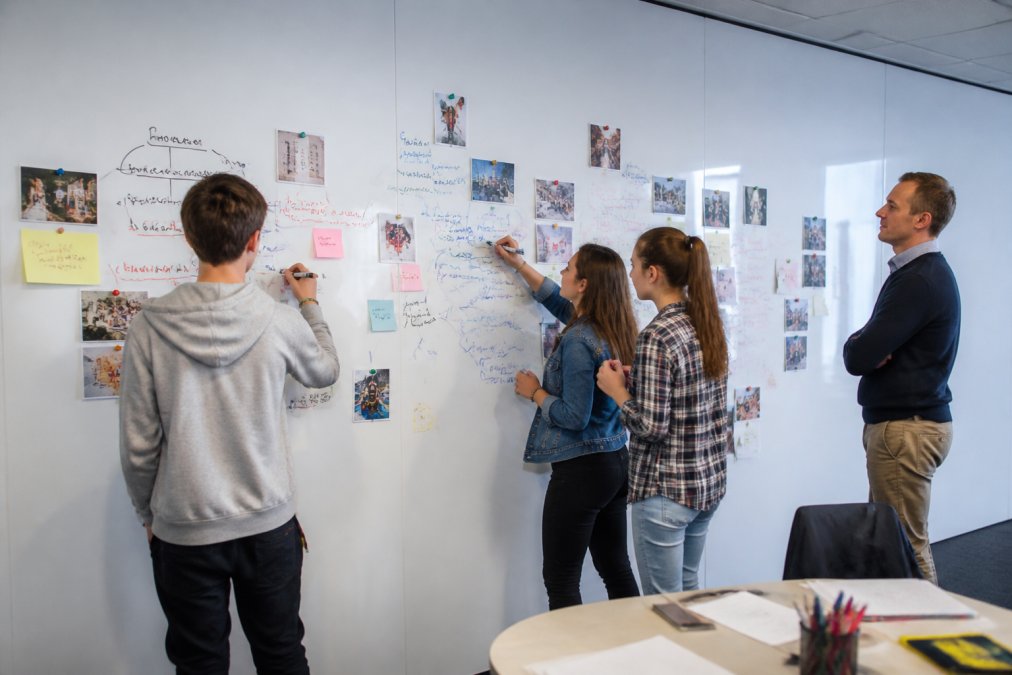
MagScapes manufactures magnet-receptive wallcoverings for exactly this purpose: MagWrite™ Gloss White Ferrous Rolls at £216.00 for a wipe-clean dry-erase finish, MagWrite™ Matt White Ferrous Rolls at £248.00 where projector use and reduced smudging matter, and MagChalk™ Matt Black Ferrous Rolls at £322.56 for a chalkboard surface. Each scores 4/5 for magnet receptivity, so standard magnets hold alongside pens.

Where a room cannot be permanently altered, MagPivot™ Freestanding Magnetic Whiteboard on Wheels (£1,195.00) and MagCaddy™ Mobile Magnetic Whiteboard on Wheels with Storage (£2,063.00) bring the same working surface into the room on a movable frame.
Flexible Classroom Design Ideas for Primary and Secondary Settings
Good flexible classroom design ideas start from movement patterns rather than furniture catalogues: map where students enter, where the teacher circulates, and where groups cross the room, then place surfaces along those routes.
Zoning, Flexible Furniture and Sightlines
Divide the room into a presentation zone, two or more group zones and a quiet zone. Group zones need adjacent vertical surface; quiet zones need none. Sightlines should let a teacher standing anywhere see every group's working without walking behind anyone.
Flexible furniture earns its place only if a single person can reconfigure the room in under two minutes. Anything slower will not happen on a Tuesday afternoon.
Transitioning from Rows to Collaborative Zones
Move in stages. Start with one wall converted to a shared working surface and keep rows for direct instruction. Once students and staff have adapted, convert a second zone.
Attempting a full-room transformation in one holiday break usually produces a room nobody knows how to teach in, and staff revert to rows within a term.
Inclusive Design: Neurodiversity and Student Agency
Inclusive design for collaborative spaces means providing genuine choice about how and where a student participates, because group work places demands on social processing, sensory tolerance and verbal speed that vary widely between learners.
Neurodiversity is where most design guidance stops being useful. Open-plan, high-stimulus rooms with hard surfaces amplify noise and make sustained attention harder for some students (PubMed). The fix is not to abandon collaboration but to build in retreat: a quiet zone with sightlines to the group, ear defenders available without negotiation, and the option to contribute in writing on the shared wall rather than aloud.
Student agency follows from the same principle. Let groups choose their own working position within the room, and let individuals choose their contribution route. A student who writes the group's reasoning on the wall has contributed as fully as one who presents it. improving meeting management efficiency.
Hybrid Collaboration and Assessment for Group Work
Hybrid collaboration requires the physical room and remote participants to share one working surface, which is why camera-facing writable walls outperform tablets passed around a table.
Most institutions now operate some blend of in-room and remote attendance. The failure mode is predictable: remote students watch a room they cannot hear and contribute nothing. A wall-mounted magnetic surface with a fixed camera aimed at it gives remote participants the same view of the group's working as everyone present.
The practical setup most schools settle on has three elements: a wide-angle camera fixed on the working wall rather than on faces, a ceiling or boundary microphone so remote students hear side conversations, and a shared digital canvas that mirrors what is written on the wall. Without the third element, remote contributions vanish the moment the lesson ends.
A Worked Rubric for Assessing Collaboration
Most assessment guidance stops at "assess the process, not just the product" and leaves teachers to invent the instrument. The framework below is usable in a single lesson without extra marking time.
| Criterion | Weighting | What a strong performance looks like | Evidence source |
|---|---|---|---|
| Shared reasoning | 40% | The group's working wall shows revisions, not just a final answer | Photographs of the wall at start, middle and end |
| Quality of peer feedback | 25% | Comments on other groups' work identify a specific error or extension | Colour-coded annotations, dated |
| Individual understanding | 25% | Any group member can explain the method, not just the answer | Two-minute verbal check, one student chosen at random |
| Teamwork efficacy | 10% | Members can restate each other's reasoning without prompting | Observation against a three-point scale |
Weighting individual understanding at a quarter of the total is deliberate. It removes the incentive for a confident student to monopolise the wall and it protects the quiet contributor whose thinking is visible in writing but not in speech.
Handling Free-Riders and Dominant Contributors
Two patterns recur in every classroom that uses group work, and both are assessment problems before they are behaviour problems.
The free-rider problem is best addressed through the evidence trail rather than surveillance. If the wall is photographed at intervals and each student's contributions are traceable, through initials, coloured pens or a shared digital canvas with edit history, a student who did nothing has no evidence to submit. The conversation shifts from accusation to absence of record.
The dominant-contributor problem is harder because the behaviour often looks like engagement. A useful counter is rotating roles within the group, recorder, challenger, summariser, changed every lesson. A student who always writes is forced to challenge; a student who never speaks gets a structured turn. The rotation is visible on the wall, so the teacher can see at a glance whether it is honoured.
What to Do When the Technology Fails
The most common hybrid failure is not bandwidth but framing. A camera pointed at the teacher's face shows remote students a lecture; a camera pointed at the working wall shows them the collaboration. Where a fixed camera is unavailable, a tablet on a tripod aimed at the wall for the whole lesson is a workable substitute, provided the wall is magnetic and writable so remote contributions can be added by a student in the room on the remote student's instruction.
The principle is that the shared surface, not the shared screen, is the point of connection. Any setup that keeps the wall visible to everyone, present or remote, will work. Any setup that replaces the wall with a screen will not.
Cost, Installation and What to Ignore
Budget conversations go wrong when institutions compare wallcovering against the price of a single whiteboard rather than the cost of replacing boards over the room's life.
A wallcovering installation covers the whole wall in one operation and avoids the frame failures, ghosting and surface wear that end a whiteboard's useful life. For stretched facilities teams, the relevant question is not purchase price but total cost across the room's lifespan, including replacement cycles and staff time spent sourcing and fitting.
A Framework for Justifying the Spend
Administrators rarely approve a redesign on pedagogical grounds alone. The framework below is one most business managers will recognise, completed with figures the school already holds.
| Cost line | What to include | Where the figure comes from |
|---|---|---|
| Capital cost | Wallcovering, adhesive, installation labour | Supplier quote plus fitter day rate |
| Replacement cycle | Expected years before surface renewal | Supplier specification, adjusted for room traffic |
| Staff time | Hours spent sourcing, ordering and supervising fitting | Departmental admin records |
| Opportunity cost | Lessons disrupted during installation | Timetable |
| Avoided cost | Whiteboard replacements no longer required over the same period | Historical maintenance records |
The avoided-cost line changes the conversation. A room that has replaced its whiteboards twice in a decade has already spent a substantial fraction of the wallcovering cost, in small transactions that never appear in a capital bid.
Installation: What the Process Actually Involves
Installation is a scheduled works item rather than a DIY job, requiring a sound, flat substrate and careful seam alignment.
The sequence most fitters follow: survey the wall and record its construction and flatness; fill and sand defects; prime; hang the wallcovering in vertical drops with seams aligned to the room's sightlines; and trim at ceiling, floor and openings. A single classroom wall typically takes one working day for two fitters, varying with wall height, openings and any remedial work.
Seam placement matters more than most specifications acknowledge. A seam down the middle of the main working area will be visible under projector light and collect pen residue over time. Plan seams where the wall is least used, or behind furniture.
What to Ignore in a Specification
Three claims appear repeatedly in specifications and should be treated with caution.
The first is that any wall can take a writable surface without preparation. It cannot. The substrate determines the finish, and no wallcovering hides a bowed or crumbling wall.
The second is a specification listing surface area without stating what the wall is made of. Area alone tells a fitter nothing about preparation required, and quotes based on area alone are the ones that overrun.
The third is a magnet receptivity rating quoted without a test method. A rating is only meaningful if it states the thickness of the steel layer and the load it will hold. Ask for the figure in kilograms per square metre, not a score out of five.
Conclusion
The barrier is rarely budget or conviction. It is the gap between knowing that collaboration works and specifying a room that makes it the path of least resistance.
MagScapes manufactures magnet-receptive wallcoverings in the UK for exactly that purpose, with fire-resistant ferrous surfaces that score 4/5 for magnet receptivity and hold both magnets and dry-erase pens. The MagWrite™ and MagChalk™ rolls cover a full wall in one installation, while MagPivot™ and MagCaddy™ bring a movable magnetic surface to rooms that cannot be permanently altered. Get started with MagScapes and turn a static wall into the working surface your students actually use.
Frequently Asked Questions
What are the core benefits of collaborative learning spaces for student development?
Collaborative learning spaces support four measurable areas of development: critical thinking, communication, teamwork and metacognition. When pupils work at shared surfaces rather than in rows, peer-to-peer interaction increases, which drives knowledge co-construction and deeper processing of material. Teachers also report higher student engagement and better knowledge retention because pupils explain reasoning aloud rather than copying from a board. Social-emotional learning develops alongside academic achievement, particularly where group dynamics are actively managed.
How do interactive wall solutions for classrooms enhance collaborative learning?
Interactive wall solutions turn a static surface into a shared workspace. A magnet-receptive wallcovering, such as MagWrite gloss ferrous rolls at £216, lets pupils pin up work, rearrange ideas with magnets and write directly on the surface. This removes the bottleneck of one pupil holding a marker at a traditional whiteboard. It also supports peer feedback, because work stays visible for the whole session and can be revisited, photographed or annotated by the next group.
What flexible classroom design ideas work in a standard-sized room?
Start with zoning rather than furniture. Divide the room into a direct-instruction zone, a small-group zone and a quiet reflection corner. Use flexible furniture on castors so groups of three to five can form and disband quickly. Add a vertical workspace, such as a magnetic wall or a mobile board like the MagPivot freestanding magnetic whiteboard at £1,195, so groups can stand and work without competing for table space. Keep sightlines open so one adult can supervise all zones.
How do flexible learning environments support inclusive education?
Flexible layouts give pupils choice over posture, noise level and grouping, which matters for neurodiverse learners. A pupil who finds open discussion overwhelming can work at a quieter zone and still contribute through a shared magnetic wall. Visual timetables, colour-coded zones and clear storage reduce cognitive load. Because the space adapts rather than the pupil being asked to adapt, inclusive education becomes a design outcome rather than an add-on.
How can schools transition from traditional layouts to collaborative zones?
Run the change in phases. Audit how each room is used across a full timetable, then pilot one subject or year group in a single room. Move in flexible furniture and one vertical magnetic surface first, and keep the front-of-room board for direct instruction. Review after half a term using pupil feedback and lesson observations. Only then roll the layout out further. Phased rollouts avoid disruption and let staff build confidence with new group dynamics.
How should group work be assessed in a collaborative learning space?
Assess the process as well as the product. Use a simple rubric covering contribution, questioning, peer feedback and reflective practice. Ask groups to photograph their wall work at the end of each session and submit it with a short written reflection. This reduces the risk of one pupil carrying the group and gives quieter contributors a route to demonstrate student agency. Weight individual reflection at around 40 per cent of the mark and group output at 60 per cent.
Is a magnetic wall worth the cost compared with replacing whiteboards?
Compare the cost per square metre over a ten-year period, not the upfront price. A MagWrite matt white ferrous roll costs £248 and covers a large wall area with a 10-year guarantee. Replacing several freestanding whiteboards over the same period, plus the labour to install and dispose of them, usually costs more. Magnetic wallcoverings also free up floor space, which matters in smaller classrooms and hybrid teaching rooms.