


Table of Contents
- Why Offices Are Looking Beyond IdeaPaint
- Comparison Table: IdeaPaint Alternatives at a Glance
- MagWrite: Magnetic Dry-Erase Wallcovering
- WritePaints: How to Apply Dry Erase Paint
- Whiteboard Paint Durability: What Really Lasts
- Whiteboard Paint vs Traditional Boards: Which Wins
- Mobile Alternatives: MagPivot and MagCaddy
- Key Factors to Consider When Choosing a Dry Erase Solution
Last Updated: August 16, 2026
Why Offices Are Looking Beyond IdeaPaint
Offices relying on traditional dry-erase boards face fundamental limitations: they don't scale with modern team workflows. IdeaPaint, whilst functional, frustrates facilities managers with application complexity, surface durability concerns, and the inability to combine magnetic functionality with dry-erase capability seamlessly.

Teams now need collaborative surfaces that don't require permanent installation, hold magnets reliably, and resist ghosting and staining after months of intensive use. The market now offers fundamentally different approaches, from premium magnetic wallcoverings to mobile boards to paint-based solutions, each solving different problems for different spaces.
At MagScapes, we've analysed what drives this transition. Facilities managers consistently cite three pain points: setup time and complexity, magnetic performance inconsistency, and long-term surface degradation. The alternatives in this guide address these gaps in measurably different ways.
Comparison Table: IdeaPaint Alternatives at a Glance
| Solution | Type | Installation | Magnetic Capability | Durability | Best For |
|---|---|---|---|---|---|
| MagWrite Wallcovering | Ferrous wallpaper | Professional paste-to-wall | 4/5 receptivity | 10-year warranty | Permanent office installations, classrooms |
| WritePaints Dry-Erase Kit | Paint | DIY application, 5-7 days cure | None | 10-year warranty | Budget-conscious teams, custom surfaces |
| MagPivot Mobile Board | Freestanding furniture | No installation | 5/5 receptivity | 10-year warranty | Flexible offices, rented spaces, agile teams |
| MagCaddy with Storage | Freestanding furniture | No installation | 5/5 receptivity | 10-year warranty | Open-plan spaces needing storage and division |
| Whiteboard Film | Adhesive film | Peel-and-stick application | None | Varies by substrate | Protecting existing surfaces, temporary use |
MagWrite: Magnetic Dry-Erase Wallcovering
MagWrite is a ferrous dry-erase wallcovering that installs like high-end wallpaper and delivers consistent magnetic receptivity and writing performance across the entire surface. Unlike paint-based solutions requiring multiple coats, careful primer application, and 5-7 day curing, MagWrite arrives as a finished product with factory-engineered dry-erase surface and ferrous backing, ensuring consistent performance regardless of application technique or wall substrate.

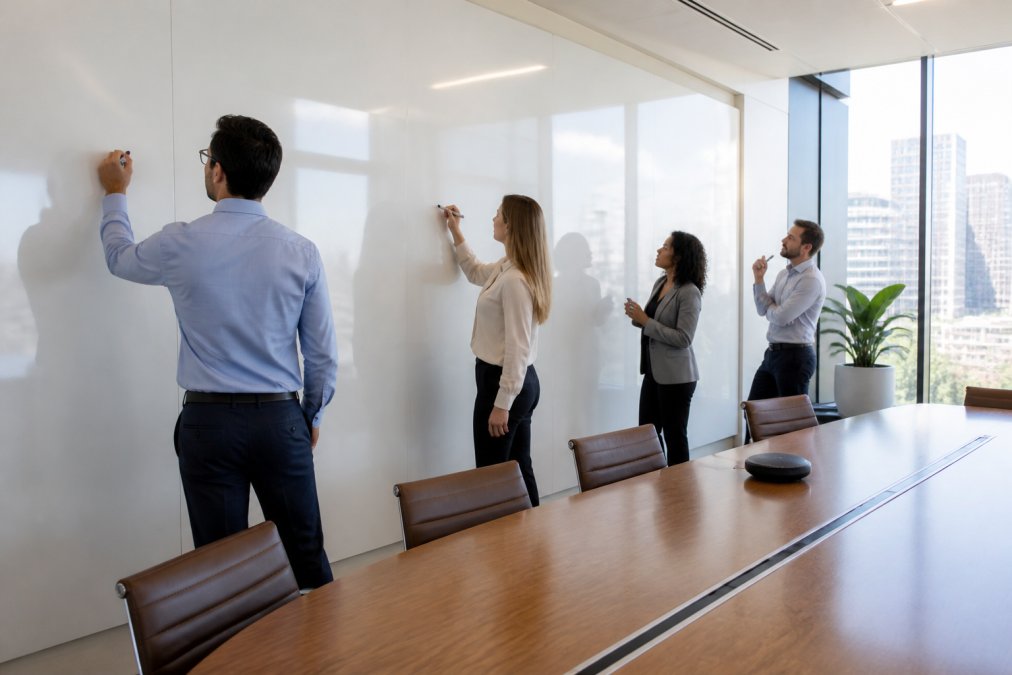
MagWrite comes in matt white (projection-friendly, non-reflective) and gloss white (maximum erasability) finishes, both with 4 out of 5 magnet receptivity. The 0.6mm ferrous backing resists ghosting and staining in ways thinner alternatives cannot match.
Key Specifications and Performance
Matt white (£248.00 per 3-metre roll) suits rooms with windows, overhead lighting, or projectors, eliminating glare issues during presentations. Gloss white (£216.00 per 3-metre roll) offers faster erasability and brighter appearance for teams without projectors.
Both versions meet EuroClass C-s1, d0 fire safety standards, carry low-VOC credentials with no odour, and include a 10-year warranty. The 120-centimetre roll width minimises visible seams. Once cured, maintenance is simple: spray cleaner and microfibre cloth every 48 hours. Unlike paint solutions requiring recoating, MagWrite maintains performance for the full 10-year warranty period.
Installation and Maintenance
Surface preparation is critical, walls must be clean, smooth, and free of loose particles. Uneven or textured walls can affect adhesion and create visible imperfections. Paste-to-wall application allows precise positioning, with virtually invisible seams once cured. Curing takes 24-48 hours before the surface is ready for writing and magnetic use.
Long-term maintenance is straightforward: damp cloth removes chalk residue, dry-erase markers wipe clean with a standard eraser or microfibre cloth. For stubborn stains, use the spray cleaner (available separately or as part of the MagScapes cleaning kit). Regular cleaning every 48 hours prevents ghosting and keeps the surface fresh indefinitely.
MagWrite is designed as a long-term installation. For offices in rented spaces or those needing flexibility, mobile alternatives like MagPivot or MagCaddy offer the same magnetic dry-erase performance without permanent commitment.
WritePaints: How to Apply Dry Erase Paint
WritePaints offers a water-based, low-VOC alternative for teams with budget constraints or custom surface requirements. The kit (£49.50) includes paint, hardening sachets, a textured roller, dry-erase markers, and cleaning spray. It delivers a functional dry-erase surface at a fraction of wallcovering cost, though application requires careful technique and a 5-7 day curing period. Surface quality depends on wall preparation, application uniformity, and environmental conditions during cure.

Application Process and Curing Time
Begin with thorough surface preparation, the wall must be clean, dry, and smooth. Use painter's tape to define the area, then clean with a wet cloth and allow to dry completely.
Mix Group A (base) and Group B (hardener) thoroughly for 3-5 minutes until smooth. Apply with the included textured roller in overlapping strokes. Use one-third of the paint for the first coat, then apply the remaining two-thirds after a 2-hour wait. Allow 5-7 days curing before writing on the surface. Temperature and humidity affect curing speed; cooler, drier conditions extend cure time.
Once cured, the surface accepts water-based dry-erase markers and wipes clean with microfibre cloth and spray cleaner.
Cost Comparison with Ready-Made Solutions
WritePaints costs £49.50 per kit, covering approximately 1.5-10 square metres. A 10-square-metre wall requires roughly three rolls of MagWrite at £216-248 each, totalling £648-744.
For budget-conscious teams needing only a writable surface, WritePaints offers substantial savings. The disadvantage is clear: no magnetic capability, longer setup time, and dependence on application quality. Many offices use WritePaints for secondary surfaces, training rooms, or breakout areas, reserving magnetic solutions for primary collaboration spaces.
Whiteboard Paint Durability: What Really Lasts
Durability depends on three factors: surface material quality, thickness of ferrous backing (if magnetic), and maintenance discipline. A thin paint application on poor substrate will ghost and stain; a properly applied, premium-grade surface maintained with regular cleaning resists degradation for years.
Ghosting and Staining Performance
Ghosting occurs when dry-erase marker pigment embeds into the surface rather than sitting on top. Premium surfaces with factory-laminated finishes have smooth, non-porous faces that shed marker pigment cleanly. MagWrite's gloss white finish resists ghosting significantly better than paint-based alternatives. WritePaints surfaces, when well-applied and regularly cleaned, remain functional for 3-5 years before ghosting becomes noticeable.
Staining is distinct from ghosting and results from permanent markers, ballpoint pens, or substances like coffee. Premium surfaces resist staining through finish hardness and chemical resistance. MagWrite's gloss variant resists staining better than the matt finish, and both resist staining better than paint.
Real-world testing shows properly maintained MagWrite surfaces remain ghost-free and stain-resistant for 10+ years. The difference compounds over time: a surface resisting ghosting for 10 years costs less per year of use than one requiring replacement every 5 years.
Long-Term Maintenance and Surface Care
Maintenance discipline directly affects durability. A surface cleaned every 48 hours with appropriate cleaner and microfibre cloth will outlast one cleaned sporadically with harsh solvents or abrasive cloths.
The [Write Cleaning Kit(/products/magwrite-cleaning-kit-250ml-cleaner-and-mf-cloth) from MagScapes | magscapes.com] (£7.49) includes 250-millilitre spray cleaner and microfibre cloth. Never use harsh solvents, acetone, or alcohol-based cleaners on dry-erase surfaces. Regular cleaning every 48 hours for high-use surfaces and weekly for low-use areas extends all surfaces' effective lifespan.
Whiteboard Paint vs Traditional Boards: Which Wins
Paint-based or wallcovering solutions transform entire walls into writing and display areas, whereas traditional standalone whiteboards are fixed rectangles typically 90 centimetres by 60 centimetres. A 3-metre by 2.5-metre wall becomes a single, continuous collaboration space, five times the area of a traditional board, with no frames, seams, or fixed boundaries.
Space Efficiency and Flexibility
Traditional whiteboards create bottlenecks in open-plan offices: only one team can use the board at a time. Multiple teams need multiple boards, consuming valuable space.
A wall-mounted dry-erase surface eliminates this constraint. Different teams can write on different sections simultaneously. The entire wall becomes a shared resource that doesn't require moving or repositioning. Space efficiency improves dramatically, particularly in smaller offices where floor space is premium.
For offices with fixed team locations and dedicated meeting rooms, traditional boards remain practical. For agile environments, hot-desking spaces, and organisations where team composition changes frequently, wall-based solutions offer superior flexibility and space efficiency.
Installation Complexity and Removal
Traditional whiteboards mount easily in minutes. Paint-based solutions require surface preparation, multiple coats, and 5-7 day cure. Wallcovering installation is faster (one day) but requires professional application.
Removal inverts the complexity. A traditional board unmounts easily, leaving only bracket holes. A painted surface is permanent; removing it means painting over it or stripping entirely. For permanent office installations in owned buildings, this one-time cost is justified. For temporary installations or rented spaces, traditional boards or mobile alternatives offer lower commitment and easier removal.
Mobile Alternatives: MagPivot and MagCaddy
For offices unable to commit to permanent wall installation, whether due to rented space restrictions, frequent layout changes, or desire for flexibility, mobile magnetic whiteboards offer full dry-erase and magnetic functionality without permanent modification.
MagPivot and MagCaddy are freestanding magnetic whiteboards on lockable wheels, delivering 5 out of 5 magnet receptivity and gloss white dry-erase surface. The difference is deployment: they roll to wherever needed and lock in place.

When Fixed Walls Aren't the Answer
Rented offices prohibit permanent installation. Mobile solutions bypass this constraint entirely, no installation, no damage, no lease violations. When the lease ends or the office relocates, the boards move with you.
Organisations with frequently changing layouts benefit from mobility. Open-plan spaces reconfiguring weekly or monthly need equipment that adapts quickly. A mobile board can define a new collaboration zone in seconds, then roll elsewhere when the project ends.
Small teams in shared spaces (co-working environments, serviced offices, startup incubators) use mobile boards as shared resources. Healthcare and blue-light environments use mobile boards for operational briefings, patient coordination, and training, positioning the board where needed without requiring permanent infrastructure.
Pricing and Space Considerations
MagPivot (£1,195.00) is the leaner option: 1200 millimetres wide, 1925 millimetres tall, 400 millimetres deep, and 23 kilograms. It passes through standard doorways without disassembly, making it genuinely portable across multi-floor buildings.
MagCaddy (£2,063.00) adds integrated storage shelving on both ends and a recessed top surface. At 1200 millimetres wide, 1980 millimetres tall, and 435 millimetres deep, it weighs 45 kilograms and functions as a room divider, storage unit, and collaboration surface simultaneously. The white finish integrates more naturally into designed interiors than MagPivot's matt black base.
For teams needing only a writing surface, MagPivot delivers. For open-plan spaces needing to create zones and store materials, MagCaddy justifies the additional investment. Both occupy similar footprints to large traditional whiteboards but offer significantly more writing surface and magnetic capability.
Key Factors to Consider When Choosing a Dry Erase Solution
Selecting between alternatives requires clarity on five decision criteria: permanence, magnetic need, budget, installation complexity, and maintenance commitment.
VOC Levels and Environmental Safety
Water-based paint products like WritePaints carry low-VOC credentials, emitting minimal harmful fumes during application and curing. MagWrite wallcovering and MagChalk are also low-VOC with no odour, suitable for installation in occupied spaces without disruption. Both carry EuroClass C-s1, d0 fire safety ratings, confirming UK and European compliance.
For organisations prioritising environmental impact and air quality, all premium alternatives meet modern standards. Budget paint-based solutions may not carry the same certifications, so verify credentials before purchase.
Magnetic Capability and Collaborative Needs
This is the critical differentiator. If teams use magnets, colour-coded project cards, document clips, presentation magnets, or magnetic hooks, magnetic capability is non-negotiable.
MagWrite delivers 4 out of 5 receptivity; all standard magnets hold securely. MagPivot and MagCaddy deliver 5 out of 5, the highest rating. WritePaints and dry-erase film offer no magnetic capability.
For agile teams using Kanban boards, Lean visual management, or magnetic project systems, magnetic solutions justify their premium pricing. For teams needing only a writable surface, non-magnetic alternatives suffice and cost significantly less.
Budget and Total Cost of Ownership
WritePaints offers the lowest entry cost at £49.50 per kit for small feature walls. Whiteboard film (£90.00 per roll) offers similar cost-effectiveness for protecting existing surfaces or creating temporary writing areas.
MagWrite wallcovering costs £216-248 per 3-metre roll. For a 10-square-metre wall, total cost ranges from £648-744. The 10-year warranty and consistent performance justify this investment for permanent installations.
Mobile solutions (MagPivot at £1,195 and MagCaddy at £2,063) have higher upfront cost but eliminate installation fees and offer flexibility fixed solutions cannot provide. Over 10 years, a mobile board serving multiple teams may deliver lower cost-per-use than a fixed solution serving only one space.
Budget for cleaning supplies (£7.49 for the Write Cleaning Kit) as part of ongoing maintenance costs.
Selecting the right dry-erase alternative depends on your specific constraints. For permanence and magnetic capability, MagWrite wallcovering delivers the most consistent, durable solution. For rented spaces or organisations needing flexibility, MagPivot or MagCaddy provide full functionality without permanent commitment. For budget-conscious teams with simple requirements, WritePaints offers a functional starting point. The market now offers genuine alternatives to IdeaPaint, each solving different problems for different contexts.
Frequently Asked Questions
Does whiteboard paint actually work for high-traffic office walls?
Yes, quality whiteboard paint and magnetic wallcoverings perform reliably in busy office environments. The key is choosing commercial-grade solutions with proven durability ratings. MagWrite, for example, achieves consistent performance through intensive daily use because its 0.6mm ferrous backing and factory-laminated PET surface are engineered for commercial settings, not consumer applications. Low-VOC formulations like WritePaints are water-based and safe for occupied buildings, though they require proper surface preparation and curing time (5-7 days) before use.
What is the most durable whiteboard paint alternative to IdeaPaint?
Magnetic wallcoverings like MagWrite offer superior durability compared to paint-based solutions. They resist ghosting and staining far better than applied coatings because the surface is factory-laminated rather than hand-applied. MagWrite carries a 10-year warranty and a 4/5 magnet receptivity rating, making it ideal for offices that need both writing and magnetic functionality. If you prefer paint, WritePaints (£49.50) provides a low-VOC option with a 10-year warranty, though wallcoverings generally outperform paint in high-traffic settings.
How do you prepare office walls for dry erase paint application?
Proper surface preparation is critical for dry erase paint success. Clean the wall thoroughly with a damp cloth and allow it to dry completely. Use painter's tape to define the area you want to cover. For WritePaints, mix the hardening sachets (Group A and Group B) for 3-5 minutes until smooth, then apply 2-3 coats with a fine texture roller, leaving 1/3 of the paint for a second application after 2 hours. Allow 5-7 days for full curing before writing on the surface. Poor preparation is the most common reason paint solutions underperform.
Is magnetic wallcovering cheaper than traditional whiteboards over 10 years?
Magnetic wallcoverings like MagWrite (£248 for a 6m roll covering approximately 7.2 square metres) typically cost less per square metre than purchasing and replacing multiple fixed whiteboards over a decade. A single MagWrite installation covers far more surface than a standard whiteboard panel, eliminates frame costs, and requires minimal maintenance. Traditional whiteboards need regular replacement due to ghosting and surface degradation, plus storage and installation costs. For offices seeking long-term value, wallcoverings represent better total cost of ownership.
Can whiteboard paint be removed without damaging walls?
Removal difficulty depends on the solution chosen. Magnetic wallcoverings like MagWrite are designed for professional installation and removal by decorators, leaving walls in good condition. Paint-based solutions like WritePaints are permanent and cannot be cleanly removed without wall damage or repainting. For rental offices or temporary installations, magnetic wallcoverings are the better choice because they can be professionally removed and repositioned. Mobile alternatives like MagPivot (£1,195) or MagCaddy (£2,063) require no wall installation at all, making them ideal for lease-bound spaces.
This article was written using GrandRanker