


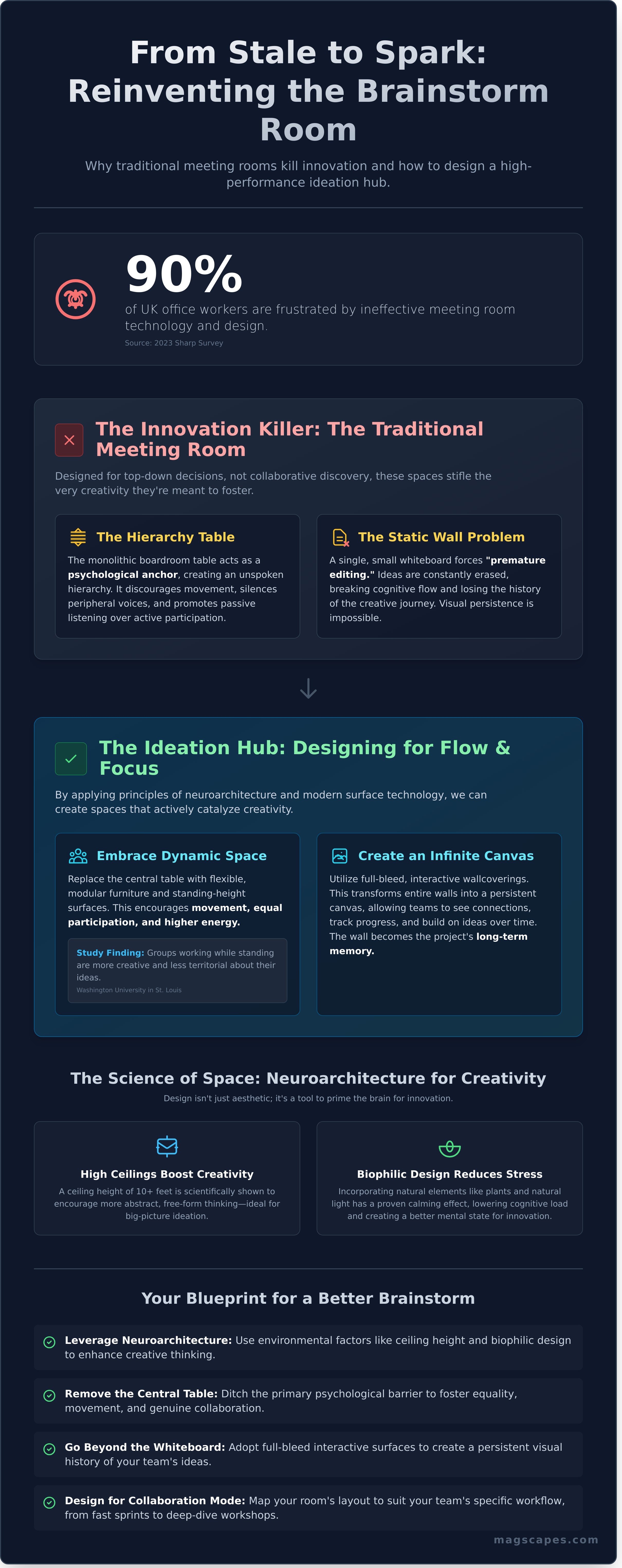
A 2023 Sharp survey of UK office workers revealed that a staggering 90% have been frustrated by outdated or ineffective meeting room technology. You've likely felt it yourself: the sterile conference room with its ghosting whiteboard and poor acoustics seems purpose-built to drain energy, not spark innovation. These spaces often feel more like corporate obligations than creative sanctuaries, stifling the very collaboration they are meant to foster.
This guide moves beyond the static and the stale. We will explore a new frontier in brainstorm room design, where neuroarchitecture principles and high-performance interactive surfaces converge to create environments that actively cultivate focus. Discover how to transform any room into a high-performance ideation hub, from strategic layouts that enhance psychological comfort to dynamic, multi-functional wallcoverings that serve as an infinite canvas for your team’s best ideas.
Key Takeaways
- Learn how environmental factors like ceiling height and biophilic design can be scientifically leveraged to enhance creative thinking and reduce stress.
- Discover a 5-step framework for mapping a room's layout based on your team's primary collaboration mode, from fast-paced sprints to deep-dive workshops.
- Evaluate the latest interactive surface technologies to understand why full-bleed wallcoverings are replacing traditional whiteboards in modern brainstorm room design.
- Understand the psychological barriers of conventional meeting rooms and why removing the central table is a critical first step toward fostering genuine innovation.
The Evolution of Collaboration: Why Traditional Meeting Rooms Stifle Innovation
For decades, the corporate meeting room has been a monument to decision-making, not discovery. It’s a space defined by a monolithic central table, static walls, and a rigid hierarchy. A standard conference room is designed for presentation and deliberation. In sharp contrast, a true brainstorm room is a dynamic canvas for generative thinking; a place where ideas are born, not just ratified. The failure to distinguish between these two functions is precisely why so many organisations find their innovation efforts stalling before they even begin. The architecture of the past simply cannot support the creative demands of the future.
To see how a thoughtful environment can foster more joyful and productive ideation, watch this short video from The Fountain Institute:
The 20th-century office was engineered for a top-down workflow. It was a physical manifestation of command and control. Today, creative and developmental processes are fluid, iterative, and collaborative. Methodologies like Agile and Scrum, which Gartner predicts will be used by 80% of software development teams by 2025, demand physical environments that mirror their principles. This requires a fundamental rethink of what a collaborative space is, starting with its two most dominant and restrictive features: the table and the walls.
The Death of the Boardroom Table
The traditional boardroom table acts as a psychological anchor, creating an immediate and often unspoken hierarchy. Those at the 'head' of the table are perceived as leaders, while those on the periphery can feel disengaged. This centralised seating arrangement discourages movement and equal participation. By transitioning to standing-height surfaces and flexible, modular furniture, teams can unlock a higher level of energy. A 2014 study by Washington University in St. Louis found that groups working while standing were more creative and less territorial about their ideas. Peripheral movement isn't a distraction; it’s a cognitive catalyst that supports the divergent thinking essential for true innovation.
The 'Static Wall' Problem
When your canvas is a single, small whiteboard, you are forced into a constant state of 'premature editing'. Ideas are erased to make room for new ones, creating a significant cognitive load as the team tries to remember what was lost. This process directly contradicts the foundational principles of brainstorming, which call for deferring judgment and capturing every thought. Visual persistence, the ability to keep the entire journey of an idea visible, is critical. When walls become limitless, interactive surfaces, they transform into a project's long-term memory. This holistic view allows teams to see connections, track progress, and build upon earlier concepts, driving project success far more effectively than a series of disconnected digital files or quickly erased notes. An effective brainstorm room design turns static boundaries into active participants in the creative process.
The Neuroarchitecture of Creativity: Environmental Factors That Spark Ideas
A truly effective brainstorm room isn't born from intuition alone; it's engineered. The emerging field of neuroarchitecture reveals how physical spaces directly influence our cognitive processes, shaping our thoughts, emotions, and capacity for innovation. By understanding the intricate connection between our brains and our built environment, we can move beyond aesthetics to design spaces that actively cultivate creativity. As leading property advisors Savills have explored in their research on neuroarchitecture and workspace design, elements from ceiling height to ambient sound are not mere background details. They are powerful tools for unlocking human potential.
Consider the very volume of the room. A 2007 study by researcher Joan Meyers-Levy demonstrated that a ceiling height of 10 feet or more encourages more abstract, free-form thinking, which is ideal for big-picture ideation. Conversely, a lower 8-foot ceiling tends to promote more concrete, detail-oriented processing. This single architectural choice can prime a team for a specific type of creative task. Colour palettes play a similarly crucial role. While traditional corporate blues are calming, they can also induce passivity. To stimulate energy and innovation, a high-arousal palette is far more effective. A splash of green, for instance, was shown in a 2012 German study to enhance creative performance.
Acoustic management is another critical, yet often overlooked, component of superior brainstorm room design. The goal is a delicate balance: eliminating distracting external noise while allowing for the energetic buzz of collaboration. Installing high-performance acoustic wall panels or felt wallcoverings can absorb ambient chatter, while a subtle white noise generator set to 40 decibels can mask disruptive sounds without impeding conversation. The space becomes a focused sanctuary. It’s a place for deep thought and dynamic exchange.
While engineering the perfect physical environment is a powerful step, supporting the team's individual mental states is another key layer for achieving peak creativity. For those interested in a holistic approach that supports the mind from within, you can explore Blended Tinctures (SLEEP, FOCUS, CHILL).
This holistic support also extends to an individual's personal life. For key leaders and creatives, knowing that their home and family are well-managed by trusted professionals is essential for maintaining focus at work. You can learn more about how elite private staffing can provide this crucial peace of mind.
This mental reset can also come from engaging in focused, tactile hobbies that provide a different kind of problem-solving challenge. For those who find clarity in detailed craftsmanship, you can explore OO9 Locomotive & Wagon Kits.
Lighting for Cognitive Performance
Before considering artificial solutions, it's essential to maximize the most potent cognitive enhancer: natural light. The quality and design of a room's windows directly impact the amount and quality of daylight, which regulates circadian rhythms and boosts alertness. Modern window technologies can reduce glare and improve thermal insulation without sacrificing light. For those undertaking a renovation, consulting with specialists in window solutions, such as Window Galaxy USA, can be a critical step in creating an environment optimized for focus and creativity.
Effectively managing that natural light is just as important as letting it in. To see examples of high-quality solutions like blinds and awnings that help control glare and create a comfortable atmosphere, you can check out QLD Shade.
Light is a biological trigger. To combat the notorious 2 PM productivity slump, circadian lighting systems can automatically shift to a cooler, blue-enriched 6500K light temperature, mimicking midday sun and boosting alertness. It's also vital to control glare, especially on ideation surfaces. A distracting reflection can cause subconscious eye strain and mental fatigue, cutting a productive session short. Opting for high-performance, matte-finish writable surfaces ensures that ideas remain the central focus, clear and unobstructed.
Biophilia and Sensory Engagement
Our innate connection to nature, or biophilia, is a powerful tool for reducing stress and enhancing focus. Integrating natural textures like wood, linen, or stone grounds a high-tech space, providing a tactile antidote to digital fatigue. Adding inspiring artwork can also enhance the creative atmosphere; to browse a curated selection of prints and frames, visit First4Frames Gallery. Beyond visual elements, curated scents like rosemary (proven to aid memory) or biophilic soundscapes can signal to the brain that it’s entering a dedicated creative zone. This sensory layering culminates in haptic engagement. When team members physically interact with a textured or magnetic wall, they engage more of their brain, forging stronger neural connections that improve memory retention of the ideas being generated.
While the focus here is on interiors, the same principles are masterfully applied in exterior spaces. The specialized field of proiectare gradini timisoara (garden design in Timisoara) offers compelling examples of how creating structured, natural environments can enhance human well-being, providing inspiration for biophilic office design everywhere.
True innovation often arises from connecting disparate ideas. While the immediate environment provides sensory input, intellectual inspiration can come from more timeless sources. Exploring foundational texts, for example, can offer new frameworks for problem-solving and communication. For those interested in how classical literature can inform modern thinking, you can learn more about Plume Charmers.
Beyond the office walls, inspiration often strikes when we engage with new experiences. Immersing the team in a vibrant cultural event, for example, can be a powerful way to recharge creative energy and see problems from a different angle. For those looking to explore the dynamic arts and culture scene in Japan, a global hub for innovation, you can check out Jasumo Tickets.
For teams closer to home, particularly in the UK, a day trip can offer a similar creative reset. Exploring a site of historical significance, for example, can provide fresh perspectives on strategy and leadership. For London-based teams looking for such an outing, Timescape Tours offers private, driver-guided experiences that can serve as both an inspirational journey and a unique team-building activity.
Beyond the Whiteboard: Comparing Surface Technologies for Modern Ideation
The era of the framed whiteboard is decisively over. For years, teams have been constrained by the physical and functional limits of traditional surfaces: the distracting glare and high cost of glass, the inevitable staining of low-grade whiteboards, and the sheer creative bottleneck of a fixed-size panel. Modern collaboration demands more. It requires surfaces that are as boundless as the ideas they are meant to capture. The evolution from static panels to dynamic, full-bleed interactive walls marks a pivotal shift in effective brainstorm room design. Evaluating the performance, lifespan, and technical resilience of these surfaces is critical to creating a space that truly works, transforming entire walls into intelligent, functional canvases.
Magnetic Wallpaper vs. Magnetic Paint
When creating a magnetic wall, the choice often comes down to paint or a professional wallcovering. The difference in performance, however, is not incremental; it's exponential. High-performance magnetic wallpaper is engineered with a dense, uniform layer of ferrous particles, delivering a magnetic pull up to 10 times stronger than magnetic paints, where particles are merely suspended in the medium. This means no more sliding papers or weak connections. For commercial projects targeting completion by 2026, installation efficiency is paramount. A 15m² wall can be covered and ready for use in under four hours with a wallcovering, while paint requires at least three coats and a curing time of up to 72 hours, significantly impacting project timelines and labour costs. Critically, roller-applied paints often result in an uneven 'orange peel' texture, which compromises the quality and smoothness of any dry-erase overlay. A professionally installed wallcovering guarantees a flawless, uniform canvas for creativity from day one.
Whether you choose a specialized wallcovering or an advanced paint solution, the quality of the final surface depends entirely on the preparation of the wall itself. The expertise of a professional team is crucial for achieving a flawless, lasting finish that serves as the perfect canvas. For example, the work highlighted by Performance Painting showcases the difference that expert application makes, a principle that applies to high-stakes commercial projects everywhere.
This focus on efficiency and timelines is where comprehensive supply chain management becomes a game-changer for any construction or refurbishment project. For architects and developers, partnering with a specialist in industrial supplies can make all the difference. For example, firms like Mobel Suministros manage the complex logistics for projects, including modular construction and specialized builds, ensuring that materials—from structural components to finishing touches—are delivered efficiently.
The Rise of Writable Magnetic Surfaces
True innovation lies in integration. Technologies like MagWrite fuse a high-performance, non-porous writing surface with a powerfully magnetic base, creating a single, seamless, multi-functional solution. This move towards floor-to-ceiling writable walls is about more than just scale; it’s a strategic design choice that dismantles creative barriers. A modular board confines ideation to a box. An entire wall liberates it. This approach aligns directly with core design thinking principles, which advocate for environments that encourage expansive, uninhibited brainstorming. When considering the Total Cost of Ownership (TCO), the value becomes even clearer. While a premium writable magnetic wallcovering may have an initial installation cost of around £150 per square metre, its 10-year warranty against staining and ghosting offers significant long-term savings. Compare this to glass boards, which often exceed £600 per panel and carry high replacement risks, or paints that require re-coating every 3-5 years at considerable expense.
These high-performance surfaces are engineered for extreme longevity. The technical cause of 'ghosting'-the absorption of ink pigments into a porous surface-is eliminated by using advanced, chemically inert PET top layers. This ensures pristine writability and easy cleaning year after year. More profoundly, these walls become the ultimate 'phygital' interface, seamlessly blending physical and digital workflows. Imagine an architectural team pinning up physical material swatches and printed blueprints (physical) directly alongside hand-drawn sketches of a 3D model (digital representation). This transforms a static wall into a living, breathing project dashboard, laying the foundation for a truly modern and agile brainstorm room design.
For teams specializing in urban and area development, this 'phygital' approach is crucial. Powerful software platforms like 3D Cityplanner are used to visualize, analyze, and simulate complex projects, and these interactive walls become the ideal place to display and collaborate on those digital plans in a group setting.
Designing for Flow: A 5-Step Framework for High-Impact Layouts
A great idea is a fragile thing. It needs a specific environment to emerge, evolve, and thrive. An effective brainstorm room design isn't about filling a space with whiteboards and beanbags; it’s a deliberate act of architectural choreography. It’s about creating a physical journey that mirrors the cognitive one, guiding a team from scattered thoughts to a unified, actionable vision. This five-step framework transforms static rooms into dynamic engines of innovation.
Step 1: Define the Primary Collaboration Mode
Your room's purpose dictates its form. Is it for a week-long 'Sprint' with a compact team of 4-6 developers, requiring intense focus and rapid prototyping? Or is it a 'Workshop' for a 15-person marketing team, demanding space for breakout groups and diverse activities? Perhaps it's a 'Deep Dive' space for two or three strategists needing quiet contemplation and extensive data analysis. Defining this primary mode from the outset ensures every design choice supports the intended workflow, preventing a one-size-fits-none outcome.
Step 2: Map the Visual Journey Across Vertical Surfaces
Think of your walls not as boundaries, but as a narrative canvas. The creative process has a natural flow: from chaotic initial thoughts to structured, prioritised concepts. Your room should reflect this. Designate one wall for initial idea dumps and another for refined mind maps. Research from the University of London shows that visual mapping can improve information recall by up to 25%. Using continuous, high-performance magnetic and dry-erase surfaces allows this journey to unfold seamlessly, capturing every stage without interruption.
Step 3: Select Modular, Mobile Furniture That Adapts
Static furniture creates static thinking. The ideal brainstorm room is fluid, reconfiguring in minutes to suit the team's needs. Opt for lightweight, mobile furniture that empowers users to shape their own environment.
- Mobile stools and perches encourage active postures and quick re-groupings.
- Nesting tables and modular sofas can shift from small group pods to a larger presentation setting.
- Flip-top tables on castors provide writing surfaces that can be instantly cleared and stored, maximising floor space.
Step 4: Implement 'Zoning' for Cognitive Shifts
The most productive sessions alternate between expansive, creative thinking (divergent) and focused, analytical thinking (convergent). A sophisticated brainstorm room design supports this rhythm through deliberate zoning. By creating distinct areas for different cognitive tasks, you provide psychological cues that help teams shift gears effectively. This isn't just about arranging furniture; it's about engineering the mental landscape.
The Power of Zoning
Create distinct zones to guide the creative process. The 'Chaos Zone' is for uninhibited, rapid-fire ideation with vast dry-erase surfaces. The 'Refinement Zone' uses magnetic walls for teams to physically cluster, sort, and prioritise ideas with custom graphics. Finally, a 'Quiet Corner' with comfortable seating allows for individual reflection and synthesis before re-engaging with the group, a critical step often overlooked in collaborative space design.
This zone for reflection is also an opportunity to draw inspiration from foundational human thought. To explore bilingual editions of classical literature and philosophy, you can check out Plume Charmers.
Furniture That Moves with the Team
Movement fuels energy. Replace static conference chairs with mobile stools to encourage active participation. For larger review sessions, tiered seating or simple benches can create a 'Town Hall' atmosphere, focusing attention. Height-adjustable desks are no longer a solo-office luxury; they allow teams to switch between sitting and standing, a transition that, according to a 2018 study by the University of Leicester, can boost engagement and reduce fatigue during long sessions.
Step 5: Future-proof with Integrated Technology and Power Access
Innovation stalls when the tech fails. A future-proofed room seamlessly integrates technology without it becoming a distraction. This means more than a single screen. Consider interactive smartboards, reliable high-speed Wi-Fi, and, most critically, ubiquitous power. A 2022 survey by Brother UK revealed that 41% of UK office workers feel a disorganised workspace negatively impacts their productivity; trailing cables are a primary culprit. Integrate power into furniture or use recessed floor boxes to ensure every participant can stay charged and connected.
While this technology is essential for modern collaboration, it's also wise to consider the invisible environment it creates. For teams and leaders prioritising holistic well-being, addressing potential environmental stressors like electrosmog can be another layer of optimizing the space for focus and reduced fatigue. To learn more about this area, you can check out Radiation-Free Living.
Your walls are your most underutilised asset in the creative process. Transform them from passive boundaries into active partners in innovation. Explore our bespoke magnetic and dry-erase wallcovering systems and start designing a space that truly works.
The Living Wall: Future-Proofing Design with MagScapes Interactive Surfaces
The walls of a room are more than mere boundaries; they are opportunities. A truly effective brainstorm room design reimagines these vertical planes, transforming them from static partitions into dynamic, living canvases for creation. This is the future of collaborative spaces, and it's powered by MagScapes. Our high-performance surfaces turn entire walls into seamless, magnetic, and writable landscapes, offering a level of interactivity that standalone whiteboards simply cannot match.
At the core of this transformation is MagScapes Pro, a professional-grade ferrous wallcovering that creates a powerful, edge-to-edge magnetic surface. Forget the limitations of framed boards. Imagine an entire wall ready to hold notes, plans, and prototypes. The aesthetic is entirely yours to define. Opt for a minimalist, pure white finish that doubles as a premium dry-erase surface, or make a bold statement with MagPrint, our service for creating custom magnetic wall graphics that infuse your brand's identity directly into the architecture.
In the high-traffic environment of a modern office, durability is not a luxury; it's a necessity. Our patented magnetic technology is engineered for relentless daily use, resisting wear and maintaining its magnetic pull for years. It’s a permanent upgrade to your creative infrastructure. Furthermore, we believe innovative design must be responsible design. All MagScapes products are VOC-free and manufactured to meet stringent UK and EU safety standards, including EN71, ensuring a healthy and safe environment for your team to create their best work.
Bespoke Brand Integration
Your brainstorm room should be a reflection of your company's vision. With custom graphics, you can tell your brand story on a grand scale, creating interactive murals that detail company timelines, display core values, or map out future goals. These surfaces are not just decorative; they are functional touchpoints that engage employees and clients, seamlessly blending aesthetic beauty with powerful, practical utility. It's where your brand comes to life.
Practical Implementation
Achieving a flawless, high-performance magnetic finish begins with the correct preparation of the substrate. Our systems are designed for straightforward installation on properly prepared walls, ensuring a smooth and durable result. We frequently collaborate with architects and specifiers on new developments and refurbishments, integrating our surfaces into the earliest stages of a project. The first step towards transforming your space is a simple conversation. Consult with a MagScapes design specialist to explore the possibilities for your unique brainstorm room design.
Transform Your Walls into Engines of Innovation
The architecture of collaboration has fundamentally changed. We've explored how neuroarchitecture proves our physical environment directly influences ideation, and that the static meeting rooms of the past actively stifle it. A truly successful brainstorm room design requires a more holistic approach. It moves beyond passive furniture and isolated whiteboards, transforming entire surfaces into dynamic, interactive canvases that invite engagement and foster a state of creative flow.
This is where theory meets application. Since 2006, our patented magnetic technology has empowered global tech leaders and design studios across the United Kingdom to build these high-impact environments. Our surfaces are more than just functional; they are high-performance, VOC-free certified materials engineered for the future of work. It's time to build a space that works as hard as your team. Reimagine your collaborative space with MagScapes Pro and discover the limitless potential locked within your walls.
Frequently Asked Questions
What is the best colour for a brainstorm room?
Light blues and greens are proven to foster creativity, while a crisp, high-quality white offers a blank canvas for unrestricted ideation. A 2009 University of British Columbia study found that blue tones significantly boosted creative performance. Our writable surfaces are available in a curated palette of designer whites and bespoke colours, ensuring your room's aesthetic aligns perfectly with its function. This approach transforms a simple wall into an inspiring, functional backdrop for innovation.
How do I make my small office room better for brainstorming?
Transform vertical surfaces into interactive canvases to maximise a compact space. Our magnetic and writable wallcoverings eliminate the need for bulky whiteboards, creating a seamless, expansive area for ideas. A core principle of effective small brainstorm room design is multi-functionality. Pair these dynamic walls with modular, lightweight furniture that can be easily reconfigured or stored. This strategy ensures the room remains agile, adaptable, and ready for creative exploration without feeling cluttered.
Is magnetic wallpaper better than a traditional whiteboard?
Magnetic wallpaper offers a transformative advantage over traditional whiteboards by providing a seamless, wall-to-wall creative surface. Unlike a framed board, our high-performance wallcoverings integrate flawlessly into your interior design, serving as both a writable and magnetic plane. This dual functionality allows your team to sketch ideas, pin up physical documents, and map out projects across an entire wall. It’s an evolution from a simple tool to a fully interactive architectural feature.
How much wall space do I need for a creative team of five?
For a creative team of five, we recommend a minimum of 8 to 10 square metres of interactive wall space. This allocation provides approximately 1.5 to 2 square metres per person, allowing for simultaneous contribution without crowding. It ensures there is ample room for parallel work streams, mind mapping, and displaying inspirational materials side-by-side. A generous canvas empowers your team to visualise complex ideas collectively and without spatial limitations, fostering a more productive session.
Can I use any magnets on magnetic wallpaper?
For optimal performance on our ferrous wallcoverings, we specify the use of high-quality neodymium magnets. Standard ferrite or souvenir-style fridge magnets lack the necessary magnetic force to hold items securely. Neodymium magnets offer a superior strength-to-size ratio, ensuring even multiple sheets of paper are held firmly in place. Using the correct magnets is essential to fully leverage the interactive potential of your dynamic wall surface and avoid any frustration during creative sessions.
What furniture is essential for a brainstorm room?
The essential furniture trio for a brainstorm room is a large collaborative table, mobile seating, and discreet storage. Opt for chairs on castors to allow for fluid movement and spontaneous regrouping. A standing-height table can also boost energy levels during sessions. A sleek credenza or integrated shelving keeps markers, erasers, and other creative tools organised yet accessible, maintaining a clean aesthetic that minimises distractions and keeps the focus firmly on innovation.
How do I maintain writable magnetic walls to prevent ghosting?
Maintain the pristine surface of your writable walls by cleaning them after each session with a soft microfibre cloth and a specialised whiteboard cleaning spray. This simple routine prevents the "ghosting" effect and ensures your creative canvas remains flawless. Of course, maintaining the entire room is just as crucial for a productive environment. To ensure you're hiring professionals who meet high standards, it's wise to use platforms with a thorough vetting process; you can explore Cleaner Registration to see what a quality sign-up and verification system for cleaners looks like in the UK.
Is magnetic wallpaper safe for use near electronic equipment?
Yes, our wallcoverings are perfectly safe for use around electronic equipment like computers and monitors. The wallpaper itself is not magnetic; it is a magnetically receptive surface containing ferrous particles that attract magnets. It does not generate its own magnetic field or create any electromagnetic interference. You can confidently design your collaborative space without any concern for its impact on your team’s laptops, tablets, or other essential digital tools.