


Table of Contents
- Types of Magnetic Whiteboard Wall Surfaces
- Magnetic Whiteboard Wallpaper Installation Methods
- Durability and Material Longevity
- How to Clean Magnetic Whiteboard Walls
- Magnetic Wallcovering for Creative Studios
- Framed vs Frameless Modular Panels
- Real-World Applications Across Sectors
- Magnetic Strength and Receptivity Performance
Last Updated: August 19, 2026
Types of Magnetic Whiteboard Wall Surfaces
Magnetic whiteboard wall solutions come in three main categories: ferrous wallcovering, magnetic paint, and mobile alternatives. The right choice depends on your space, budget, and usage intensity.

Ferrous wallcovering represents the premium option. These purpose-engineered wallpapers feature a steel-backed layer bonded to a dry-erase writing surface. MagWrite delivers a 4 out of 5 magnet receptivity rating, meaning all magnet types hold securely. The 0.6mm thickness is critical, thinner imitations cannot achieve the same performance. Fire-rated to EuroClass C-s1, d0, with low VOC credentials, these products suit commercial offices, schools, and healthcare facilities.
Ferrous Wallcovering (MagWrite)
MagWrite solves the core problem competing solutions struggle with: reliable magnetic receptivity combined with a durable dry-erase surface. It arrives as a finished product, ready to install in a single session.
The product comes in rolls of 120cm width by 3m, 6m, or 12m lengths. The matt finish suits projection-compatible environments and reduces glare; the gloss finish wipes cleaner for high-traffic spaces. Both carry a 10-year warranty. Cost starts at £248 for a 3m roll of matt, £216 for gloss. While higher than paint solutions, the cost-per-square-metre becomes reasonable when factoring in installation labour, curing time, and longevity.
Magnetic Paint and Film Solutions
Magnetic paint offers a lower-cost entry point but with significant tradeoffs. WritePaints, a water-based low VOC option, requires mixing hardener sachets, applying multiple coats, and waiting 5-7 days for full cure. Magnetic receptivity is lower than ferrous wallcoverings, and lightweight magnets hold adequately while heavy clip magnets are risky. At £49.50 for the full kit, it suits spaces needing one function or the other, but not both.
WriteFilms, a clear peel-and-stick dry-erase film at £90 for a 120cm × 6m roll, serves a different purpose. Apply it over existing prints or decorative surfaces to make them writable without adding magnetic capability.
Mobile Magnetic Whiteboard Alternatives
Rented offices and flexible workspaces often cannot accommodate permanent installation. MagPivot and MagCaddy deliver full magnetic whiteboard functionality on mobile furniture with lockable castors.
MagPivot is a frameless magnetic board on wheels, 1200mm wide, 1925mm tall, weighing 23kg. The gloss white dry-erase surface achieves 5 out of 5 magnet receptivity. No installation required. At £1,195, it's ideal for teams that move between rooms or work in spaces where permanent fixtures are prohibited.
MagCaddy extends the concept with integrated storage shelving and a recessed top surface. At 1200mm wide, 1980mm tall, and 435mm deep, it functions simultaneously as a magnetic whiteboard, space divider, and practical storage. At £2,063, it transforms a partition into an active collaboration surface for open-plan offices.
| Solution Type | Magnet Receptivity | Installation | Cost (per 3m) | Best For |
|---|---|---|---|---|
| MagWrite Ferrous Wallcovering | 4/5 | Professional decorator, paste-the-wall | £216-£248 | Permanent installations, offices, schools |
| Magnetic Paint | Lower | DIY or professional, multi-coat, 5-7 day cure | £49.50 | Budget projects, non-magnetic use |
| WriteFilms Dry-Erase Film | None (non-magnetic) | Peel-and-stick overlay | £90 | Protecting existing surfaces |
| MagPivot Mobile Board | 5/5 | No installation required | £1,195 (unit) | Flexible spaces, rented offices, frequent moves |
| MagCaddy Mobile + Storage | 5/5 | No installation required | £2,063 (unit) | Open-plan offices needing structure and storage |
Magnetic Whiteboard Wallpaper Installation Methods
The installation approach determines both final surface quality and reversibility. Professional installation delivers consistency and warranty coverage; DIY works for smaller projects but requires skill.
Professional Installation vs DIY Approach
Professional decorators trained in commercial wallcovering install ferrous wallcovering cleanly and efficiently, managing seams, roll width, and adhesive pressure. For full-room installations or high-visibility areas, professional installation costs £150-£250 per day depending on region and complexity.
DIY installation is feasible for smaller feature walls if you have wallpapering experience. The paste-the-wall method is forgiving: adhesive goes on the wall, not the product, giving you time to position and adjust. Common mistakes include insufficient adhesive coverage, misaligned seams, and trapped air bubbles.
Mobile solutions like MagPivot or MagCaddy require no installation, they arrive built and ready to use.

Wall Preparation and Surface Requirements
The substrate matters enormously. Smooth, clean walls bond reliably; textured, dusty, or uneven surfaces cause adhesive failure.
Absorbent surfaces (plasterboard, painted drywall) require MagFix adhesive. Non-absorbent surfaces (tile, glass, high-gloss painted walls) require MagVOV adhesive. Before application, clean the wall thoroughly, sand bumps smooth, fill holes or cracks, and allow filler to dry completely. Never apply ferrous wallcovering to damp walls or in high-humidity environments without proper ventilation.
Paste-the-Wall Application Process
Measure your wall height and width, then calculate how many 120cm-wide rolls you need. Cut your first roll to length using a sharp utility knife and steel straightedge. Mark a vertical plumb line on the wall using a spirit level as your starting point.
Apply adhesive to the wall using a paint roller or brush, working in sections slightly wider than the roll width. Position the first roll at the top, aligning the edge with your plumb line. Smooth downward using a plastic squeegee, working out air bubbles. Overlap the next roll by approximately 2cm. Once both rolls are tacky, use a sharp utility knife to cut through both overlapping layers, remove excess, and re-smooth together to create an invisible seam.
Repeat for each subsequent roll, working methodically to avoid misalignment. Allow the adhesive to set according to manufacturer guidance (typically 24-48 hours). Once dry, apply WriteTrims decorative edge trims to frame the installation neatly.
Durability and Material Longevity
Durability depends on material thickness, surface engineering, and usage intensity. MagWrite's 0.6mm thickness is the critical differentiator. Thinner imitations cannot deliver the same magnetic receptivity or durability. The ferrous backing holds magnets reliably for years; the PET laminate face resists ghosting and maintains brightness through intensive use. mounting wall displays.
Properly installed ferrous wallcovering maintains performance for 10+ years in standard office use. In high-traffic environments, surfaces remain functional for 8-10 years before showing visible wear. Paint solutions degrade faster, losing effectiveness after 3-5 years. Mobile solutions like MagPivot carry the same 10-year warranty.
Fire Resistance and Safety Standards
Commercial installations must comply with building regulations. MagWrite carries an EuroClass C-s1, d0 fire rating, meeting strict fire safety standards required for occupied buildings. This certification is non-negotiable for healthcare facilities, care homes, and educational institutions. The low-VOC formulation allows installations in occupied buildings without extended ventilation periods.
Warranty Coverage and Long-Term Performance
MagWrite and MagScapes mobile products carry a 10-year product warranty, covering manufacturing defects, adhesive failure, and surface degradation under normal use. This reflects the reality that ferrous wallcovering, installed correctly, is a long-term investment rather than a consumable.
How to Clean Magnetic Whiteboard Walls
Proper maintenance keeps surfaces looking pristine and performing reliably. Neglect leads to ghosting, staining, and reduced marker clarity.
Preventing Ghosting and Staining
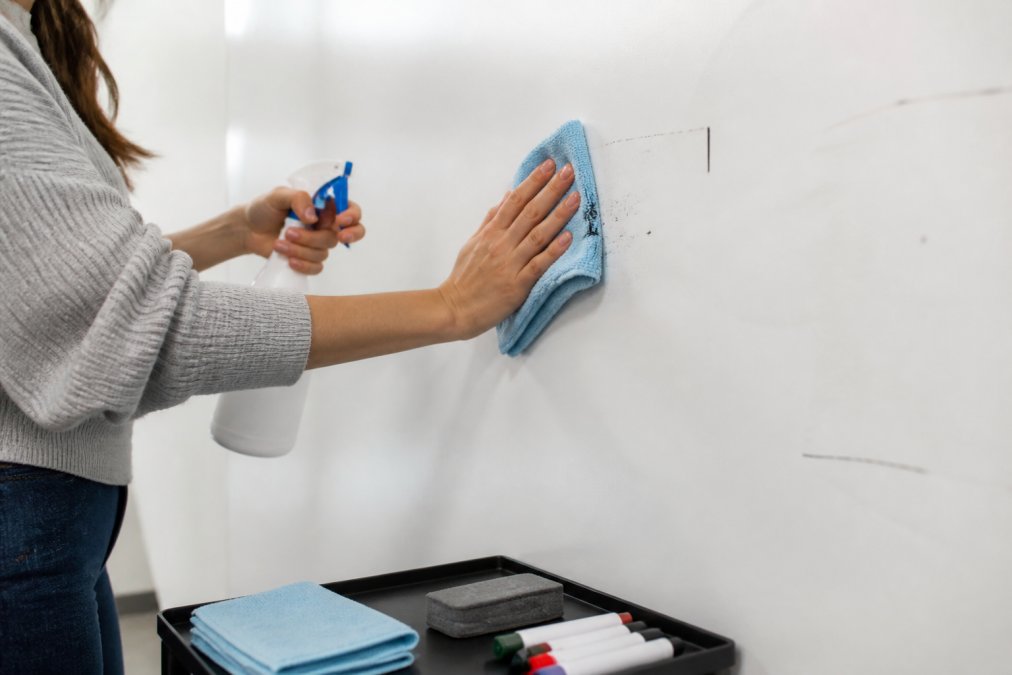
Ghosting occurs when dry-erase marker pigment bonds to the surface and resists complete removal. Prevention is straightforward: clean regularly. MagScapes recommends cleaning every 48 hours. Use a spray cleaner designed for dry-erase surfaces. The Write Cleaning Kit includes a 250ml bottle formulated specifically for MagWrite. Spray lightly and wipe with a microfibre cloth. Do not oversaturate; excess moisture can seep behind the wallcovering and damage the adhesive bond.
Use only dry-erase markers designed for professional surfaces. Premium brands like Artline wipe cleanly. Never use permanent markers, highlighters, or ballpoint pens on magnetic whiteboard surfaces.
Recommended Cleaning Products and Techniques
The Write Cleaning Kit is purpose-engineered for ferrous wallcoverings. The 250ml spray bottle and 20cm square microfibre cloth are included. Spray lightly onto the surface or cloth and wipe with medium pressure in circular motions, working from top to bottom. Allow the surface to air dry. For stubborn residue, repeat or allow the cleaner to sit for 30 seconds before wiping. The microfibre cloth is machine-washable for indefinite reuse.
Magnetic Wallcovering for Creative Studios
Design studios, architecture firms, and creative agencies use magnetic whiteboard walls as active thinking surfaces. The continuous, uninterrupted writing space encourages ideation in ways fixed whiteboards cannot match.
Collaboration and Visual Management in Design Spaces
Creative work is inherently visual and iterative. Designers sketch concepts, pin reference images, annotate layouts, and rearrange ideas continuously. A magnetic whiteboard wall becomes the project surface where thinking happens. MagWrite's matt finish integrates into carefully considered interiors without announcing itself as office equipment. The non-reflective surface works seamlessly with natural light and artificial task lighting. The magnetic functionality enables studios to layer information: printed reference boards stay pinned at eye level, sketch overlays hold in place with magnets, colour swatches and material samples attach without tape.
Projection Compatibility and Workspace Productivity
MagWrite's matt finish is compatible with projection, maintaining image clarity and colour accuracy from any viewing angle. This eliminates the need for a separate projection screen, freeing up wall space. A team can project a design mockup, annotate it with dry-erase markers, attach printed reference materials with magnets, and erase and redraw as ideas develop, all without leaving the space or switching between tools.
Framed vs Frameless Modular Panels
Traditional whiteboard panels come in rigid frames that define edges and anchor to the wall. Frameless solutions eliminate this visual interruption, creating the impression of a continuous magnetic surface without discrete boundaries.
Framed panels are modular and easy to install; multiple panels arrange side by side to create larger surfaces. The trade-off is visual: frames announce "office equipment" rather than integrating into designed interiors. Frameless ferrous wallcovering creates a seamless surface extending edge-to-edge without visible demarcation. Design studios and premium corporate offices favour wallcovering over framed panels for this visual continuity. MagPivot and MagCaddy adopt frameless design language for the same reason.

Real-World Applications Across Sectors

Corporate Offices and Agile Workspaces
Open-plan offices demand surfaces teams can reconfigure throughout the day. A magnetic whiteboard wall becomes the project surface for standups, sprint planning, retrospectives, and brainstorms. Teams using Kanban or Scrum pin task cards with magnets, colour-code them, and move them across swim lanes as work progresses. MagWrite's high receptivity rating means all magnet types work reliably, from lightweight neodymium discs to heavy clip magnets holding multiple pages of reference material.
Education and Training Environments
Classrooms benefit from magnetic whiteboard walls in ways traditional whiteboards cannot replicate. Teachers can write large, maintain eye contact with students, and display printed materials simultaneously. The continuous surface encourages interactive teaching. Students write directly on the wall during group activities, eliminating clustering around a small board. MagWrite's fire rating and low-VOC specification make it suitable for schools where safety and air quality standards are non-negotiable.
Healthcare and Medical Facilities
Hospitals use magnetic whiteboard walls for patient care coordination and staff communication. Ward boards display patient information, treatment schedules, and handover notes. Magnetic colour-coded cards allow quick visual scanning of ward status. The easy-clean surface is critical in healthcare; regular disinfection is routine. The Write Cleaning Kit's spray cleaner is compatible with standard hospital disinfectants. The non-porous PET laminate resists bacterial colonisation better than porous surfaces. MagWrite's low-VOC and fire-resistant specification meet building regulations for occupied medical facilities.
Magnetic Strength and Receptivity Performance
Magnet receptivity is measured on a scale of 0-5, where 5 equals a high-quality fridge door and 0 indicates no magnetic capability. This rating determines which magnet types hold reliably.
Understanding Magnet Receptivity Ratings
A 4 out of 5 rating (MagWrite ferrous wallcovering) holds all standard magnet types securely: neodymium discs, clip magnets, pin magnets, and presentation magnets. Lightweight magnets hold without drift; heavy magnets remain secure under normal movement and vibration. A 5 out of 5 rating (MagPivot and MagCaddy) is the highest achievable, holding the same magnet types with additional security margin. Ratings below 4 out of 5 are common in budget magnetic paint solutions, forcing teams to choose between magnetic functionality and dry-erase writing rather than combining both reliably.
Testing Weight-Bearing Capacity
Weight-bearing capacity measures how much a magnet can hold before slipping. MagPlus Pin Steel Magnets carry a grip rating of 11 sheets, meaning each magnet holds approximately 11 sheets of standard office paper (roughly 0.5kg per magnet). Professional-grade ferrous wallcoverings are tested to far higher standards than budget alternatives. MagWrite's 4 out of 5 receptivity rating reflects real-world testing in commercial environments.
Conclusion
Selecting the right durable magnetic whiteboard wall solution requires balancing installation permanence, magnetic performance, cost, and aesthetic integration. Ferrous wallcoverings like MagWrite deliver superior durability, reliable magnetic receptivity, and seamless visual integration for permanent installations in offices, schools, and healthcare facilities. Mobile solutions like MagPivot and MagCaddy solve the flexibility problem for rented spaces and frequently reconfigured environments.
MagScapes ferrous wallcoverings have been specified across diverse sectors because they solve real problems: unreliable magnetic paint, limited writing space from traditional whiteboards, and inflexibility of framed panels. The 10-year warranty, EuroClass fire rating, and low-VOC specification reflect a product engineered for professional environments.
If your workspace demands a surface combining reliable magnetic functionality, continuous dry-erase writing capability, and long-term durability, explore MagWrite ferrous wallcovering in matt or gloss finishes. For flexible spaces where installation isn't an option, MagPivot and MagCaddy deliver the same magnetic performance in mobile form. MagScapes product range offers samples and technical guidance to help you specify the right solution for your environment.
Frequently Asked Questions
What is the difference between magnetic paint and magnetic whiteboard wallpaper?
Magnetic paint requires multiple coats, curing time of 5-7 days, and specialist surface preparation. Magnetic whiteboard wallpaper like MagWrite installs in a single session with paste-the-wall application and is ready to use immediately. Wallpaper delivers superior magnetic receptivity (4-5 out of 5) compared to paint, holds all magnet types securely, and resists ghosting far more effectively over years of intensive use.
Can magnetic whiteboard wallcovering be installed over existing paint?
Yes, magnetic whiteboard wallpaper can be applied over existing paint on properly prepared walls. The surface must be clean, smooth, and free from loose particles or bumps. Wall preparation is critical: use the correct adhesive for your substrate (MagFix for absorbent surfaces, MagVOV for non-absorbent). Professional decorators recommend priming heavily textured or glossy paint to improve adhesion. Always follow the manufacturer's installation guide for best results.
How durable is a magnetic whiteboard wall in high-traffic environments like schools?
Premium magnetic whiteboard wallcoverings like MagWrite are engineered for high-use commercial environments. The 0.6mm thick ferrous backing and hard-wearing PET laminate surface resist ghosting and maintain clarity through hundreds of erase cycles. With a 10-year warranty and fire-resistant certification (EuroClass C-s1, d0), they are fully suitable for busy classrooms and school environments where surfaces are written on and cleaned daily.
What magnetic receptivity rating do I need for reliable magnet hold?
A receptivity rating of 4 out of 5 or higher ensures secure magnet hold comparable to a quality fridge door. At this level, all magnet types, neodymium discs, clip magnets, document holders, and pin magnets, perform reliably without slipping. MagWrite wallcovering achieves 4/5 receptivity, whilst freestanding options like MagPivot and MagCaddy deliver the highest 5/5 rating for maximum holding strength across the entire surface.
How do I prevent ghosting and staining on a magnetic whiteboard wall?
Regular cleaning every 48 hours is the best prevention method. Use a spray cleaner and microfibre cloth to wipe the surface after each use. MagScapes' Write Cleaning Kit is specifically formulated to protect dry-erase surfaces. Quality wallcovering materials with non-porous PET laminate finishes resist ghosting far better than paint. Always use quality dry-erase markers and avoid leaving pen marks on the surface for extended periods.
This article was written using GrandRanker