


The promise of the open-plan office often falls short, leaving many leaders wondering how to create a collaborative workspace that truly works. Instead of a hub of innovation, you're left with a landscape of noise and distraction, where meeting rooms are perpetually booked and brilliant ideas vanish from undersized whiteboards before they can take root. The challenge isn't a lack of vision, but a lack of functional, inspiring spaces for it to flourish. True collaboration requires more than just tearing down walls; it demands the creation of intelligent, interactive environments.
This definitive 2026 guide moves beyond outdated layouts to offer a transformative, step-by-step approach. We will explore the principles of effective collaborative design, revealing how to activate your existing walls into dynamic, magnetic, and writable canvases. You will discover scalable, high-impact solutions that foster spontaneous innovation and focused teamwork-all without the need for a costly, full-scale renovation. Prepare to reimagine your environment and build a space where great ideas are not just discussed, but brought to life.
Key Takeaways
- Discover why the traditional open-plan office fails to foster true collaboration and learn the principles of a modern, multi-functional workspace.
- Learn the four foundational pillars, starting with psychological safety, that are essential for building an innovative and high-performing team culture.
- Understand how to create a collaborative workspace by transforming your largest, most underutilised asset-your walls-into dynamic, interactive canvases for ideas.
- Receive a practical, zone-by-zone blueprint for designing a high-impact office that supports every mode of work, from deep focus to team brainstorming.
Beyond Open Plan: Redefining the Collaborative Workspace for 2026
For decades, the open-plan office has been championed as the pinnacle of collaborative design. The prevailing wisdom was simple: remove walls, and teamwork will flourish. Yet, as we look towards 2026, it is clear this approach is fundamentally flawed. The reality is often a landscape of acoustic chaos and constant distraction, not the dynamic exchange of ideas we were promised. The essential question of how to create a collaborative workspace demands that we move beyond simplistic floor plans and reimagine our environments as active instruments for innovation.
A truly transformative workspace is not a passive container for desks and chairs; it is a high-performance tool meticulously engineered to support the complex rhythms of modern teamwork. It is a dynamic, interactive ecosystem that adapts to the needs of its users, contrasting sharply with the static, one-size-fits-all environments of the past.
What is a Truly Collaborative Workspace?
At its core, a truly collaborative workspace is an environment designed for flow-the seamless movement between different modes of work. Understanding what is a collaborative working environment reveals that it's a sophisticated ecosystem that must balance multiple needs. It is a space that:
- Encourages both planned and spontaneous interaction, creating opportunities for the serendipitous conversations that spark innovation.
- Provides teams with intuitive tools to visualise, iterate, and share ideas without friction, turning static walls into dynamic canvases for creativity.
- Harmonises the need for group synergy with dedicated zones for focused, individual tasks, acknowledging that deep work is as crucial as teamwork.
Why Most Modern Offices Still Fail at Fostering Teamwork
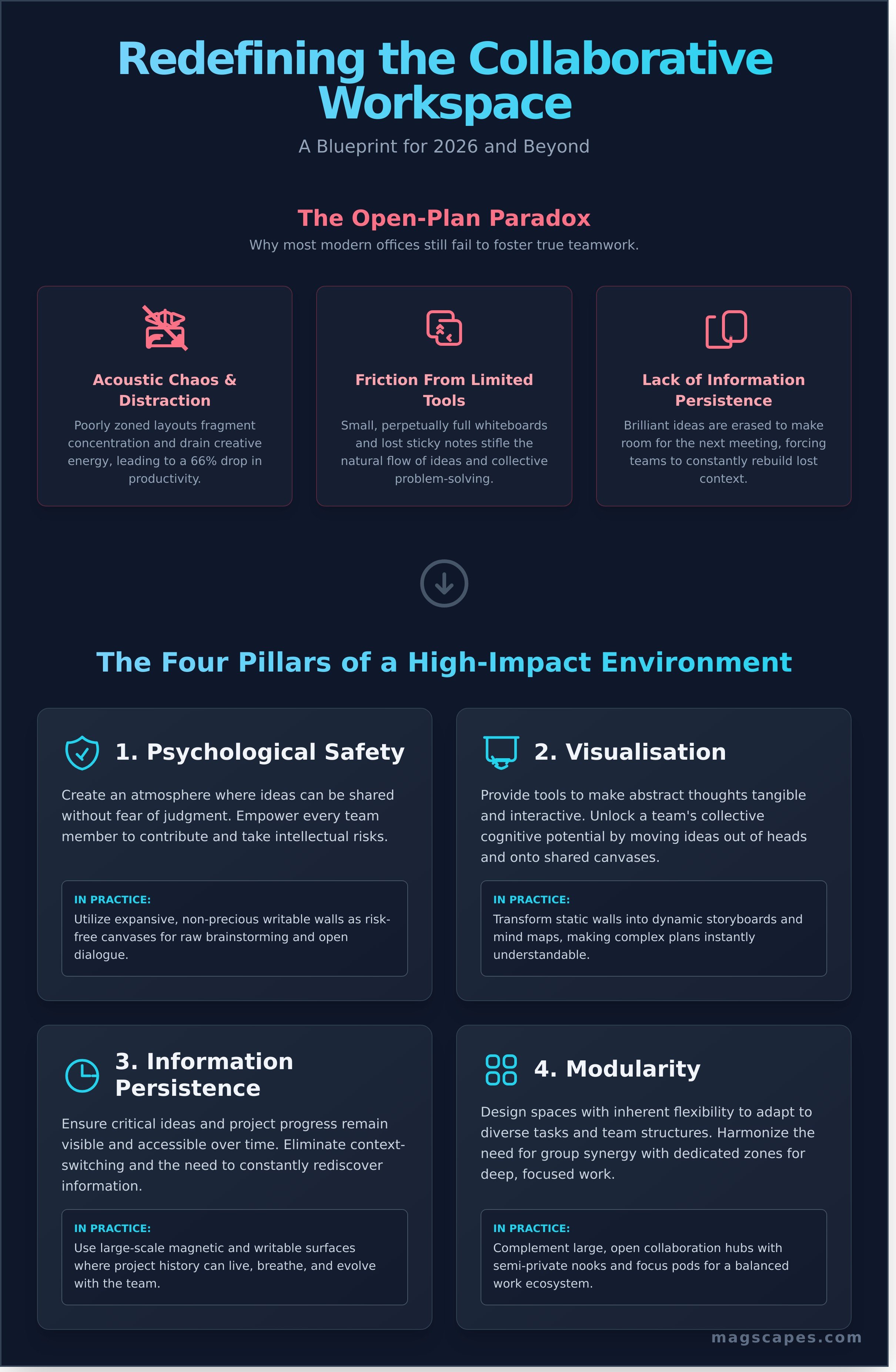
Many contemporary offices fall short because they address the aesthetics of collaboration without engineering its function. The result is a collection of persistent failures that actively hinder teamwork. The most common issues include the pervasive problem of noise and interruption in poorly zoned open layouts, which fragments concentration and drains creative energy. Furthermore, teams are often constrained by the friction of limited tools-the small whiteboard that’s always full, the lost sticky notes, the brilliant idea erased to make room for the next meeting. This creates a critical lack of 'information persistence', where a project's progress and history are not continuously visible, forcing teams to constantly rediscover and rebuild context.
The Four Pillars of a High-Impact Collaborative Environment
Before selecting a single piece of furniture or specifying a colour palette, understanding how to create a collaborative workspace begins with its foundational principles. A truly effective environment is more than an aesthetic arrangement; it is an ecosystem engineered to support the human dynamics of teamwork. These four pillars provide the essential blueprint for transforming static rooms into dynamic hubs of innovation and shared success.
- Psychological Safety: Creating an atmosphere where ideas can be shared without fear of judgement.
- Visualisation: Providing the tools to make abstract thoughts tangible and interactive for the entire group.
- Information Persistence: Ensuring critical ideas and project progress remain visible and accessible over time.
- Modularity: Designing spaces with the inherent flexibility to adapt to diverse tasks and team structures.
Designing for Psychological Safety and Open Dialogue
Innovation thrives on intellectual risk-taking. A space must feel safe for a team to truly connect and create. Unlike a formal, permanent report, an expansive writable wall becomes a risk-free canvas for raw brainstorming. These non-precious surfaces empower every team member to contribute, democratising the flow of ideas. While open-plan offices often aim for this, research on open office collaboration indicates they can sometimes hinder deep work. The solution lies in balance: complement large, open zones with semi-private nooks designed for more intimate, focused team discussions where complex challenges can be unravelled in confidence.
Enabling Visual Thinking and Collective Idea Capture
The human brain processes visual information with remarkable speed. Externalising thoughts onto a large, shared canvas unlocks a team's collective cognitive potential, moving beyond the limitations of linear lists. This is where surfaces become transformative tools. Imagine a project plan not as a spreadsheet, but as a dynamic storyboard or mind map sprawling across an entire wall. High-performance magnetic surfaces further enhance this process, allowing teams to physically cluster, re-order, and prioritise concepts with fluid ease, turning a static wall into an interactive thinking tool.
The Power of a 'Persistent' Workspace
When a team’s progress disappears the moment a meeting ends, momentum is lost. A persistent workspace ensures that key information remains visible, reinforcing goals and maintaining alignment. Dedicating a wall to serve as a project 'war room'-a living document that evolves from initial brief to final delivery-keeps the entire team synchronised. This ambient awareness of project status, key metrics, and next steps drastically reduces the need for repetitive status meetings, freeing up valuable time for more creative, high-impact work.
Your Most Valuable Asset: Transforming Walls into Collaborative Platforms
In any discussion about how to create a collaborative workspace, the conversation often turns to tools. But what if your most powerful tool isn't on a desk, but all around you? While a traditional whiteboard serves a purpose, it confines creativity to a small, framed rectangle. We invite you to see your walls not as boundaries, but as the largest untapped canvases in your office-vast surfaces ready to be activated for dynamic ideation and strategic planning.
By transforming an entire wall into an interactive platform, you remove the physical and mental constraints of a limited board. Ideas are no longer erased to make room; they expand, connect, and evolve across a seamless, architectural-scale surface. This is the shift from static tools to a truly living environment.
Static Tools vs. Dynamic Surfaces: A Comparison
The difference between a standard whiteboard and a high-performance, full-wall interactive surface is a matter of both scale and possibility. One is a tool; the other is an integrated part of the environment.
| Feature | Traditional Whiteboard | Full-Wall MagWrite Surface |
|---|---|---|
| Size & Scale | Limited, fixed dimensions. Constrains thought. | Wall-to-wall. Unlocks expansive, non-linear thinking. |
| Flexibility | Single-use: writing only. | Multi-functional: magnetic, writable, and projectable. |
| Aesthetic | Utilitarian, often interrupts design flow. | Seamlessly integrated with bespoke printable finishes. |
The Three Layers of an Interactive Wall
A truly transformative surface is built on a trifecta of functionality, where each layer adds a new dimension of collaborative potential:
- The Magnetic Layer: This is the foundation for modularity. A ferrous base allows you to attach, move, and reorganise physical documents, custom-printed magnets, and project management tools with effortless fluidity.
- The Writable Layer: A high-performance, dry-erase surface provides the canvas for fluid brainstorming, spontaneous annotation, and visual problem-solving without ghosting or staining.
- The Printable Layer: This is where function meets identity. A bespoke top layer can feature your company branding, project management templates like Kanban boards, or inspirational graphics, turning a functional wall into a statement piece.
Integrating Digital and Analogue Workflows
A physical collaboration hub is not a rejection of digital tools but a powerful partner to them. A key part of knowing how to create a collaborative workspace for hybrid teams is bridging this physical-digital divide. Your interactive wall becomes the central touchpoint, integrating seamlessly with the essential technologies for collaboration that power modern teams. Use magnetic QR codes to link physical project cards to their digital counterparts on Trello or Asana. At the end of a session, a simple photograph digitises the entire wall, creating a shareable record of progress for remote colleagues. The wall acts as the team's anchor, a constant and visible source of truth in a fluid work environment.
A Zone-by-Zone Blueprint for a Collaborative Office
Transforming abstract principles into a physical reality is the core challenge of how to create a collaborative workspace. The solution lies in strategic zoning, dedicating specific areas to distinct modes of work. By reimagining your vertical surfaces, you can create a dynamic environment where ideas flow freely and teams connect seamlessly. This blueprint offers a practical, zone-by-zone guide to activating your office's full potential.
The High-Energy Brainstorm Room
Dedicate a space to pure, uninhibited creation. By installing floor-to-ceiling, high-performance magnetic dry-erase wallpaper, such as our MagWrite® surface, you create an almost infinite canvas for ideation. This approach encourages expansive, full-body engagement, moving creativity away from the confines of a small whiteboard. It’s a transformative environment where multiple team members can capture thoughts simultaneously, mapping out complex ideas in a shared, immersive space.
The Focused Project 'War Room'
For projects demanding meticulous planning and tracking, the 'war room' is your strategic hub. Here, a bespoke printed magnetic wall provides unparalleled functionality. Imagine a permanent Kanban board, project timeline, or business model canvas printed directly onto the wall. This creates a powerful, tactile interface where tasks, team avatars, and milestones can be represented by magnets. The project status becomes a living, evolving display, offering at-a-glance clarity and fostering collective ownership.
Activating Huddle Spaces and Corridors
Innovation doesn't always happen in a meeting room. Turn underutilized corridors, alcoves, and breakout areas into spontaneous collaboration hubs. Installing smaller magnetic wallpaper panels in these spaces invites quick stand-up meetings and ad-hoc problem-solving sessions. These surfaces can also serve a cultural purpose, used to post company news, celebrate team successes, or display inspirational graphics, weaving a visible thread of connection and shared purpose throughout your entire workspace.
A holistic approach to workspace design often considers the entire company campus, including outdoor areas. Creating well-defined, secure, and aesthetically pleasing exterior spaces for breaks, informal meetings, or even bike storage contributes to the overall employee experience. For businesses undertaking such improvements, sourcing from a reputable supplier is key. For instance, companies looking for fencing solutions might turn to specialists like Romford Fencing Ltd who supply to both trade and public customers online.
Extending Collaboration to Outdoor and Campus Environments
Bringing Your Vision to Life with MagScapes
Designing a collaborative workspace is a strategic endeavour; executing that vision requires a toolkit of equal calibre. The principles and zones discussed in this guide provide the blueprint, and MagScapes offers the high-performance materials to bring it to life. We transform static walls into dynamic, interactive canvases, providing the essential foundation for a truly agile and engaging environment. Understanding how to create a collaborative workspace is the first step; choosing the right surfaces is how you make it a lasting reality.
Choosing the Right High-Performance Surface
Your collaborative zones demand surfaces that are as flexible and resilient as your team. Each MagScapes product is engineered for a specific purpose, ensuring every wall performs beautifully.
- MagWrite: The definitive surface for dynamic brainstorming sessions and fluid idea capture. Its premium, ghost-free dry-erase finish is perfect for focus zones and project rooms where thoughts need to flow freely and visibly.
- MagPrint: Transform functional walls into bespoke brand statements. Ideal for project-specific Kanban boards, branded welcome areas, or functional art, MagPrint allows you to embed your company's visual identity directly into your collaborative infrastructure.
- MagScapes Pro: For ultimate versatility, this powerful magnetic liner acts as a high-performance foundation. Install it beneath paint, digital wallpaper, or other finishes to create a discreet yet powerful magnetic surface anywhere you need it.
Bespoke Design for a Unique Brand Environment
A truly collaborative space reflects your unique culture. With our bespoke printing capabilities, functional surfaces become an extension of your brand narrative, displaying company values, project timelines, or inspirational graphics. We achieve this blend of sophisticated aesthetics and high-performance functionality using only the highest quality, VOC-free materials, contributing to a healthier and more inspiring workspace for your team. Durability is engineered into every product, ensuring your investment looks and performs exceptionally for years to come.
Begin Your Workspace Transformation
Embarking on the journey of how to create a collaborative workspace doesn't require a complete overhaul. Begin by activating a single wall in a high-traffic area or redesigning one project room. Witness the immediate impact on engagement and productivity, and let the results inspire your next step. We invite you to experience the quality and potential of our materials firsthand.
Reimagine your surfaces. Explore the MagScapes collection.
Transforming Space into a Catalyst for Innovation
The journey to 2026 and beyond reveals that an effective collaborative workspace is far more than an open-plan layout; it is a meticulously designed ecosystem. As we've explored, the future lies in creating distinct zones for focus and interaction, and activating your most valuable asset-your walls-by turning static boundaries into dynamic canvases for creativity. This guide has provided a blueprint for how to create a collaborative workspace, but the ultimate expression of that vision is in the details.
At MagScapes, we empower this transformation. Trusted by leading architects and designers across the United Kingdom and worldwide, our patented magnetic technology and bespoke, high-resolution printing turn your aesthetic vision into a high-performance reality. We provide the interactive surfaces that bring your team’s best ideas to life.
The future of collaboration is not just a concept; it is a space waiting to be built. Begin your workspace transformation. Explore our solutions.
Frequently Asked Questions
How much does it cost to create a collaborative wall?
The investment for a collaborative wall in the UK varies based on the solution's scale and specification. A DIY magnetic paint application for a small area may cost between £150 - £300 for materials. For a truly transformative and high-performance result, our bespoke magnetic wallcoverings typically range from £50 to over £150 per square metre. Professional installation ensures a flawless, durable finish that elevates the aesthetic and functional value of your workspace, representing a lasting investment in team productivity.
Is magnetic wallpaper difficult to install?
While the process is similar to hanging a high-quality, heavy-duty wallcovering, we recommend professional installation to achieve a seamless, high-performance finish. Precision is key to ensuring a perfectly smooth surface for optimal magnetic receptivity and, if applicable, a flawless dry-erase function. Our expert installers are trained to handle the specific weight and adhesive requirements of our products, guaranteeing a durable and aesthetically superior result that meets commercial standards and brings your design vision to life.
Can you create a collaborative space in a small office?
Absolutely. Small offices are prime environments for innovation through smart design. The key is to utilise vertical surfaces. By transforming a single wall into a multi-functional magnetic and writable canvas, you eliminate the need for bulky flip charts and freestanding whiteboards. This approach maximises floor space while providing an expansive area for brainstorming and planning. Learning how to create a collaborative workspace in a compact setting is about making every surface work harder, fostering creativity without the clutter.
What's the difference between magnetic paint and magnetic wallpaper?
The primary differences are performance, finish, and durability. Magnetic paint often requires numerous coats to achieve even a modest magnetic pull and can result in a gritty, uneven texture. In contrast, our high-performance magnetic wallpaper provides a powerful, uniform ferrous surface with exceptional strength. It delivers a smooth, professional aesthetic that can be combined with writable or printed finishes, offering a far more durable and sophisticated long-term solution for any commercial or educational environment.
How do interactive walls help with hybrid team collaboration?
Interactive walls serve as a powerful physical anchor in a hybrid work model. They create a tangible focal point for project management, brainstorming, and strategic planning that both in-office and remote team members can engage with. Physical updates made on the wall can be instantly shared via video calls or high-resolution images, bridging the digital-physical divide. This shared visual canvas ensures remote colleagues feel connected to the dynamic, real-time creative process happening within the office.
Are magnetic walls durable enough for a high-traffic office?
Yes, our commercial-grade magnetic wallcoverings are engineered for high-traffic environments. Constructed from robust, high-performance materials, they are designed to withstand the daily rigours of a busy office, school, or retail space. Many of our solutions feature scrubbable, scratch-resistant surfaces that maintain their pristine appearance and functionality over time. This focus on durability ensures your collaborative wall remains a reliable and inspiring feature of your workspace for years to come.
Can you write on any magnetic wallpaper?
Not inherently. A wallcovering's magnetic receptivity is a separate property from its ability to be written on. The magnetic function is due to a ferrous layer, while writability requires a specialised topcoat, such as a high-gloss dry-erase finish. MagScapes excels in creating multi-functional surfaces that seamlessly integrate both. We offer innovative solutions that are both powerfully magnetic and flawlessly writable, providing a single, elegant surface for limitless creative and organisational expression.
What kind of magnets work best on MagScapes walls?
To fully leverage the high-performance nature of our surfaces, we strongly recommend using high-quality neodymium magnets, often called rare-earth magnets. Their superior strength-to-size ratio ensures a powerful hold, capable of securing multiple documents, architectural plans, or even lightweight samples without slipping. Weaker ferrite magnets, like those typically used on refrigerators, do not provide the necessary magnetic force and will not deliver the optimal interactive experience our walls are designed for.