


Table of Contents
- What Are Interactive Wall Systems and Digital Screens?
- How Interactive Wall Projection and Touch-Sensitive Technology Work
- Interactive Wall Solutions for Classrooms
- Benefits of Magnet-Receptive Wallcoverings in Interactive Environments
- Cost of Interactive Wall Installation vs Digital Displays
- Durability, Maintenance, and Long-Term Total Cost of Ownership
- Key Differences: Interactive Walls vs Digital Screens
- Conclusion
Last Updated: August 25, 2026
What Are Interactive Wall Systems and Digital Screens?
Interactive wall systems and digital screens represent two fundamentally different approaches to transforming static surfaces into dynamic communication tools. An interactive wall system is a specially prepared wall surface, typically a magnet-receptive wallcovering, that combines writing capability with magnetic holding power. A digital screen is an electronic display panel that projects content, updates remotely, and requires power, connectivity, and ongoing software management.
The distinction matters because these technologies solve different problems. Interactive walls excel at collaborative ideation, tactile engagement, and spaces where teams need unlimited writing surface without glare, lag, or maintenance overhead. Digital screens dominate when you need real-time data feeds, remote updates, or video content. Many organisations discover they need both, but positioned strategically, not interchangeably.
The choice hinges on three core questions: how your team actually works, what your space constraints allow, and what your total cost of ownership looks like over five years.
How Interactive Wall Projection and Touch-Sensitive Technology Work
Interactive wall systems function through ferrous backing technology, a layer beneath the surface that responds to magnets with consistent, reliable holding power. Premium magnetic wallcoverings like MagWrite deliver a 4 out of 5 magnet receptivity rating, meaning every magnet type holds securely without fail.
The writing surface is a hard-wearing laminate engineered for thousands of dry-erase cycles. MagWrite's gloss or matt finish sits on a precision-engineered PET laminate that wipes clean completely, resists ghosting, and maintains clarity through intensive daily use. This differs fundamentally from whiteboard paint, which requires multiple coats, curing time, and yields variable results.
Touch-sensitive digital screens detect finger contact through capacitive sensing or motion sensors. This technology demands power supply, network connectivity, calibration, and ongoing software updates. Latency, the delay between your gesture and the screen's response, vaires based on processor speed, display refresh rate, and network conditions.
An interactive wall system works the moment you install it and continues working for a decade with zero maintenance. A touch-sensitive digital screen requires infrastructure planning, IT integration, regular software patches, and environmental controls.
:::pro-tip Magnetic wallcoverings don't interfere with Wi-Fi routers or medical equipment. The ferrous layer is passive with no electronics, making interactive wall systems ideal for healthcare settings where electromagnetic interference is a concern. Digital screens emit electromagnetic fields and require careful placement near sensitive medical equipment. :::
Interactive Wall Solutions for Classrooms
Classrooms demonstrate interactive wall systems' transformative advantage. Teachers need unlimited writing space, tactile engagement, and surfaces students can physically interact with without screen distraction.
A classroom fitted with MagWrite wallcovering becomes a continuous collaboration surface. The entire front wall becomes a teaching tool instead of one fixed whiteboard in the corner. Lesson plans, concept maps, student work, and reference materials display simultaneously using magnets. The matt finish works with projectors without the reflection problems that plague gloss digital displays.

Research shows handwriting, spatial reasoning, and tactile interaction support better retention than passive screen consumption (peer-reviewed research). When students write directly on the wall and see their ideas physically displayed alongside peers' contributions, they engage with material in ways digital-only environments cannot replicate.
Durability matters significantly in busy classrooms. MagWrite's 0.6mm ferrous backing and hard-wearing laminate handle intensive daily use. The product carries a 10-year warranty and is fire-resistant (EuroClass C-s1, d0 rating), meeting educational building safety standards ([EXTERNAL_LINK: European Commission information on EuroClass standards | eu-cap-network.ec.europa.eu]). Digital screens face screen damage, calibration drift, and regular replacement needs.

MagWrite wallcovering (starting from £216 for a 3-metre roll covering 3.6 square metres) costs significantly less than digital displays over time. A single large format interactive screen costs £5,000-£15,000 with annual support contracts; a full wall of MagWrite costs a fraction of that with no ongoing expenditure.
Benefits of Magnet-Receptive Wallcoverings in Interactive Environments
Magnet-receptive wallcoverings deliver benefits pure digital systems cannot match, particularly in high-collaboration environments.
Unlimited scalability without infrastructure cost: A digital screen is a fixed rectangle. An interactive wall system spans entire walls, wraps around corners, or covers multiple surfaces. You're not constrained by display footprint or cable runs.
Tactile, distraction-free collaboration: Teams write, sketch, move magnetic cards, and physically rearrange ideas with no keyboard lag, software interface learning, or Wi-Fi dropout. Interaction is immediate and intuitive. MagPivot and MagCaddy mobile magnetic whiteboard solutions extend this benefit to any room without installation, at £1,195 and £2,063 respectively.

Environmental resilience: Interactive wall systems work in any lighting condition. Digital screens suffer from ambient light rejection problems; bright environments wash out content and force blind closure or anti-glare filter investment.
Accessibility and compliance: Magnet-receptive wallcoverings are inherently accessible, no screen glare, no audio-only content, no complex software interface. For healthcare facilities, staff update patient information boards and coordinate care using magnets and dry-erase markers with no training required.
Total cost of ownership advantage: Digital displays require initial capital expenditure, ongoing software licensing, annual support contracts, replacement components, and eventual full replacement every 5-7 years. Interactive wall systems require one installation cost and deliver 10+ years of service with zero maintenance. [EXTERNAL_LINK: Comparison of LED screens vs projection | led-ad.be].
Cost of Interactive Wall Installation vs Digital Displays
Interactive wall installation: MagWrite Matt White Ferrous Rolls cost £248 per 3-metre roll (covering approximately 3.6 square metres). A standard 10 square metre boardroom wall requires roughly 3 rolls, totalling £744 in material. Professional installation typically costs £400-£800. Total installed cost: approximately £1,200-£1,500.
Digital display installation: A mid-range interactive digital display of around 165 cm (approximately 65 inches) costs £3,000-£6,000; a larger display of around 215 cm (approximately 85 inches) runs £8,000-£15,000. Installation, mounting, cabling, and network integration add £1,000-£3,000. Software licensing typically runs £500-£2,000 annually. Total first-year cost: £5,500-£20,000.
Five-year total cost of ownership:
Interactive wall system:
- Initial installation: £1,500
- Annual maintenance: £0
- Five-year total: £1,500
Digital display:
- Initial installation: £10,000
- Annual software licensing: £1,500 × 5 years = £7,500
- Replacement components: £800-£1,500
- Five-year total: approximately £19,000-£20,000
The interactive wall system costs roughly one-tenth of the digital display over five years. Unlike the digital display, it won't become obsolete or require replacement after seven years.
This advantage amplifies in larger environments. A healthcare facility outfitting 20 clinical planning boards with digital displays faces capital expenditure exceeding £200,000 plus ongoing licensing and support. The same facility could install 20 MagWrite walls for approximately £30,000 total with no recurring costs.
Durability, Maintenance, and Long-Term Total Cost of Ownership
A magnet-receptive wallcovering like MagWrite is designed for intensive daily use. The 0.6mm ferrous backing maintains magnetic receptivity indefinitely with no degradation. The laminate surface resists ghosting, maintains colour, and wipes clean with a standard microfibre cloth and spray cleaner. A 10-year warranty backs this durability; many MagScapes installations perform flawlessly after 15 years.
Digital displays face predictable failure patterns. LCD and LED panels degrade over time; brightness diminishes by 20-30% within five years of intensive use. Touch-sensitive surfaces accumulate calibration drift. Software support windows close, leaving five-year-old displays vulnerable to security issues. By year seven, most organisations face full replacement.
Maintenance requirements reveal another critical difference. An interactive wall requires no maintenance beyond standard cleaning. A digital display requires weekly screen cleaning, monthly software updates, quarterly calibration checks, annual cooling system inspection, and as-needed technical support.
Environmental impact also favours interactive walls. Digital displays consume 80-150 watts continuously ([EXTERNAL_LINK: National Institutes of Health study on display power consumption | pmc.ncbi.nlm.nih.gov]). Over a decade, a single display uses approximately 7,000-12,000 kWh of electricity. Interactive walls consume zero power. A healthcare facility replacing 50 digital displays with interactive wall systems eliminates energy consumption equivalent to powering 25 homes for a year.
Key Differences: Interactive Walls vs Digital Screens
Interaction Model: Interactive walls are synchronous and spatial; everyone sees the same physical surface with real-time changes through direct manipulation. Digital screens are asynchronous and mediated; content updates remotely through software interfaces.
Scalability: Interactive walls scale horizontally by covering more wall space. Digital screens scale vertically through larger panels and higher resolution. For collaborative surface area, interactive walls win decisively.
Maintenance and Longevity: Interactive walls require zero maintenance and deliver 10+ years of service. Digital screens require ongoing maintenance and typically need replacement every 5-7 years.
Environmental Integration: Interactive walls integrate into any environment without infrastructure changes. Digital screens require power supply, network connectivity, mounting systems, and often environmental controls.
Accessibility: Interactive walls are universally accessible with no training required. Digital screens create barriers for users unfamiliar with touch interfaces.
Cost Over Time: Interactive walls are inexpensive over time. Digital screens are expensive over time.
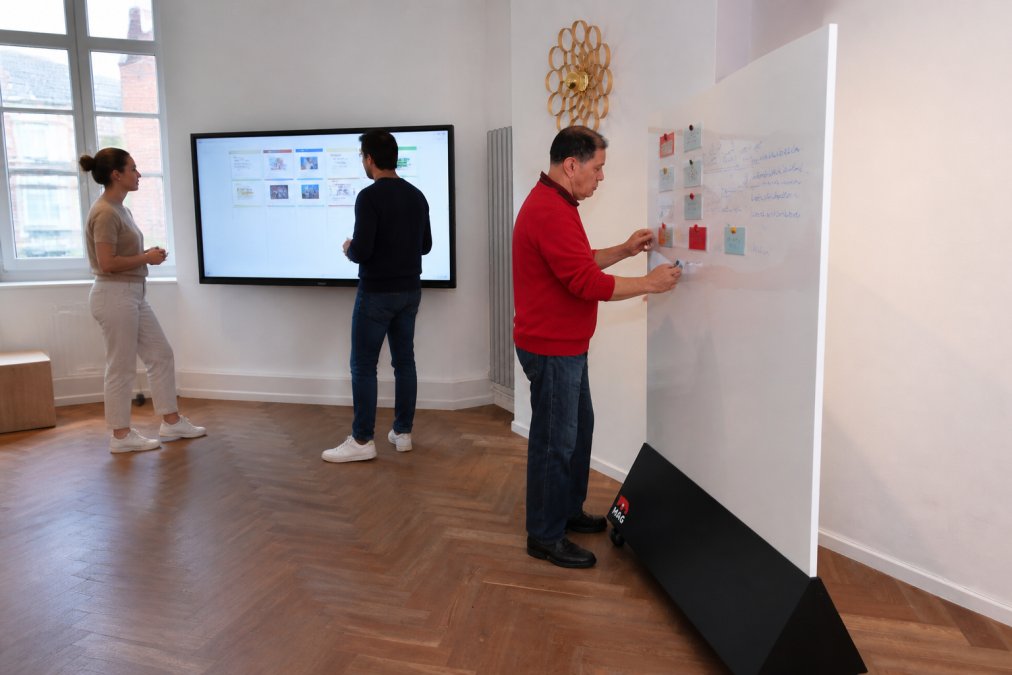
Real-Time Data: Digital screens excel at displaying live feeds and frequently updated information. Interactive walls are static, displaying what's written or pinned on them.
Collaboration Quality: Interactive walls support deeper, more engaged collaboration through tactile, spatial, and synchronous interaction. Digital screens support efficient information sharing but lack collaborative depth.
Flexibility and Adaptation: Interactive walls adapt to any use case. Digital screens are optimised for specific software and content types.
Use interactive walls for spaces where teams gather synchronously to collaborate, create, and plan. Use digital screens where you need live data, distributed team coordination, or media-rich content. Most large organisations benefit from both, strategically deployed.
| Criterion | Interactive Walls | Digital Screens |
|---|---|---|
| Upfront Cost | £1,200-£2,000 per wall | £5,000-£15,000 per display |
| Five-Year Cost | £1,200-£2,000 | £15,000-£25,000 |
| Maintenance | None | Ongoing (software, calibration) |
| Scalability | Horizontal (more wall space) | Vertical (larger/higher-res panels) |
| Collaboration Quality | High (tactile, synchronous) | Moderate (mediated by interface) |
| Real-Time Data | Not suitable | Excellent |
| Lifespan | 10+ years | 5-7 years |
| Environmental Impact | Zero power consumption | 80-150W continuous |
| Installation | Single session | Requires infrastructure |
| Accessibility | Universal | Requires digital literacy |
The choice depends entirely on your specific needs. If your priority is cost-effective, durable collaboration surfaces requiring zero ongoing maintenance, interactive wall systems from MagScapes deliver unmatched value. For organisations seeking to reduce long-term facility costs whilst maintaining premium collaboration quality, MagWrite wallcovering (starting at £248 per roll) and mobile solutions like MagPivot (£1,195) provide infrastructure for dynamic, adaptive workspaces. Explore MagScapes' full range of ferrous wallcoverings and magnetic furniture to create the collaborative environments your teams deserve.
Frequently Asked Questions
What are the primary differences between interactive wall systems and digital screens?
Interactive wall systems like magnetic wallcoverings combine writing and magnetic attachment in one physical space, offering unlimited surface area and no power dependency. Digital screens provide dynamic content, video playback, and remote updates but require electrical infrastructure, have fixed display sizes, and can suffer from glare and latency issues. Interactive walls suit permanent installations in offices and classrooms; digital screens excel where dynamic content and real-time updates matter most.
Are interactive wall systems more cost-effective than large-format digital displays?
Initial installation costs differ significantly. MagWrite magnetic wallcovering starts from £248 per roll for a 3-metre length, making wall coverage affordable for most budgets. Digital displays range from £2,000 to £15,000+ depending on size and resolution. However, digital screens require ongoing maintenance, software licensing, and electricity costs. Interactive wall systems have minimal operating expenses and a 10-year warranty, making long-term total cost of ownership substantially lower in most commercial and educational settings.
How does maintenance compare between interactive wall systems and digital displays?
Interactive wall systems require only basic cleaning with a microfibre cloth and spray cleaner. There are no software updates, calibration issues, or technical support costs. Digital screens demand regular maintenance, software patches, potential component replacement, and professional servicing. In high-traffic environments like classrooms and hospitals, interactive walls prove far simpler to maintain. Their durability also exceeds most digital displays, which typically have a 5-7 year lifespan compared to 10+ years for quality magnetic wallcoverings.
Which solution offers better durability for high-traffic educational or commercial settings?
Interactive wall systems excel in durability. MagWrite and similar products resist ghosting, maintain surface quality through intensive daily use, and carry 10-year warranties. The ferrous backing ensures consistent magnet receptivity over time. Digital screens, while strong, are vulnerable to accidental damage, screen burn-in, and component failure. In schools with heavy daily use and hospitals where reliability is critical, interactive wall systems prove more resilient and cost-effective over their lifetime.
Can magnetic wallcoverings enhance the functionality of interactive display systems?
Yes. Magnetic wallcoverings like MagWrite combine dry-erase writing, magnet attachment for documents and visual aids, and projection compatibility on matt surfaces. This multi-function capability means a single wall surface handles brainstorming, document display, and presentations without requiring separate equipment. Teams can use colour-coded magnets for project management, attach printed reference materials, and write notes, all on one interactive surface. This integrated approach is far more flexible than digital screens alone, particularly in collaborative environments.
This article was written using GrandRanker