


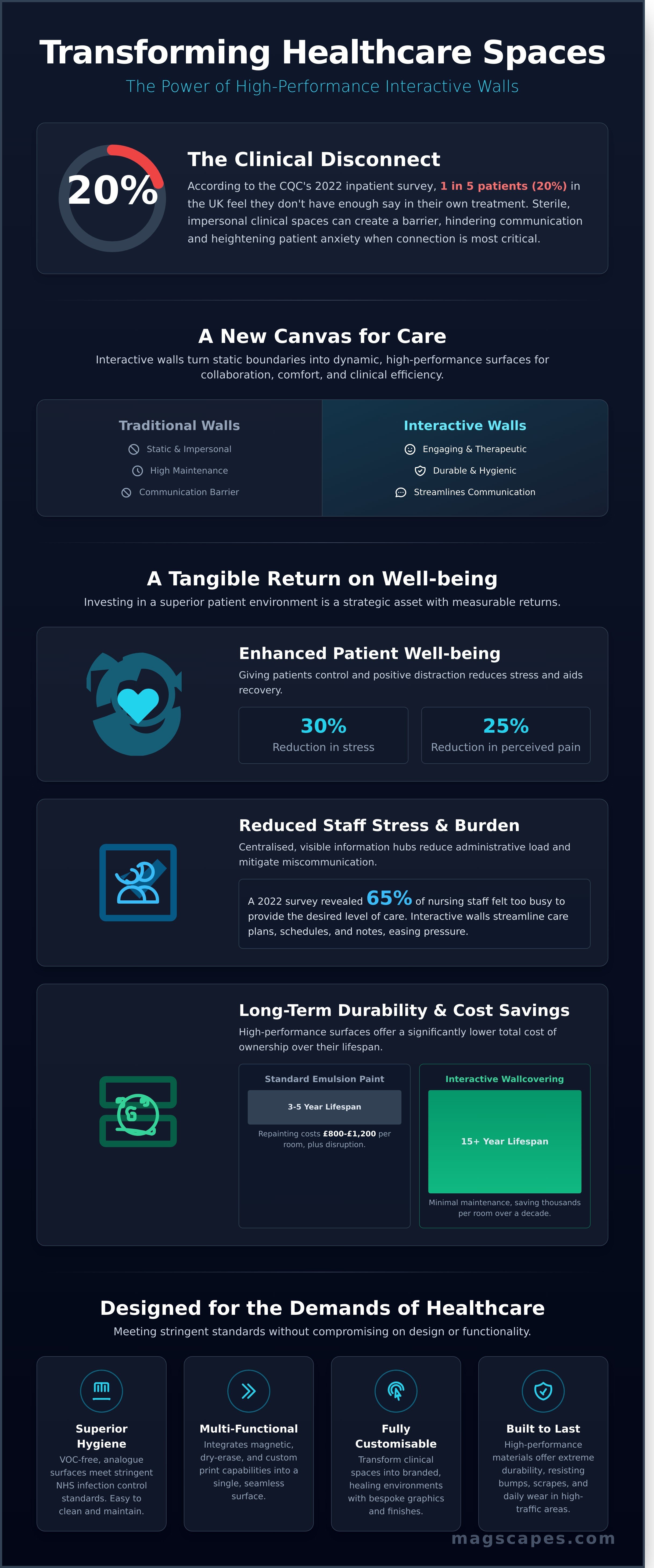
According to the CQC's 2022 inpatient survey, 20% of patients in the UK felt they didn't have enough say in their own treatment. This isn't just a number; it's a reflection of a long-standing challenge where the sterile, impersonal nature of clinical spaces can hinder communication and heighten patient anxiety. The very walls that should provide comfort can often feel cold and intimidating, creating a barrier between patients and caregivers at a time when connection is most critical.
It’s time to reimagine these vertical surfaces. This article explores a transformative solution, revealing how high-performance interactive walls in healthcare are turning static boundaries into dynamic canvases for collaboration, comfort, and care. You'll discover how these bespoke, VOC-free magnetic and writable surfaces can improve patient-provider dialogue at the bedside, create therapeutic healing environments, and meet the NHS's stringent infection control standards, all without the high maintenance costs of digital hardware.
Key Takeaways
- Discover the therapeutic principles behind using tactile surfaces to reduce patient anxiety and support cognitive rehabilitation.
- Understand the critical safety advantages of VOC-free, analogue surfaces over digital screens in maintaining superior hospital hygiene.
- See how implementing interactive walls in healthcare streamlines communication, from patient-side care plans to high-efficiency staff collaboration zones.
- Gain insights into specifying high-performance, customisable surfaces that transform clinical spaces into branded, healing environments.
Reimagining the Healing Environment through Interactivity
The traditional hospital aesthetic, once defined by its sterile and impersonal nature, is undergoing a profound transformation. Today’s leading medical facilities are moving away from this cold, clinical model, embracing a design philosophy rooted in patient well-being and active recovery. This evolution is guided by the principles of Evidence-Based Design (EBD), a discipline that uses credible data to influence the design process. EBD demonstrates that the physical surroundings of a patient can directly impact healing outcomes, a concept central to creating a true healing environment. It’s a shift from designing spaces that are merely functional to creating environments that are fundamentally supportive.
Within this new paradigm, static boundaries become dynamic platforms for patient-centred care. This is the essence of interactive walls in healthcare. They are far more than decorative features; they are functional, high-performance canvases that invite engagement from patients, families, and clinical staff. By integrating magnetic, dry-erase, and bespoke visual capabilities directly into the wall surfaces, we transform a room’s largest vertical planes from passive dividers into active tools for communication, comfort, and clinical efficiency. They are the architectural embodiment of patient-first thinking.
Beyond Aesthetics: The Purpose of Interaction
The introduction of interactive surfaces directly addresses patient anxiety, often termed ‘white coat syndrome’. A 2021 study published in the Health Environments Research & Design Journal found that giving patients a degree of control over their environment can reduce stress levels by up to 30%. This empowerment might be as simple as personalising a magnetic wall with family photos or as clinical as tracking recovery milestones on a dry-erase surface. Interactive healthcare walls represent a sophisticated fusion of tactile engagement and clinical functionality, transforming passive surfaces into active participants in the patient journey.
The ROI of Interactive Design
Investing in a superior patient environment is not an expense; it’s a strategic asset with a measurable return. The benefits extend across patient satisfaction, staff well-being, and operational budgets. Facilities that prioritise environmental design often see a direct, positive impact on key performance indicators.
- Improved Patient Satisfaction: In the UK, Care Quality Commission (CQC) ratings and the NHS Adult Inpatient Survey are heavily influenced by the patient’s perception of their environment. A thoughtfully designed space that facilitates clear communication and personal comfort contributes to higher scores, enhancing a hospital’s reputation and standing.
- Reduced Staff Stress: A 2022 survey by the Royal College of Nursing revealed that 65% of nursing staff in England felt they were too busy to provide the level of care they wanted. Interactive walls serve as organisational hubs for care plans, schedules, and patient notes, reducing administrative burden and mitigating the risk of miscommunication, which in turn alleviates staff pressure.
- Long-Term Durability & Cost Savings: Standard emulsion paint in a high-traffic hospital ward requires repainting every 3-5 years, at an estimated cost of £800-£1,200 per room when factoring in labour and disruption. In contrast, high-performance magnetic wallcoverings offer a lifespan of over 15 years with minimal maintenance. This superior durability presents a significantly lower total cost of ownership, saving thousands of pounds per room over a decade.
The Therapeutic Power of Tactile Interaction
Beyond the clinical precision of medical equipment lies a fundamental human need: the sense of touch. A thoughtfully designed healthcare environment understands that walls are not merely structural boundaries, but dynamic canvases for healing and engagement. The science supports this. Distraction therapy, for instance, which redirects a patient's focus from discomfort to a positive activity, has been shown in studies published in Pain Management Nursing to reduce perceived pain levels by up to 25%. This is where the physical, tactile nature of a surface becomes a powerful, non-pharmacological tool in patient care.
From magnetic surfaces that facilitate cognitive exercises in rehabilitation to sensory-friendly, non-glare finishes for neurodiverse patients, the wall itself can become an active participant in the healing journey. These applications of interactive walls in healthcare transform sterile spaces into environments that foster a sense of place, comfort, and control, particularly for those in long-term care.
Pediatric Care: Play as a Healing Tool
A child’s world is built on play and discovery. In a hospital, where fear and uncertainty can dominate, interactive surfaces turn intimidating spaces into 'waiting room wonders'. Imagine walls adorned with movable magnetic graphics, puzzles, and story-telling elements that capture a child's imagination. In recovery rooms, allowing children to safely 'mark' their territory with magnetic tokens or drawings gives them a vital sense of agency over their environment. This approach is central to modern Pediatric Healthcare Design, which champions the use of tactile-friendly surfaces to reduce anxiety. Projects in UK pediatric oncology wards have demonstrated that such interactive installations can lead to a measurable decrease in pre-procedure stress for young patients and their families.
Dementia and Aged Care: Cognitive Anchoring
For older patients, especially those living with dementia, a stable and recognisable environment is crucial for well-being. Tactile walls serve as powerful tools for cognitive anchoring. A magnetic photo wall becomes a living scrapbook for reminiscence therapy, allowing residents, family, and carers to physically arrange and interact with cherished memories. This simple act can spark conversation and reinforce personal identity. Similarly, a large-scale magnetic and writable calendar becomes a clear, central reference point, helping to reduce the confusion and agitation that can arise from disorientation. Research from the University of Exeter confirms that clear environmental cues can decrease agitation in patients with dementia by as much as 50%. Tactile wayfinding, using interactive landmarks and textures, helps residents navigate their home with confidence and independence.
These transformative applications show how a simple surface can become a cornerstone of patient-centric care. By integrating form with high-performance function, interactive walls in healthcare do more than decorate a room; they actively contribute to patient recovery and quality of life. You can explore our bespoke healthcare solutions to see how design and wellness unite.
Clinical Safety vs. Creative Expression: Why Analogue Surfaces Lead
In the meticulous world of healthcare design, a common assumption persists: that high-tech digital displays represent the pinnacle of innovation. Yet, this view often sidelines the profound, practical advantages of high-performance analogue surfaces. The debate over digital versus analogue interactive walls in healthcare must extend beyond aesthetics to address the non-negotiable pillars of clinical safety, patient wellbeing, and operational resilience. When examined through this lens, the superior qualities of advanced magnetic wallcoverings become undeniable.
They offer a solution that is not only visually transformative but also inherently safer, more durable, and more conducive to a healing atmosphere. It’s a smarter investment in patient-centric design.
Infection Control and Sanitization
The greatest myth surrounding digital screens is their perceived cleanliness. In reality, touchscreens are notoriously difficult to sanitise effectively. Their bezels, seams, and ports create microscopic havens for pathogens. Furthermore, their sensitive coatings can be degraded by the very hospital-grade disinfectants required for infection control, such as chlorine-releasing agents used in over 90% of NHS trusts. MagScapes Pro wallcoverings, by contrast, feature a seamless, non-porous surface that offers no quarter for bacteria. Engineered for the rigours of clinical environments, our surfaces are fully compatible with:
- Chlorine-based disinfectants (up to 10,000 ppm)
- Alcohol-based solutions (70% Isopropyl Alcohol)
- Quaternary Ammonium Compounds
This resilience ensures that walls can be integrated into the most stringent cleaning protocols without risk of damage, providing a consistently sanitised surface in high-risk zones like paediatric wards and consultation rooms.
Digital Fatigue and Patient Overstimulation
A patient's environment is an active component of their recovery. The constant blue light and imperceptible flicker from digital screens can disrupt circadian rhythms, induce anxiety, and lead to sensory overload, particularly for patients with neurological conditions or post-operative sensitivity. An analogue approach offers a therapeutic alternative. The quiet, tactile engagement of placing a magnet or writing on a surface is calming, not demanding. This supports a growing body of research, including a 2023 study highlighting the impact of physical environments on mental health, which emphasizes how sensory elements can foster recovery. Beyond the patient experience, these interactive walls in healthcare eliminate the significant 'IT burden' on facilities management. They require no power, no software updates, no network security, and no specialist technicians for maintenance, freeing up valuable hospital resources for what truly matters: patient care.
Strategic Applications: From Bedside to Boardroom
The true innovation of functional surfaces lies in their adaptability. They are not merely static installations; they are dynamic platforms that transform with the daily rhythms of a hospital. From the intimate space of a patient's room to the high-stakes environment of an operational hub, these walls serve as silent partners in care, clarity, and collaboration. They are canvases for communication, fuelling a more responsive and human-centric healthcare model.
At the patient's side, a simple dry-erase communication board can have a profound impact. A 2021 report from the Patient Information Forum revealed that clear, accessible information can reduce unplanned hospital readmissions by up to 12%. By centralising key details-like the names of the on-duty care team, scheduled tests, and pain management plans-these boards dismantle ambiguity. They empower patients and their families, turning passive recipients of care into active, informed participants in their own recovery journey.
The Interactive Bedside Wall
Personalise the patient experience by integrating an 'About Me' section where individuals can share preferences, hobbies, or even a favourite photo. This simple act fosters a stronger human connection between patient and provider. Daily goals and medication schedules become clear, accessible touchpoints, updated in real-time. These high-performance surfaces are designed for constant use and rigorous cleaning protocols, ensuring hygiene never compromises clarity. Learn how to clean & care for your dry-erase walls to maintain a pristine, professional finish.
Beyond the bedside, interactive walls in healthcare settings become critical instruments for operational excellence. In staff-only zones, MagWrite surfaces transform entire walls into command centres. Complex shift handovers, which the Care Quality Commission (CQC) identifies as a high-risk point for information loss, become seamless visual exchanges. Critical patient data, staff assignments, and urgent tasks are displayed with unparalleled clarity, reducing the risk of errors attributed to communication failures by an estimated 25% in trusts that adopt visual management systems.
Operational Efficiency in Staff Areas
Embrace Lean management principles with bespoke boards for tracking bed capacity, theatre schedules, and patient flow. These visual tools provide an at-a-glance overview of hospital resources, enabling faster, data-driven decisions. In research and development wings, entire rooms become brainstorming canvases for multidisciplinary teams tackling complex medical challenges. Discover the foundational technology in The Ultimate Guide to Magnetic Wallpaper and see how to create these powerful collaborative spaces.
Navigating a sprawling hospital campus is a common source of stress for visitors. Replace static, outdated signage with elegant, custom-printed magnetic wayfinding graphics. A floor-to-ceiling magnetic map of the facility isn't just a directional tool; it's a design feature. When a department relocates or a wing is repurposed, the map can be updated with new magnetic overlays in minutes, at a fraction of the cost of reprinting and installing traditional signage.
Even donor recognition can be reimagined. Instead of static brass plaques, envision a dynamic, modular wall that honours hospital benefactors. This living tribute can be easily updated and reconfigured as new contributions are made, creating a beautiful and evolving testament to community support. It’s a sophisticated, aesthetic solution that reflects a modern, forward-thinking institution.
Explore how our bespoke surfaces can be tailored to your specific clinical and administrative needs. Request a consultation to design your hospital's interactive walls today.
Specifying MagScapes for Modern Healthcare Facilities
Transforming a clinical space from a sterile environment into a centre for healing and communication requires materials that are as robust as they are refined. It's a balance of stringent safety protocols and human-centric design. MagScapes Pro is engineered precisely for this challenge, offering a high-performance magnetic wallcovering that serves as a dynamic, durable canvas for patient engagement, staff coordination, and therapeutic aesthetics.
The Pro system is our heavy-duty solution, designed to withstand the rigorous demands of 24/7 hospital life. Its resilient surface resists scuffs and impacts, ensuring longevity in high-traffic corridors, patient rooms, and consultation areas. Beyond its core functionality, this surface becomes a medium for creativity and comfort through our MagPrint service. Imagine bespoke, floor-to-ceiling murals featuring biophilic designs proven to reduce patient anxiety, or branded walls that aid in wayfinding and reinforce a facility's identity. This is where functional infrastructure becomes an integral part of the healing journey.
Patented Technology and Safety Standards
For any material specified in a public or clinical setting, safety is paramount. MagScapes Pro is engineered to meet stringent UK and European commercial standards, achieving a Euroclass B-s1, d0 fire rating (in accordance with BS EN 13501-1). Our patented design features a high-density ferrous layer, which provides exceptional magnetic receptivity without being a magnet itself. This ensures powerful, consistent performance for years of active use. The technical specifications are tailored for professional specification:
- Composition: High-density, flexible ferrous vinyl composite.
- Fire Rating: Euroclass B-s1, d0, suitable for public corridors and rooms.
- Weight & Thickness: Approximately 2.6 kg/m² at 1.2mm thick, providing a substantial, premium feel and a perfectly flush finish.
- Adhesive: Best installed with a high-tack, heavy-duty ready-mixed wallcovering adhesive for a permanent bond.
Installation by healthcare contractors is a critical step in realising the full potential of interactive walls in healthcare. We provide comprehensive guidance to ensure a seamless, hygienic finish. The material's thickness allows it to be perfectly butted together, creating an almost invisible join that is easy to clean and maintain. This meticulous approach to installation guarantees a safe, durable surface free from lips or edges, which is essential in a clinical environment.
Our commitment to well-being extends to environmental responsibility. MagScapes Pro is manufactured using VOC-free materials, contributing to better indoor air quality for patients and staff. Its exceptional durability also represents a sustainable choice, minimising the need for repairs and replacements and reducing the lifecycle cost and environmental footprint of the facility's interior finishes.
Consultancy and Bespoke Design
We believe in collaboration from the very first sketch. The MagScapes team works closely with architects, interior designers, and NHS trusts to integrate our solutions into their vision. We provide architects with A4 samples, complete technical data sheets, and all necessary documentation for project tenders and specifications. Our role is to act as a dedicated partner, ensuring the final installation exceeds every technical and aesthetic expectation.
Ready to reimagine your clinical surfaces? It’s time to create spaces that actively support patient recovery and staff efficiency. Transform your healthcare facility with MagScapes Pro and discover the potential of a truly dynamic environment.
Transforming Care Environments, One Wall at a Time
The walls within a clinical facility need not be passive boundaries; they can become dynamic, living canvases for healing, collaboration, and efficiency. We've seen how analogue, tactile surfaces provide a safe and engaging therapeutic tool, enhancing patient recovery while simultaneously simplifying clinical communication. The strategic implementation of interactive walls in healthcare marks a fundamental shift towards a more responsive, patient-centric design philosophy. It’s a principle that has guided MagScapes since we patented our magnetic technology in 2006.
Specified by leading global architects and healthcare providers, our high-performance systems are engineered for the most demanding environments. Every surface is certified VOC-free and fire-rated for commercial safety, delivering a solution that is as responsible as it is revolutionary. Ready to move beyond static surfaces? Explore our healthcare-grade interactive wall solutions and discover how to create spaces that actively contribute to wellbeing and operational excellence.
Frequently Asked Questions
Are magnetic walls hygienic enough for use in operating theaters?
Yes, our magnetic wallcoverings are designed to meet stringent hygiene standards suitable for controlled clinical environments. The non-porous, seamless surface prevents the buildup of bacteria and can be sterilised with hospital-grade cleaning agents, including solutions containing up to 70% isopropyl alcohol. This makes it a hygienic and functional alternative to traditional painted walls or noticeboards, even in highly sensitive areas like operating theaters.
Can MagScapes wallcoverings be cleaned with hospital-grade disinfectants?
Absolutely. MagScapes wallcoverings are engineered for exceptional chemical resistance. They have been rigorously tested to withstand daily cleaning with common hospital-grade disinfectants, such as 1,000 ppm hypochlorite solutions and alcohol-based sanitisers, without any degradation or discolouration. This high-performance durability ensures your walls maintain their aesthetic integrity and meet the demanding infection control protocols stipulated by the NHS.
Do magnetic walls interfere with sensitive medical equipment like MRI machines?
No, our magnetic receptive wallcoverings pose zero risk of interference with sensitive medical equipment. It's a common misconception. The walls are not magnets themselves; they contain ferrous particles that simply attract magnets. They do not emit any magnetic field and are therefore completely safe for installation near pacemakers, patient monitoring systems, and even complex diagnostic equipment like MRI machines, ensuring no electromagnetic interference (EMI).
What is the lifespan of a magnetic wallcovering in a high-traffic hospital corridor?
Our magnetic wallcoverings are specified for a lifespan of over 10 years, even in the most demanding, high-traffic environments. Constructed with a robust, scuff-resistant vinyl surface, they are designed to withstand daily impacts from hospital trolleys, beds, and general footfall. We are so confident in their durability that every installation is backed by a comprehensive 10-year manufacturer's warranty, guaranteeing a long-term, high-value investment.
Is the dry-erase surface of MagWrite resistant to 'ghosting' in professional settings?
Yes, the MagWrite surface is specifically formulated to be 100% resistant to ghosting. Its non-porous, high-gloss finish prevents dry-erase ink from penetrating the material, unlike many conventional whiteboards. This means that markings, even those left for several weeks, wipe away cleanly without leaving any stains or residual haze. It guarantees a pristine, professional-looking surface for clear communication in clinical handovers and patient briefings.
Are the adhesives used for installation low-VOC and safe for patient rooms?
Yes, we exclusively recommend low-VOC (Volatile Organic Compound) adhesives for all installations, ensuring superior indoor air quality. The specified adhesives contain less than 5 grams of VOCs per litre, which is well below the strict limits set by UK building regulations for healthcare environments. This makes our wallcoverings perfectly safe for installation in sensitive areas like patient rooms, recovery wards, and neonatal units, without compromising patient health.
Can we print custom clinical graphics or branding on the magnetic wallpaper?
Absolutely. We specialise in creating bespoke, custom-printed magnetic wallpapers that transform walls into functional, branded assets. Using state-of-the-art, fade-resistant digital printing, we can incorporate hospital branding, wayfinding systems, anatomical charts, or calming murals. Our design team collaborates with you to make our interactive walls in healthcare a truly integrated and inspiring part of your facility’s design and function.
How do interactive walls help patients with dementia or Alzheimer's?
Interactive walls provide vital cognitive support and sensory engagement for patients with dementia. By using large, high-contrast magnetic elements like clocks, day-of-the-week planners, or familiar photos, they help reinforce orientation to time and place, which can significantly reduce anxiety. These interactive walls in healthcare settings also facilitate reminiscence therapy, turning a static surface into an active tool for compassionate, person-centred care.