


Table of Contents
- Magnetic Paint vs Magnetic Wallpaper: Key Differences
- Magnetic Pull Strength: Paint vs Wallpaper Comparison
- Ease of Installation and Application
- Durability and Long-Term Performance
- Aesthetic Finish and Customisation Options
- Cost-Effectiveness and Budget Analysis
- Environmental and Health Impact
- Removal and Wall Damage Considerations
Last Updated: August 2, 2026
Choosing between magnetic paint vs magnetic wallpaper transforms static walls into functional, collaborative spaces, but they work differently. Both have trade-offs in cost, longevity, and visual finish. At MagScapes, we've helped facilities managers, educators, and homeowners navigate this decision, the answer depends on your priorities: installation speed, magnetic strength, aesthetic flexibility, or durability.

Magnetic Paint vs Magnetic Wallpaper: Key Differences
Magnetic paint is a liquid coating containing magnetite particles suspended in a water-based binder, applied in 3 coats to build ferrous particle density. Magnetic wallpaper is a pre-manufactured sheet with ferrous particles already distributed throughout, hung like standard wallpaper using adhesive.
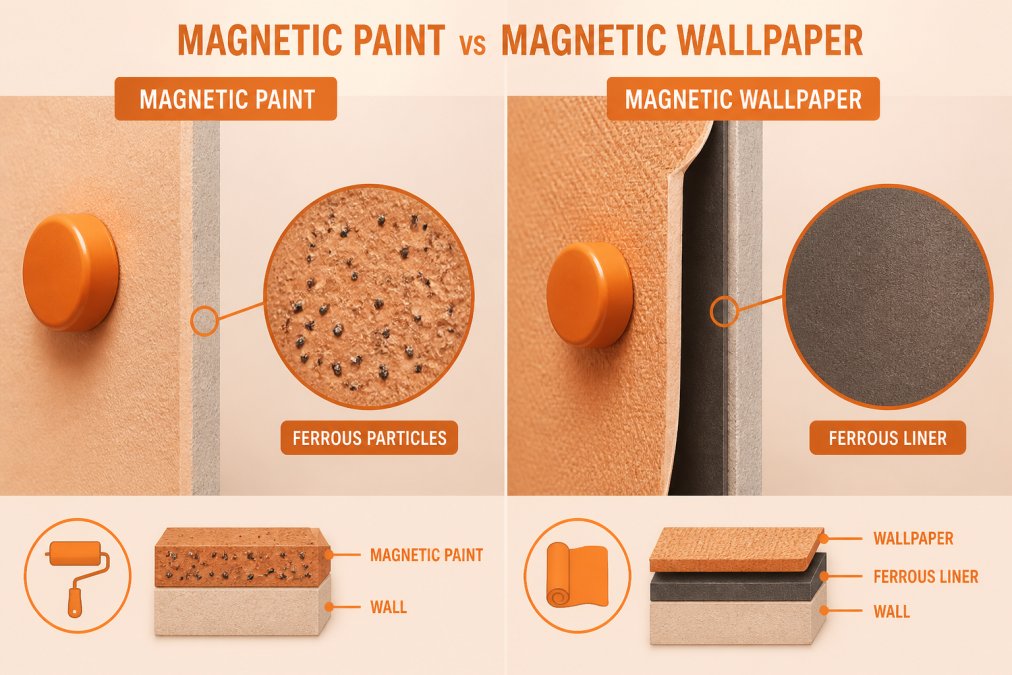
This structural difference creates cascading implications for installation time, magnetic pull strength, durability, and aesthetic options. Magnetic paint allows complete colour and finish customisation, you can paint over the base coat with any emulsion, wallpaper, or specialist finish. Magnetic wallpaper comes in fixed visual appearances (matte finishes, textured surfaces, or pre-finished colours).
Research from Smarter Surfaces technical documentation confirms that magnetic paint formulations typically achieve 55% magnetite content by volume, while wallpaper-based solutions distribute ferrous particles more evenly but at lower overall density per square metre.
Installation speed diverges sharply. Magnetic wallpaper can be hung in 1-2 days. Magnetic paint requires 24-48 hours between coats, plus curing time before topcoat application, 5-7 days total.
How Magnetic Paint Works
Magnetic paint operates as a ferrous base layer that attracts magnets once fully cured. The paint contains fine magnetite particles (iron oxide), which respond to magnetic fields. The critical step most people miss is applying sufficient coats, one coat will not hold magnets reliably. Professional application typically involves 3 coats minimum, with 24 hours drying time between each layer.
After the final coat cures (usually 48 hours), you can apply a topcoat of standard emulsion paint, wallpaper, or specialist finishes. This topcoat does not reduce magnetic strength if applied correctly, ferrous particles remain active beneath the surface. Setup typically takes 4-7 days for a single wall when accounting for drying time between coats.
How Magnetic Wallpaper Works
Magnetic wallpaper is a manufactured sheet with ferrous particles fully enclosed within or bonded to the wallcovering material. Installation follows standard wallpaper procedures: apply adhesive to the back, position on the wall, and smooth out air bubbles.
The ferrous particles are typically contained within a protective layer, making them less exposed to moisture, dust, or physical damage than paint-based solutions. Magnetic wallpaper comes in fixed visual formats: matte grey or brown finishes, paintable white surfaces, or specialist finishes like dry-erase white or chalkboard black. MagScapes manufactures several solutions tailored to different use cases, MagPaintable™ Matt White Ferrous Rolls allow customisation with any paint colour, whilst MagWrite™ Gloss White provides an integrated dry-erase surface.

A professional can hang magnetic wallpaper on a 15-person office wall in 1-2 days. The surface is functionally ready immediately after installation, no curing time required.
Magnetic Pull Strength: Paint vs Wallpaper Comparison
Magnetic pull strength depends on ferrous particle density and magnet type.
Magnetic paint achieves strong holding capacity when applied correctly (3+ coats). A properly applied surface can hold standard neodymium magnets securely enough for whiteboards, notice boards, or heavy magnetic accessories. Holding capacity scales with coats: 2 coats hold lighter items, 3 coats hold moderate weight, 4 coats hold substantial weight.
Magnetic wallpaper provides consistent holding capacity across the entire surface because ferrous particles are uniformly distributed during manufacturing. A single layer typically matches the holding strength of 2-3 coats of magnetic paint. However, wallpaper cannot be layered to increase strength, you install one sheet, and that's your ferrous density.
| Factor | Magnetic Paint | Magnetic Wallpaper |
|---|---|---|
| Holding capacity (standard neodymium magnets) | Scales with coats (2-4+) | Fixed per product specification |
| Magnet type compatibility | Works with standard and high-strength magnets | Optimised for specific magnet ratings |
| Consistency across surface | Varies with application technique | Uniform by design |
| Maximum weight per magnet | 2-4kg depending on coats | 1-3kg depending on wallpaper type |
| Layering for increased strength | Possible (add more coats) | Not possible |
For lightweight items (A4 papers, small whiteboards), either solution works. For heavier items (large magnetic boards, metal shelving), you need either multiple coats of paint or high-strength magnets with wallpaper.
Ferrous Particle Content and Magnetic Density
Magnetic paint suspends magnetite particles in a liquid binder at typical concentration of 50-60% by volume. Three coats deposit three layers, creating cumulative ferrous density.
Magnetic wallpaper manufactures ferrous particles into the material during production. The particle distribution is controlled and consistent, but total ferrous content per square metre is fixed. In busy environments, ferrous particles in paint can shift slightly over months or years, potentially reducing holding capacity. Wallpaper's enclosed design resists this shifting because particles are bonded into the material structure.
For healthcare settings, ferrous particle stability is particularly important. Hospitals require consistent magnetic performance for months or years without degradation. The enclosed ferrous design of wallpaper provides this consistency more reliably than paint.
Ease of Installation and Application
Installation difficulty separates these solutions sharply. Magnetic paint demands careful technique and time management. Magnetic wallpaper requires standard wallpaper hanging skills.
How to Apply Magnetic Paint UK
Prepare the wall surface thoroughly. Remove old wallpaper, sand rough areas, and fill holes or cracks. Apply a primer coat if the wall is porous. Then apply the first coat of magnetic paint using a roller, working in small sections for even coverage. Allow 24 hours drying time. Apply the second coat, allowing 24 hours. Apply the third coat and allow 48 hours curing before applying any topcoat.
Common mistakes include insufficient roller pressure, uneven application, and rushing between coats. Applying three even coats to a 10-square-metre wall typically takes 6-8 hours of active work, spread across 5-7 days.
Professional magnetic paint application in the UK typically costs £40-60 per square metre, including labour and materials. For a 15-square-metre feature wall, expect £600-900 in professional installation costs. Material costs run £15-25 per square metre.
Installing Magnetic Wallpaper
Each roll is typically 10 metres long by 0.62 metres wide, covering approximately 6.2 square metres. Measure your wall carefully and plan your roll layout to minimise seams and waste. Prepare the wall surface by filling holes, sanding rough spots, and applying primer if very porous. Cut your first strip to length, apply wallpaper adhesive to the back, and position it on the wall starting at the top. Smooth out air bubbles working downward using a plastic squeegee.
Align subsequent strips carefully to match seams and maintain vertical alignment. Installation typically takes 1-2 days for a single wall. Professional installation in the UK costs £25-40 per square metre, including labour and materials. For a 15-square-metre wall, expect £375-600 in professional costs. Material costs run £20-35 per square metre.
Wallpaper installation is complete in 1-2 days, while paint requires 5-7 days minimum due to drying time between coats.
Durability and Long-Term Performance
Long-term durability differs significantly between paint and wallpaper, particularly in high-traffic environments.
Surface Durability and Wear Resistance
Magnetic paint surfaces are exposed to direct contact from hands, magnets, and objects sliding across them. Over months or years, the paint surface can show wear marks, scuffs, or slight fading. The underlying magnetic layer remains functional, but the aesthetic finish may degrade.
Wallpaper surfaces are more resilient to wear because ferrous particles are enclosed within the material. The outer surface can be selected for durability, matte finishes resist fingerprints better than gloss, textured surfaces hide minor scuffs. In healthcare environments, durability is critical. Hospital walls experience frequent cleaning with disinfectants, high-traffic contact, and intensive magnetic board usage. Magnetic wallpaper typically outlasts paint in these settings because the enclosed ferrous design resists degradation from chemical exposure and physical wear.
For home use, either solution lasts 5-10 years with normal care. Paint may show cosmetic wear sooner but remains functionally magnetic. Wallpaper maintains appearance better but cannot be easily spot-repaired if damaged.
Curing Time and Functional Readiness
Magnetic paint requires 48 hours minimum curing before the surface is truly functional. Magnetic wallpaper is functionally ready immediately after installation. You can begin using the magnetic surface the same day installation completes, which is a significant practical advantage for facilities managers managing tight project timelines.
Aesthetic Finish and Customisation Options
Aesthetic flexibility is a major differentiator. Magnetic paint allows unlimited colour and finish customisation. Magnetic wallpaper offers fixed visual options unless you apply additional decoration.
Paintability and Finish Texture
Once magnetic paint cures, you can apply any standard emulsion paint, specialist finishes, or wallpaper on top. This means you can match your existing colour scheme exactly, create feature walls in bold colours, or integrate magnetic surfaces seamlessly into your interior design. You can also apply textured finishes, matte or gloss topcoats, or chalkboard paint on top of magnetic paint to create multi-functional surfaces.
This flexibility is particularly valuable for interior designers and facilities managers who need magnetic surfaces to blend with existing décor rather than dominate visually. The downside: topcoat application adds 2-3 days to your project timeline and increases labour costs if hiring professionals.
Magnetic Wall Ideas UK
Collaborative office spaces feature magnetic walls for project planning and team brainstorming. Educational settings use magnetic walls for interactive learning. Healthcare facilities use magnetic walls for patient communication boards and staff schedules. Home offices increasingly feature magnetic walls for organisation and inspiration boards.
MagScapes offers specialist solutions for each use case. MagChalk™ Matt Black ferrous wallcovering transforms walls into [magnetic chalkboard(https://magscapetest.myshopify.com/products/magchalk-magnetic-chalkboard) surfaces | magscapes.com/products/magchalk], ideal for creative brainstorming spaces. MagLiner™ Matt Grey/Brown ferrous rolls provide a neutral, professional aesthetic suitable for corporate environments.

Cost-Effectiveness and Budget Analysis
Budget considerations often drive the paint vs wallpaper decision.
Price Per Square Metre
Magnetic paint material costs approximately £15-25 per square metre in the UK. However, you need 3 coats minimum, so material cost multiplies to £45-75 per square metre. Professional application adds £40-60 per square metre in labour, bringing total installed cost to £85-135 per square metre.
Magnetic wallpaper material costs approximately £20-35 per square metre, with professional installation adding £25-40 per square metre. Total installed cost ranges from £45-75 per square metre, roughly half the cost of professionally installed magnetic paint.
For a 15-square-metre feature wall:
- Magnetic paint (DIY): £225-375 (materials only, 6-8 hours labour)
- Magnetic paint (professional): £1,275-2,025 (materials + labour)
- Magnetic wallpaper (DIY): £300-525 (materials only, 8-12 hours labour)
- Magnetic wallpaper (professional): £675-1,125 (materials + labour)
Wallpaper is significantly cheaper for professional installation. DIY costs are comparable, but wallpaper requires less specialised skill.
Long-Term Value and Replacement Costs
Paint surfaces typically remain functional for 5-10 years with normal care. If you need to refresh the appearance, you can repaint the topcoat without disturbing the underlying magnetic layer. Repainting costs £10-20 per square metre in materials and labour.
Wallpaper surfaces typically last 7-12 years before requiring replacement. If the outer surface becomes damaged or aesthetically worn, you must remove and replace the entire sheet. However, wallpaper resists cosmetic wear better than paint, so replacement cycles are often longer in practice.
For long-term value, wallpaper offers better durability in high-traffic environments. Paint offers better flexibility for aesthetic updates and cost-effective refreshes. For homeowners, paint provides superior long-term value because you can update colours without full replacement. For facilities managers managing multiple spaces, wallpaper's faster installation and lower initial cost often provide better value.
Environmental and Health Impact
Environmental and health considerations are increasingly important for UK facilities managers and homeowners.
VOC Content and Indoor Air Quality
Magnetic paint formulations vary in volatile organic compound (VOC) content. Quality magnetic paints are water-based and low-VOC, typically containing less than 50g/litre of VOCs. Always verify VOC content before purchasing, look for products certified as low-VOC by UK environmental standards bodies.
Magnetic wallpaper contains no VOCs because it's a dry material. Installation uses standard wallpaper adhesive, which typically contains minimal VOCs if water-based products are selected. This makes wallpaper the preferred choice for sensitive environments like hospitals, nurseries, or homes with residents who have respiratory sensitivities.
Safety for Sensitive Environments
Healthcare facilities must meet strict environmental standards. Magnetic paint's water-based, low-VOC formulations are generally safe for hospital use, but some facilities prefer wallpaper to avoid any potential off-gassing during application.
Wallpaper's enclosed ferrous design means particles are not exposed to air during installation, eliminating any dust or particle inhalation risk. This is particularly important in operating theatres, patient wards, or immunocompromised care areas.
For nurseries and early years settings, wallpaper is often preferred because installation is quick and there's no curing period with potential air quality effects. Research from UK Health and Safety Executive guidance on workplace air quality recommends low-VOC finishes for occupied spaces, particularly those with vulnerable populations. Both magnetic paint (if low-VOC) and magnetic wallpaper meet these standards, but wallpaper eliminates any potential concerns entirely.
Removal and Wall Damage Considerations
Magnetic paint removal requires sanding or scraping the painted surface, which is labour-intensive and generates dust. You'll need to sand through all coats to reach bare wall, then fill and prepare for new finishes. This process typically takes 1-2 days for a single wall.
Magnetic wallpaper removal is faster and cleaner. You score the seams, apply a removal solution, and peel away the sheet. Residual adhesive can be cleaned with warm water. The wall surface remains largely undamaged. Removal typically takes 4-6 hours for a single wall.
For rental spaces, wallpaper is clearly superior. You can install it without damaging the underlying wall and remove it cleanly when you relocate. For permanent installations in owned spaces, paint offers slightly better long-term integration with the wall structure.
| Consideration | Magnetic Paint | Magnetic Wallpaper |
|---|---|---|
| Installation time | 5-7 days (accounting for drying) | 1-2 days |
| Professional installation cost (per m²) | £40-60 | £25-40 |
| DIY difficulty | Moderate (technique-sensitive) | Easy (standard wallpaper skills) |
| Aesthetic customisation | Unlimited (any topcoat colour/finish) | Fixed (limited pre-finished options) |
| Holding capacity | Scales with coats (2-4kg per magnet) | Fixed per product (1-3kg per magnet) |
| Durability in high-traffic areas | 5-10 years (cosmetic wear common) | 7-12 years (resists wear better) |
| Removal difficulty | High (labour-intensive sanding) | Low (quick peeling and cleaning) |
| Suitable for rentals | Poor (permanent wall changes) | Excellent (reversible installation) |
| Healthcare suitability | Good (low-VOC options available) | Excellent (no VOCs, enclosed design) |
| Long-term refresh cost | Low (repaint topcoat only) | High (full replacement required) |
Magnetic paint vs magnetic wallpaper ultimately depends on your priorities. Choose paint if you need unlimited aesthetic customisation, plan long-term occupation of the space, and have time for a multi-day installation. Choose wallpaper if you prioritise speed, work in a rental space, operate in a sensitive environment like healthcare, or need a reversible installation.
For facilities managers seeking a premium, future-proofed solution that works across diverse sectors, offices, schools, hospitals, and homes, MagScapes magnetic wallcoverings deliver consistent magnetic performance, rapid installation, and durability that withstands intensive daily use. Our products like MagPaintable™ Matt White allow complete aesthetic customisation whilst maintaining superior ferrous density and MagWrite™ Gloss White integrate dry-erase functionality with magnetic receptivity, transforming static walls into dynamic collaborative environments. Explore MagScapes solutions and discover how magnetic walls can enhance your space.
Frequently Asked Questions
Is magnetic paint as good as magnetic wallpaper?
Both have strengths depending on your needs. Magnetic paint typically requires 3 coats for optimal magnetic pull strength and allows complete colour customisation, but takes longer to apply and cure. Magnetic wallpaper applies as a single layer, offers consistent magnetic receptivity due to its manufactured ferrous particle distribution, and installs faster. For holding capacity with neodymium magnets, quality magnetic wallpaper often performs slightly better due to higher ferrous density, though premium magnetic paint can achieve comparable results with proper application.
How much does magnetic paint cost compared to magnetic wallpaper in the UK?
Magnetic paint ranges from approximately £61 per 3 square metres (around £20 per square metre) for standard formulations, while premium options cost more. Magnetic wallpaper typically costs £129.98 per roll (10 metres by 0.62 metres, roughly 6 square metres), working out to approximately £21-22 per square metre. Costs vary by brand and coverage area. MagScapes ferrous wallcoverings range from £66.64 to £322.56 per roll depending on finish type, offering options for different budgets and functional requirements.
Can you paint over magnetic wallpaper?
Yes, magnetic wallpaper can be painted over with standard emulsion or wallpapered with decorative coverings, provided the topcoat is applied thinly. However, painting over magnetic wallpaper reduces the magnetic pull strength because the paint layer creates distance between magnets and the ferrous particles. For best results, use low-thickness applications and avoid heavy topcoats. If you want a specific colour finish, consider magnetic paint instead, or choose a pre-finished magnetic wallpaper like MagWrite or MagChalk that already includes your desired surface.
What are the disadvantages of magnetic paint, and how do magnetic wallpapers compare?
Magnetic paint requires multiple coats (typically 3) for adequate magnetic pull strength, making application time-consuming and labour-intensive. Drying time between coats extends the project timeline. Surface preparation must be meticulous, and achieving uniform magnetic density across large areas is challenging. Magnetic wallpaper avoids these issues by delivering consistent ferrous particle distribution in a single layer. However, magnetic wallpaper cannot be customised in colour without topcoating (which reduces pull strength), and application requires wallpaper adhesive expertise. Paint offers more aesthetic flexibility; wallpaper offers faster, more reliable installation.
How long does magnetic paint last, and does magnetic wallpaper perform better over time?
Magnetic paint durability depends on surface preparation, application quality, and environmental conditions. With proper curing (typically 24 hours) and protection from high moisture, it can last several years. Magnetic wallpaper, being a manufactured product with enclosed ferrous particles, generally resists degradation longer and maintains consistent magnetic pull strength over time. Both can suffer damage from heavy impacts, moisture, or poor surface prep. In high-traffic environments like classrooms or hospitals, magnetic wallpaper typically outperforms paint in durability testing, maintaining functional magnetic receptivity longer with minimal maintenance.
This article was written using GrandRanker