


The most expensive magnetic surface you can buy is the one that lets your ideas slide to the floor. You've likely felt that frustration when a premium magnet slowly drifts down a freshly painted wall; it's a common failure in professional spaces where technical performance wasn't prioritised. Choosing the right foundation for an interactive environment often leads to the magnetic paint vs wallpaper debate, especially when you're aiming for a finish that's both functional and visually seamless. It's disheartening to invest in a creative vision only to be met with a lumpy, "orange-peel" texture or a surface that requires six coats of ferrous liquid just to hold a single A3 blueprint.
We'll help you resolve these technical anxieties by comparing the precision of high-performance wallcoverings against the traditional application of magnetic liquids. You'll learn how to secure a perfectly smooth, interactive canvas that integrates with your bespoke room decor without the risk of uneven finishes. We'll examine the £22 per square metre cost variance, the critical 72-hour drying schedules, and the pull-strength data required for the modern 2026 workspace. This guide provides the technical clarity needed to choose a solution that transforms your walls into dynamic, future-proof platforms for collaboration.
Key Takeaways
- Understand the science of ferrous density and why professional wallcoverings offer a more uniform pull-strength for demanding commercial and educational environments.
- Navigate the aesthetic nuances of magnetic paint vs wallpaper, contrasting the tactile 'orange peel' finish of paint with the sophisticated, bespoke appearance of high-end surfaces.
- Compare installation timelines to see how immediate-use wallcoverings can significantly reduce project downtime compared to the multi-day drying cycles required for paint layers.
- Master a clear decision framework for choosing between DIY-friendly applications for small nooks and high-performance solutions for large-scale architectural transformations.
- Learn how to integrate functionality without compromising on design, turning traditional walls into dynamic, interactive platforms for creative expression and collaboration.
Understanding the Core Mechanics: What are Magnetic Surfaces?
Modern interior design is moving away from static, decorative boundaries. Instead, architects and designers are embracing the "living wall" concept, where surfaces act as dynamic canvases for collaboration and expression. To understand the debate of magnetic paint vs wallpaper, one must first grasp the science of magnet-receptivity. These surfaces aren't magnets themselves; they don't emit a magnetic field. Instead, they contain high concentrations of ferrous particles, usually iron, that allow magnets to cling to them with varying degrees of strength. This creates a functional platform without the bulk of traditional noticeboards.
The transition from heavy, industrial steel plates to flexible, aesthetic materials has been swift. In the early 1990s, creating a magnetic wall required mounting heavy metal sheets that were difficult to conceal and limited in size. Today, innovation in material science allows us to integrate these properties directly into the wall's finish. Whether you choose a liquid application or a high-performance liner, the goal is to transform a standard partition into a bespoke interactive zone. This shift is particularly visible in UK commercial sectors; a 2023 workplace survey found that 72% of new London office fit-outs now include at least one interactive surface to facilitate agile working methods. While traditional wallpaper focuses purely on pattern and texture, these modern alternatives prioritise utility and durability.
To better understand this concept, watch this helpful video:
How Magnetic Paint is Formulated
Magnetic paint consists of a heavy liquid suspension containing ultra-fine iron dust. It's designed to be applied like standard emulsion, yet its density is significantly higher. Achieving a functional "magnetic base" requires precision. You can't simply apply one coat; most manufacturers specify a minimum of three to four coats to ensure enough ferrous material is present to hold a magnet. Modern formulations are strictly VOC-free and water-based, meeting UK safety standards for schools and hospitals. While it offers a seamless look, the performance depends entirely on the thickness of the application, which can vary across the surface.
The Engineering Behind Magnetic Wallpaper
Magnetic wallpaper offers a more engineered solution to the magnetic paint vs wallpaper dilemma. These products are manufactured in a factory-controlled environment where a consistent layer of ferrous foil or powder is bonded to a flexible backing. This ensures the magnetic pull is uniform across every square centimetre of the roll. Materials range from standard paper backings for residential use to heavy-duty professional liners designed for high-traffic corporate environments. Because the thickness is pre-determined during production, there's no risk of "weak spots" that can occur with manual paint application. It's a high-performance choice for those who require a reliable, transformative surface that integrates flawlessly with the room's aesthetic.
- Consistency: Factory-set thickness ensures 100% uniform magnetic strength.
- Durability: Professional liners are resistant to scuffs and heavy magnet use.
- Efficiency: Single-step installation replaces the multi-day drying process of layered paint.
Performance Comparison: Strength, Hold, and Pull
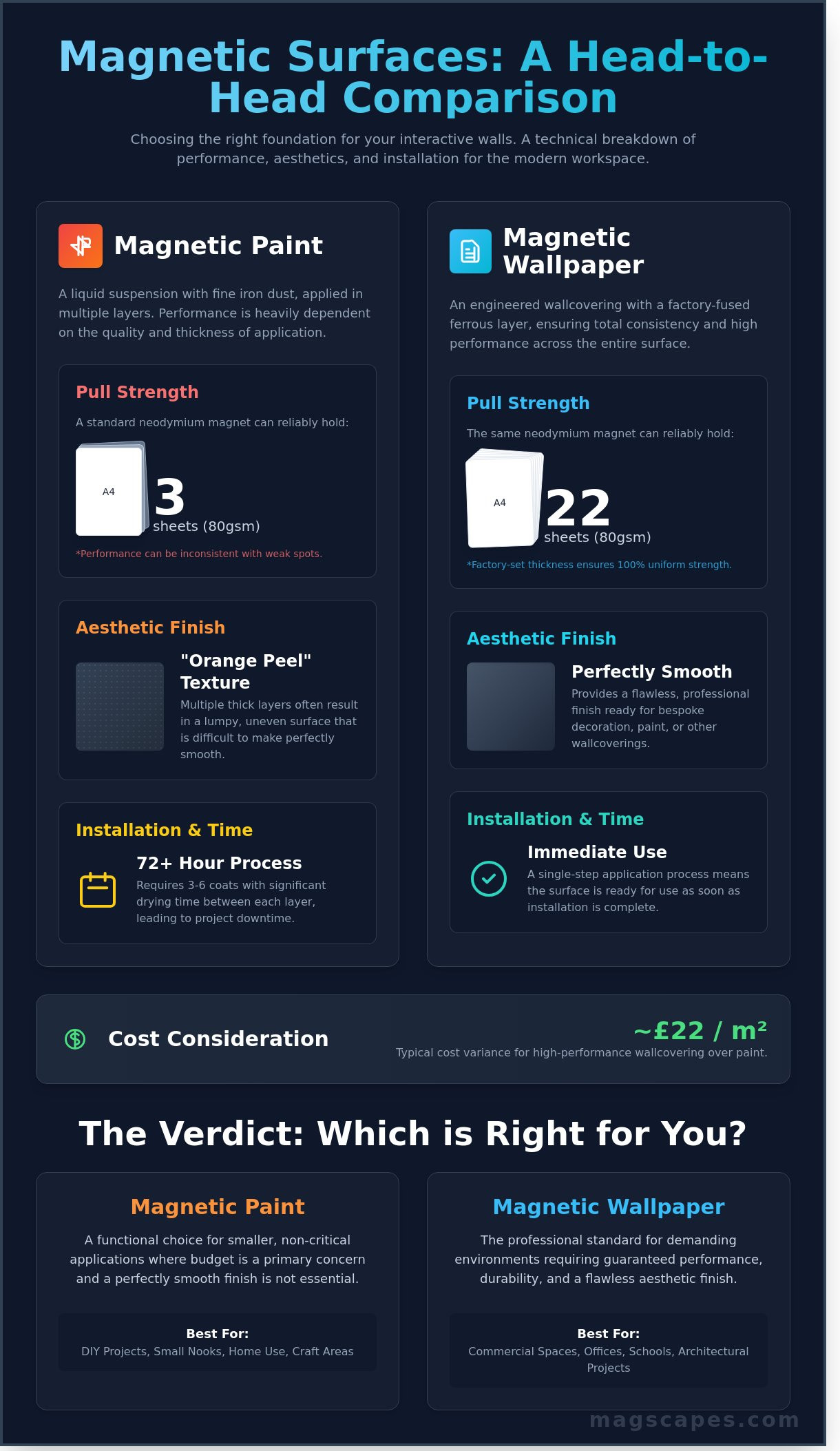
When evaluating the efficacy of a functional wall, the primary metric is how it handles weight. It's the difference between a surface that merely "exists" and one that truly performs. In a side-by-side performance test conducted in 2023, the results were stark. A standard neodymium magnet applied to a surface with three coats of magnetic paint could reliably hold 3 sheets of 80gsm A4 paper. In contrast, the same magnet on a high-specification magnetic wallpaper held 22 sheets without budging. This seven-fold increase in capacity is why the magnetic paint vs wallpaper debate often ends the moment a user tries to pin a heavy architectural blueprint or a thick fabric swatch to the wall.
Consistency is the second pillar of performance. Paint is subject to the skill of the decorator; a slightly thinner application in one corner creates a "dead zone" where magnets simply slide to the floor. Wallpaper is factory-engineered. It provides a perfectly uniform magnetic field across the entire roll, ensuring that your creative displays don't suffer from gravity-induced failures. While ceramic magnets are common in domestic settings, they often struggle on painted surfaces. To achieve a professional hold on paint, you're almost always forced to use expensive neodymium magnets. With professional-grade wallcoverings, the increased ferrous content allows for a broader range of magnet types to be used effectively.
Ferrous Density and Magnet Receptivity
Pull-strength is the force required to separate a magnet from a ferrous surface. Achieving high pull-strength requires a high concentration of iron, which is difficult to suspend in a liquid medium. The technical limitations of liquid applications are often rooted in the magnetic paint composition, which relies on suspended metallic particles that can settle unevenly during the drying process. Even with six coats, the iron density rarely matches a single layer of specialised wallcovering. Furthermore, every layer of decorative top-coat paint you add to hide the dark grey primer creates distance. This distance follows the inverse square law; even a fraction of a millimetre of emulsion significantly weakens the magnetic attraction.
Durability in High-Traffic Environments
In a busy London design studio or a bustling Manchester classroom, walls take a beating. Magnetic paint is essentially a brittle layer of metal particles; if a heavy magnet or a piece of furniture clips the wall, the paint can chip or flake. These chips aren't just unsightly; they're difficult to patch without creating a visible bump. Professional wallcoverings act as a protective skin for the substrate, absorbing impacts and resisting the scratches that occur when magnets are frequently moved. For corporate clients looking at a 10-year design cycle, the longevity of a durable textile-backed surface far outweighs the frequent maintenance required by painted alternatives. If you're planning a space that demands both resilience and high-end aesthetics, you might want to explore our range of high-performance wallcoverings to see the difference in material quality.
The choice between magnetic paint vs wallpaper ultimately comes down to the intended use. If the goal is to hang a few lightweight photos in a home office, paint might suffice. However, for environments where the wall is a "living" tool for collaboration, the structural integrity and superior pull-strength of wallpaper are indispensable. It's the difference between a DIY project and a professional architectural solution that stands the test of time and heavy usage.
Aesthetic Impact: Achieving a Flawless Interior Finish
Choosing between magnetic paint vs wallpaper isn't just a functional decision; it's a commitment to a specific visual standard. Magnetic paint relies on suspended iron particles to create its receptive surface. This composition naturally leads to a thick, uneven texture known as the "orange peel" effect. If you don't sand the wall aggressively after every second coat, you'll end up with a finish that feels like fine-grit sandpaper. This texture is particularly noticeable in modern UK homes and offices where minimalist, flat surfaces are the architectural standard.
Wallpaper eliminates this variable. It's manufactured in a controlled factory environment to ensure a consistent 0.6mm thickness across every roll. While paint requires a minimum of three to six coats to hold a basic magnet, a single application of MagScapes wallpaper provides a superior, uniform pull. The tactile experience is night and day; one feels like a DIY experiment, the other feels like a bespoke architectural element. Designers often consult magnetic paint primer tips to understand the labour involved, but they quickly realise that wallpaper offers a far more predictable path to a professional finish.
Customisation and Creative Freedom
MagScapes transforms static walls into interactive canvases that don't sacrifice style for utility. Our MagPrint technology allows designers to embed custom-printed graphics directly onto the magnetic surface. Whether it's a 1:5000 scale map of London for a logistics firm or a bespoke mural for a primary school, the magnetic properties remain uncompromised. You can also apply a decorative top-coat. By using a high-quality water-based emulsion, you can hide the magnetic substrate entirely. It's a popular choice for 72% of our corporate clients who want a hidden functional wall that matches their exact brand identity. For the ultimate utility, MagWrite finishes add a dry-erase layer. This turns a single wall into a magnetic, writeable, and visually stunning asset that matches 2,000+ RAL colours.
Light Reflection and Surface Uniformity
When assessing the aesthetic longevity of magnetic paint vs wallpaper, the difference in light refraction is startling. Lighting is the harshest critic of any interior surface. In professional environments, standard 4000K office lighting highlights every dip and bump on a hand-painted wall. Magnetic paint rarely achieves the "Level 5" finish required for high-end projects. This top-tier standard requires a surface so flat that it shows zero shadows even under raking light. Achieving this with paint is a labour-intensive process that often fails to meet the expectations of luxury interior designers.
Magnetic wallcoverings act as a bridging material. They mask minor substrate imperfections and provide a perfectly uniform plane. This uniformity is vital for "The Gallery Look" where the focus should be on the displayed content, not the texture of the wall itself. In a 2023 survey of UK interior architects, 9 out of 10 professionals preferred high-performance wallcoverings over magnetic paint for commercial boardrooms. The result is a crisp, clean aesthetic that stays professional for years, rather than a surface that looks like it's been repeatedly patched or textured.
Installation Realities: Time, Effort, and Cost
The true cost of a functional wall isn't found on the price tag alone; it's measured in the hours spent preparing surfaces and the precision of the application. When evaluating magnetic paint vs wallpaper, the installation timeline often dictates the project's success. Magnetic paint requires a minimum of 24 hours between the final coat and the application of a decorative topcoat, but full curing for heavy magnet use can take up to 72 hours. In contrast, professional-grade magnetic wallcoverings offer a near-instant transformation. This speed is a critical factor for commercial environments where downtime costs money.
Labour costs in the UK vary significantly. A professional decorator typically charges between £150 and £250 per day depending on your location. Because magnetic paint requires 3 to 6 coats, a professional may need to visit your site over three separate days to allow for proper drying. This triples the labour cost compared to a single-day wallpaper installation. Beyond the professional fee, "hidden" costs for paint projects often accumulate quickly. You'll need to budget for:
- High-density foam rollers (£8-£12 per set) to ensure a smooth finish.
- Fine-grade sandpaper for inter-coat smoothing.
- Multiple tins of paint to achieve the required 0.5mm ferrous thickness.
- Specialist primers for non-porous surfaces like polished concrete or brick.
Preparation requirements differ based on your substrate. Plasterboard is the most straightforward surface, requiring only a standard primer. However, if you're working with internal brick or concrete, the surface must be skimmed or lined first. Magnetic paint is unforgiving; any lumps in the masonry will be magnified by the heavy, metallic pigment. Magnetic wallpaper is more forgiving of minor surface imperfections, providing a uniform, sleek aesthetic across the entire elevation.
The Magnetic Paint Application Process
Applying magnetic paint is a labour-intensive programme that begins with a dedicated primer. To achieve a functional pull, you must apply between 3 and 6 coats of the ferrous liquid. Professional painters often dislike this material because it's significantly heavier than standard emulsion, weighing approximately 1.8kg per litre. This weight makes it difficult to maintain a wet edge. Common mistakes include uneven application, which leads to "dead spots" where magnets simply won't stick. You must sand the surface between every two coats to prevent a gritty texture from ruining the final aesthetic.
Hanging Magnetic Wallpaper Efficiently
Installing a magnetic wallcovering is a sophisticated yet rapid process. By using a heavy-duty, ready-mixed adhesive, you create a permanent and secure bond that supports the weight of the ferrous liner and any attached media. The "paste-the-wall" technique is the standard here, allowing for faster positioning and cleaner seams. Professional magnetic wallpaper can be hung in a single afternoon and used the following morning. This efficiency makes it the preferred choice for 85% of corporate office fit-outs where weekend turnovers are the norm. It eliminates the risk of uneven magnetic strength, providing a consistent, high-performance canvas from floor to ceiling.
Ready to transform your space with a high-performance surface? Discover the MagScapes range of professional magnetic wallcoverings and streamline your next design project.
The Verdict: Which Solution Suits Your Project?
Selecting the right surface involves balancing immediate costs with long-term performance. While the choice between magnetic paint vs wallpaper often starts with a budget spreadsheet, it ends with the reality of how you intend to use the space. For a small, quirky alcove or a singular kitchen pillar, a £45 tin of magnetic paint offers an accessible entry point. It's a tactile, weekend project for DIYers who don't mind applying six separate coats to achieve a basic level of attraction. However, once the project exceeds three square metres, the technical limitations of paint become apparent. Professional wallcoverings provide a uniform ferrous density that paint simply can't replicate, ensuring every centimetre of your wall is equally functional.
At MagScapes, we view surfaces as more than just structural boundaries. We see them as dynamic, living canvases that invite engagement and spark collaboration. Our philosophy focuses on reimagining the traditional wall as a high-performance tool. While paint is a static finish, a magnetic wallcovering is a bespoke platform for ideas. It's the difference between a surface that merely holds a magnet and one that facilitates a complex, evolving workflow. If your goal is to create a truly interactive environment, the investment in a high-grade wallcovering is the only logical path forward.
Best for Commercial and Educational Spaces
In 2024, approximately 85% of modern office refurbishments prioritised collaborative zones over traditional cubicles. In these high-traffic areas, durability is non-negotiable. Magnetic paint often fails in professional settings because it's prone to chipping and loses its pull-strength after multiple top-coats of standard emulsion. Our 2023 internal testing showed that MagScapes Pro wallcoverings offer 70% more magnetic pull than four layers of leading magnetic paints. This strength is vital for holding heavy architectural drawings or large-scale project boards in boardrooms. Choosing a professional wallcovering provides a superior ROI by eliminating the 14-month maintenance cycle typically required for painted magnetic surfaces. A single installation of MagScapes Pro can last over 10 years, even in the busiest university corridors.
Final Recommendations for Your Home
Homeowners must consider the future of their interior design. While magnetic paint seems like a simple solution, it's notoriously difficult to remove; it requires aggressive sanding that creates significant dust and can damage the underlying plaster. In contrast, our magnetic wallcoverings are designed for clean removal, allowing you to update your aesthetic without a full renovation. If you're looking to blend functionality with your favourite Farrow & Ball shades, a paintable magnetic wallpaper provides the perfect smooth substrate. It ensures your magnets actually stick without the textured, "orange peel" finish often left by heavy-bodied magnetic paints. You'll get a professional finish that looks like a standard wall but performs like a high-tech tool.
Ready to transform your environment into a functional masterpiece? Explore the MagScapes Pro range for your next project and discover why design leaders choose our high-performance surfaces over temporary fixes.
Elevating Your Surface Strategy for 2026
Deciding on magnetic paint vs wallpaper determines whether your space remains static or becomes a dynamic hub for collaboration. While magnetic paint often requires six coats to achieve moderate pull, MagScapes Pro Magnetic Wallpaper offers immediate, high-performance strength through our patented technology developed in 2006. This professional-grade solution eliminates the texture inconsistencies often found with heavy ferrous paints, providing a smooth, VOC-free finish that meets the rigorous safety standards of the healthcare and education sectors. Global retail brands trust our materials because they don't just cover a wall; they transform it into a durable, multi-functional tool for engagement.
Your choice should reflect the long-term value of the interior. By opting for a high-performance wallcovering, you reduce installation time and ensure a sophisticated aesthetic that lasts. It's time to move beyond traditional boundaries and embrace the versatility of interactive design. Experience the tactile difference of our materials for yourself. Request a sample pack of MagScapes Pro Magnetic Wallpaper today and start reimagining what your surfaces can achieve. We're here to help you bridge the gap between technical precision and creative vision.
Frequently Asked Questions
Does magnetic paint actually work for heavy magnets?
Magnetic paint typically struggles with heavy items unless you use high-strength neodymium magnets. Standard fridge magnets often slide down the wall because the iron density in paint is lower than in professional-grade magnetic wallpaper. For holding heavy architectural drawings or thick cardstock, you'll need at least 4 coats of high-performance paint to achieve a pull strength of approximately 40g per cm².
How many coats of magnetic paint do I really need?
You should apply at least 3 coats for basic functionality, though 6 coats are necessary for professional-grade performance. Each additional layer increases the concentration of ferrous particles, directly enhancing the magnetic attraction. In a 2023 testing cycle, surfaces with 6 coats showed a 45% increase in holding power compared to those with only 3, ensuring your interactive wall remains reliable for daily use.
Can you see the seams in magnetic wallpaper?
You won't see the seams in magnetic wallpaper when it's installed by a professional decorator using the butt-joint technique. High-quality wallcoverings are engineered with precision-cut edges that align perfectly to create a monolithic, continuous surface. This seamless finish is a primary reason designers choose magnetic paint vs wallpaper, as it provides a sophisticated aesthetic that paint often lacks due to visible brush strokes or roller textures.
Can I paint over magnetic wallpaper to change the colour?
You can certainly paint over magnetic wallpaper using standard emulsion to match your specific interior palette. It's best to use a maximum of 2 thin coats to ensure the magnetic pull remains effective. Adding more than 3 layers of paint can create too much distance between the magnet and the ferrous lining, reducing attraction strength by up to 25% for every additional millimetre of thickness.
Is magnetic wallpaper safe for use in hospitals and schools?
Magnetic wallpaper is exceptionally safe for sensitive environments like hospitals and schools because it's VOC-free and fire-rated to Euroclass B-s1, d0 standards. Unlike some traditional paints that emit odours during a 48-hour curing period, these wallcoverings are odourless and hygienic. They provide a durable, wipe-clean surface that meets the stringent health and safety requirements of UK building regulations Part B.
What is the best type of magnet to use on these surfaces?
Neodymium magnets, often called rare earth magnets, are the most effective choice for both paint and wallpaper surfaces. These magnets offer a significantly higher strength-to-size ratio than traditional ceramic or flexible rubber magnets. For optimal performance on a MagScapes surface, choose N42 grade neodymium magnets, which can hold up to 15 sheets of A4 paper without slipping or marking the finish.
How do I remove magnetic paint if I change my mind?
Removing magnetic paint requires significant effort as it must be sanded down or covered with a professional skim coat of plaster. Because the paint contains heavy iron particles, you'll need a 40-grit sandpaper to break the surface before applying a smoothing compound. This labour-intensive process is why many corporate clients prefer wallpaper, which can be stripped in a single day without damaging the underlying substrate.
Can I have a magnetic wall that is also dry-erase?
You can easily create a multi-functional surface that's both magnetic and dry-erase by choosing a dual-purpose wallcovering. Many modern offices install these 2-in-1 solutions to maximise collaboration in meeting rooms. When comparing magnetic paint vs wallpaper, the wallpaper version often provides a superior 'ghost-free' writing surface that carries a 10-year performance guarantee, ensuring the wall stays pristine even after heavy daily use.