


Table of Contents
- What Are Magnetic Wall Solutions for Professionals?
- Magnetic Paint vs. Magnetic Plaster vs. Magnetic Wallcovering: A Professional Comparison
- Load-Bearing Capacity and Magnetic Strength: What You Need to Know
- Installation Guide: Creating a Magnetic Whiteboard Wall UK
- Magnetic Display Systems UK: Applications for Offices and Workspaces
- Maintenance, Cleaning, and Long-Term Durability
- Flexible Workspace Design UK: Integrating Magnetic Walls Into Modern Offices
- Cost Analysis: Pricing and ROI for Magnetic Wall Solutions
Last Updated: July 23, 2026
What Are Magnetic Wall Solutions for Professionals?
Magnetic wall solutions transform ordinary office walls into dynamic, interactive surfaces using ferrous particles, tiny iron-based materials embedded in specialized coatings or wallcoverings, to create magnet-receptive surfaces that support project boards, visual management systems, display graphics, and modular shelving. At MagScapes, we've engineered premium magnetic wallcoverings that allow professionals to reimagine their workspace as a collaborative tool rather than a static boundary.
An entire wall becomes a working surface where teams reorganize projects in real time, pin documentation, track progress visually, and adapt their environment as priorities shift. Unlike traditional alternatives, these systems integrate seamlessly into interior design, maintain magnetic strength over years of use, and work in healthcare, education, corporate, and industrial settings without interfering with sensitive equipment.
According to architectural design trends from the British Institute of Facilities Management, workspace flexibility and visual communication have become critical competitive advantages for organizations managing distributed or hybrid teams.
How Ferrous Particles Create Magnet-Receptive Surfaces
Ferrous particles in magnetic coatings function as tiny electromagnets. When you apply a permanent magnet to the surface, iron particles align with the magnetic field, creating a pull force that holds the magnet in place. Magnetic strength depends on particle density, particle size uniformity, and the binding medium that suspends them.
MagScapes ferrous wallcoverings contain high concentrations of magnetite particles, a naturally occurring iron oxide, suspended in a durable polymer matrix, delivering consistent pull-force across the entire surface. The ferrous particles are non-toxic and environmentally inert, don't emit electromagnetic radiation, don't interfere with Wi-Fi or medical equipment, and remain stable indefinitely, a critical distinction for healthcare facilities and offices with sensitive electronics.
Why Professionals Choose Magnetic Walls Over Traditional Alternatives
Traditional display systems occupy floor or wall space and serve only single purposes. Magnetic walls adapt: use them for project tracking one month and brainstorming sketches the next. The surface doesn't degrade, magnets never lose strength, and because the magnetic layer sits beneath your chosen finish, aesthetic integration is seamless. A single magnetic wall eliminates the need for three separate display systems, delivering significant capital savings over five years, particularly for organizations managing multiple locations.
Magnetic Paint vs. Magnetic Plaster vs. Magnetic Wallcovering: A Professional Comparison
Each magnetic solution type has distinct advantages and constraints.
Magnetic Paint: Application, Performance, and Durability
Magnetic paint is a water-based coating enriched with iron powder applied with a roller or sprayer. Professional-grade magnetic paint requires a minimum of three coats to achieve reliable magnetic strength, with each coat covering approximately 10 square metres.
Walls must be clean, smooth, and primed with a ferrous-rich primer. Any dust, grease, or imperfect preparation compromises adhesion and performance. Magnetic paint holds lightweight items reliably, notecards, printed documents, small metal signs. For heavier loads, modular shelving, or large display panels, it underperforms. Durability depends on topcoat finish; standard emulsion isn't washable and scuffs easily in high-traffic areas. Magnetic paint is cost-effective for small projects but impractical for large wall areas or demanding applications.
| Solution Type | Application Coats | Drying Time | Load Capacity | Best For |
|---|---|---|---|---|
| Magnetic Paint | 3+ coats | 7-10 days | Lightweight items | Budget-conscious, small areas |
| Magnetic Plaster | 1-2 coats | 3-5 days | Medium loads | Seamless integrated finish |
| Magnetic Wallcovering | Single application | 1 day | Heavy loads | Professional, high-traffic spaces |
Magnetic Plaster UK: Integrated Solutions for Seamless Finishes
Magnetic plaster is a specialist finishing compound that creates a smooth, durable surface with integrated magnetic properties. Applied in fewer coats than paint, it cures to a harder, more resilient finish. Once cured and decorated, the magnetic layer is invisible, no visible coating, no texture.
Installation requires skilled application, proper humidity control during curing, and careful decoration afterward. Repairs are more involved than repainting, and material and labour costs are higher. Magnetic plaster works best for permanent installations in controlled environments, boardrooms, healthcare facilities, educational spaces, not rental properties or spaces requiring frequent reconfiguration.
Magnetic Wallcovering: Premium Performance and Design Flexibility
Magnetic wallcovering is a ferrous-impregnated textile or vinyl applied like conventional wallpaper. The ferrous layer bonds to a decorative surface that can be matte, gloss, textured, or custom-printed with graphics.
This approach combines the best attributes of paint and plaster: faster installation than paint (single application, no multi-coat waiting), superior durability, and exceptional design flexibility. MagScapes wallcoverings deliver up to 45% more magnet retention than standard magnetic paint, making them suitable for heavy-duty applications, modular shelving, large display systems, and sustained collaborative use. The surface finish is highly durable and washable, resisting scuffing and staining. Once installed, the wallcovering is maintenance-free and lasts indefinitely.
Load-Bearing Capacity and Magnetic Strength: What You Need to Know
Load-bearing capacity is where magnetic solutions diverge most significantly. Magnetic strength is measured in pull-force, the weight a magnet can hold before slipping. A standard neodymium magnet has a pull-force of 2-5 kilograms depending on size and grade.
MagScapes ferrous wallcoverings achieve pull-force retention of approximately 3.5-4.2 kilograms per standard neodymium magnet. Multiple magnets distribute the load: two magnets hold 8kg, four magnets hold 16kg. Magnetic paint typically achieves 1.5-2.5kg pull-force per magnet, while magnetic plaster falls in the middle range at 2.5-3.5kg.
A common mistake is underestimating cumulative weight. A wall covered in 20 notecards, three shelf brackets, and a printed project tracker may total 8-12kg. If your magnetic surface only provides 1.5kg per magnet, you'll need 6-8 magnets distributed across the wall. For professional installations, always calculate maximum intended load, then choose a magnetic solution that provides 30% safety margin above that load.
Installation Guide: Creating a Magnetic Whiteboard Wall UK
Creating a functional magnetic wall requires careful preparation and attention to detail.
Surface Preparation and Primer Application
The most common installation failure is inadequate surface preparation. Dust, grease, loose paint, wallpaper residue, or uneven surfaces all compromise adhesion and performance.
Remove existing wallpaper completely. If painted, the existing paint must be sound with no peeling or flaking. Clean the wall thoroughly with a damp cloth to remove dust and grease. Fill any holes, cracks, or uneven areas with filler, then sand smooth once cured.
For magnetic paint or plaster applications, apply a ferrous primer that seals the substrate and provides an initial magnetic layer. For magnetic wallcovering, the wall must be smooth, clean, and sized with standard wallpaper primer. This sizing seals the wall and provides correct adhesion levels.
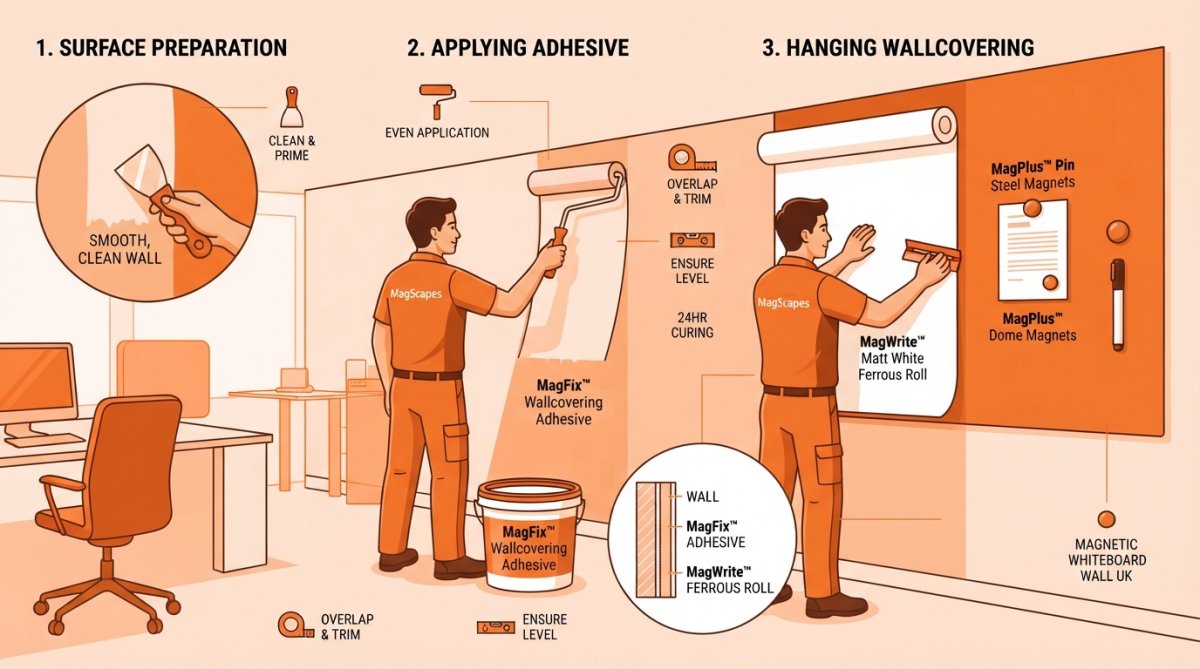
Installation Methods for Different Magnetic Products
Magnetic Paint Installation: Apply the first coat with a roller in 1-meter sections, maintaining a wet edge to avoid lap marks. Allow 24 hours drying time, then lightly sand with fine-grit sandpaper (220+) to improve adhesion for the second coat. Apply the second and third coats following the same method. Allow 7 days full cure before hanging magnets.
Magnetic Plaster Installation: Magnetic plaster is typically applied by specialist plasterers. The substrate is dampened, plaster is applied in a single coat using a trowel, then smoothed and finished. Curing time depends on humidity and temperature, typically 3-5 days. This is not a DIY-friendly process; budget for professional labour.
Magnetic Wallcovering Installation: Wallcovering is applied like conventional wallpaper but requires precision because wrinkles or bubbles compromise magnetic performance. The wall is sized, the wallcovering is cut to length, adhesive is applied, and the covering is hung in vertical strips, smoothing out air bubbles as you work. Professional installation is strongly recommended and takes 1-2 days for a typical office wall.
Common Installation Mistakes to Avoid
Inadequate Surface Preparation: Skipping surface preparation prevents adhesion. Always invest time in thorough preparation.
Insufficient Coats of Paint: Applying only one or two coats of magnetic paint results in weak performance. Commit to three full coats with proper drying time between each.
Ignoring Environmental Conditions: Humidity, temperature, and air circulation affect curing times and adhesion. Plan installations during appropriate seasons or control the environment during application.
Topcoating Too Soon: Wait for primer to cure fully before topcoating. Applying topcoat too soon traps moisture and compromises adhesion.
Magnetic Display Systems UK: Applications for Offices and Workspaces
Magnetic walls excel in environments where visual communication, rapid reorganization, and team coordination are priorities.
Project Tracking and Team Coordination
Many professionals use magnetic walls as dynamic project management boards. Teams use colour-coded magnets and printed documents arranged on the magnetic surface. Physical manipulation of cards engages different parts of the brain than digital tools, and the shared visual reference point keeps all team members synchronized.
A common setup uses columns representing project phases (To Do, In Progress, Review, Complete) with cards representing individual tasks. Team members move cards across the wall as work progresses. Status updates happen in real time without meetings or email chains. Standard magnetic paint or plaster is sufficient, though magnetic wallcovering's higher durability prevents surface wear from frequent magnet placement and removal.
Brainstorming Spaces and Collaborative Environments
Brainstorming sessions benefit from magnetic walls. Teams sketch ideas on notecards, pin them to the wall, cluster related ideas, and iterate visually. The magnetic surface eliminates tape, which damages paint and leaves residue. Any magnetic solution works for this lightweight application.
Visual Management and Communication Graphics
Healthcare facilities, manufacturing plants, and logistics centres use magnetic walls for visual management, displaying key metrics, safety information, shift schedules, and operational status in real time. These installations demand high durability and reliability. Magnetic wallcovering is ideal here because it's durable, washable (important in healthcare), and can be custom-printed with facility-specific graphics and logos.
Maintenance, Cleaning, and Long-Term Durability
Magnetic wall solutions require minimal maintenance, but understanding proper care protocols extends their lifespan and preserves aesthetic quality.
Cleaning Protocols for Different Surface Finishes
Matte Finishes: Clean with a soft, dry cloth or slightly damp microfibre cloth. Avoid abrasive cleaners or scouring pads.
Gloss and Semi-Gloss Finishes: Use a damp microfibre cloth for routine cleaning. Gloss finishes are particularly suitable for high-traffic areas and healthcare environments because they're washable and resist staining.
Chalkboard and Magnetic Chalkboard Finishes: Use only chalk or chalk markers. Clean with a soft brush or damp cloth after use. Avoid abrasive erasers, which scratch the surface.
Printed or Custom Wallcoverings: Clean gently with a soft, dry cloth. Avoid excessive moisture, which can seep into seams and compromise adhesion.
In all cases, avoid harsh chemicals, abrasive tools, and excessive moisture.
Preserving Magnetic Strength Over Time
Magnetic strength in ferrous wallcoverings and coatings is permanent; iron particles don't degrade, lose charge, or weaken over time. However, several factors can compromise perceived magnetic performance:
Magnet Degradation: The magnets you place on the wall, not the wall itself, may lose strength if exposed to heat, humidity, or physical damage. If magnets seem to weaken, they've likely been damaged; replace them rather than assuming the wall is at fault.
Surface Buildup: Dust, dirt, or paint residue can create a thin barrier between the magnet and ferrous particles, reducing contact and apparent pull-force. Regular cleaning prevents this.
Physical Damage: If the magnetic wallcovering or painted surface is gouged, cracked, or punctured, ferrous particles in that area may be damaged, compromising local magnetic strength. Minor damage is cosmetic; significant damage may require localized repair or replacement.
In properly maintained installations, magnetic performance remains consistent indefinitely.
Flexible Workspace Design UK: Integrating Magnetic Walls Into Modern Offices
Modern office design prioritizes adaptability. Magnetic walls are a strategic component of flexible workspace design because they enable rapid reconfiguration without structural changes or capital reinvestment.
Modular Wall Systems and Removable Panels
Some organizations use magnetic wallcovering in combination with modular wall systems, movable partitions that divide open-plan spaces. A modular wall with a magnetic surface becomes a dual-purpose element: it divides space and functions as a collaborative tool.
Removable magnetic panels are another approach. Rather than covering an entire wall, panels (typically 1-2 meters wide) are mounted on existing walls. For rental offices or temporary installations, removable panels are ideal because they don't require permanent surface modification. MagScapes offers ferrous wallcoverings designed for both permanent installation and removable panel applications.
Integration With Digital Tools and Acoustic Properties
A sophisticated approach combines magnetic walls with digital tools. A wall displays physical project cards, notes, and sketches, while a camera captures the layout. Software then digitizes the information, syncing it with project management platforms, Slack, or email. This hybrid approach maintains the cognitive benefits of physical manipulation while ensuring information flows into digital workflows.
Research from the British Institute of Facilities Management on open-plan office design indicates that visual communication systems reduce meeting frequency by 15-20%, suggesting magnetic walls may have indirect acoustic benefits by reducing the need for in-person meetings.
Cost Analysis: Pricing and ROI for Magnetic Wall Solutions
Cost analysis requires comparing material costs, installation labour, and long-term value.
Magnetic Paint: Material cost is approximately £99.99 for a 5-litre tin covering 10 square metres with three coats. For a typical 20-square-metre office wall, total material cost: £250-350. Labour adds £300-800. Total installed cost: £550-1,150 for 20 square metres, or £27-57 per square metre.
Magnetic Plaster: Material cost is approximately £104.78 per 25kg bag, covering 15-20 square metres. For 20 square metres, budget two bags (£210) plus topcoat. Professional installation labour is £400-800. Total installed cost: £610-1,010 for 20 square metres, or £30-50 per square metre.
Magnetic Wallcovering (MagScapes): MagScapes ferrous wallcoverings include MagLiner™ (£66.64 per roll), MagWrite™ (£248.00 per roll), MagPaintable™ (£216.00 per roll), and MagChalk™ (£322.56 per roll). Each roll covers approximately 5-6 square metres. For 20 square metres, budget 4 rolls (£800-1,290 depending on finish) plus professional installation labour (£400-600). Total installed cost: £1,200-1,890 for 20 square metres, or £60-95 per square metre.
The upfront cost of magnetic wallcovering is higher than paint or plaster. However, the long-term value proposition is compelling: superior durability, no repainting required, and flexibility to change finishes or remove and reinstall the wallcovering in future office reconfigurations.
ROI Calculation: Consider a 15-person design firm in a rental office. They currently use three large whiteboards (£800 total), a pinboard (£200), and a shelving unit (£600). Total display system cost: £1,600. Over five years, they'll replace whiteboards (£400), repair shelving (£200), and potentially reconfigure the office (£500). Total five-year cost: £2,700.
Installing a 30-square-metre magnetic wall (MagScapes wallcovering) costs approximately £1,800-2,850 installed. No replacement costs. When the firm moves offices, the wallcovering can be carefully removed and reinstalled. Five-year cost: £1,800-2,850. The magnetic wall saves £850-900 over five years while providing superior functionality, flexibility, and aesthetic integration.
Magnetic wall solutions for professionals represent a shift in how organizations think about workspace design. Rather than treating walls as static boundaries, they become active tools for collaboration, communication, and coordination. The choice between magnetic paint, plaster, and wallcovering depends on your budget, timeline, and performance requirements. For most professional applications, particularly those demanding durability, design flexibility, and sustained use, magnetic wallcovering delivers the best long-term value. MagScapes' ferrous wallcoverings provide superior load-bearing capacity, exceptional durability, and seamless aesthetic integration, making them the top choice for organizations serious about creating truly adaptive, high-performance workspaces.
Frequently Asked Questions
What is the difference between magnetic paint, magnetic plaster, and magnetic wallcovering?
Magnetic paint contains ferrous particles and requires multiple coats (typically 3+) to achieve adequate magnetic strength; it's budget-friendly but time-consuming. Magnetic plaster UK offers integrated magnetism in a single application with superior strength, ideal for seamless finishes. Magnetic wallcovering, such as MagScapes ferrous rolls, delivers the highest performance with patented technology, providing up to 45% more magnet retention and professional-grade durability. Choose based on your budget, timeline, and desired surface finish.
How do magnetic wall solutions for professionals improve office collaboration and workspace efficiency?
Magnetic wall solutions transform static surfaces into interactive collaboration tools. They enable visual management systems for project tracking, support brainstorming spaces with removable magnetic panels, and facilitate team coordination through dynamic communication graphics. Unlike traditional whiteboards or pinboards, magnetic walls integrate seamlessly into your office architecture, reduce clutter, and allow for modular customization. This creates high-performance environments where teams can adapt their workspace in real-time without permanent installations.
Will magnetic walls interfere with Wi-Fi routers, medical equipment, or sensitive electronics?
No. Magnetic wall solutions do not emit electromagnetic fields or radio frequencies, they simply create a ferrous-receptive surface that holds magnets through passive magnetic attraction. Unlike active magnetic devices, they pose no interference risk to Wi-Fi routers, medical equipment, or sensitive electronics. MagScapes products are tested and certified for healthcare environments, making them suitable for hospitals, clinics, and offices with sensitive equipment. The magnetic field is extremely localised and only activates when magnets are in direct contact.
What is the load-bearing capacity of magnetic walls, and how much weight can they hold?
Load-bearing capacity depends on the product type and magnetic strength. Premium magnetic wallcoverings like MagScapes ferrous products offer superior pull-force, capable of holding heavier items and supporting modular shelving systems. Standard magnetic paint typically holds lighter objects (under 2kg per magnet), whilst professional-grade wallcoverings can support significantly more. Surface finish quality, magnet type (neodymium vs. standard), and installation method all affect capacity. For heavy-duty applications, consult product specifications or contact manufacturers for load-testing data.
Can magnetic wallcovering be installed in rental offices, or does it require permanent installation?
Magnetic wallcovering can be installed temporarily or permanently depending on the product and method. Some options use adhesive backing suitable for rental spaces without damaging walls upon removal, whilst others require professional installation. MagScapes products offer flexible installation options, check specific product documentation for rental-compatible methods. Always confirm with your landlord before installation. For rental spaces, prioritise products with removable adhesive systems or consider temporary magnetic panels that mount without wall damage.
How do you maintain and clean magnetic walls to preserve their durability and magnetic strength?
Maintenance depends on surface finish. Gloss and matte finishes require gentle cleaning with microfibre cloths and mild, non-abrasive cleaners to avoid scratching. For magnetic paint or plaster surfaces, avoid harsh chemicals that may degrade the finish. Regular dusting prevents particle buildup. Magnetic strength itself does not diminish with normal use or cleaning, ferrous particles remain stable. However, avoid excessive moisture and ensure proper ventilation. For high-traffic areas, protective coatings or regular inspection help extend lifespan and maintain aesthetic appeal.
What are the typical costs for magnetic wall solutions, and how do they compare to traditional whiteboards or pinboards?
Costs vary significantly by product type. Magnetic paint starts around £99.99 for 5L (covering 10m² with 3 coats). Magnetic plaster UK ranges from approximately £104.78 per 25kg bag. Premium magnetic wallcovering like MagScapes ferrous rolls (MagLiner, MagWrite, MagPaintable, MagChalk) range from £66.64 to £322.56 per roll. Whilst initial investment exceeds single whiteboards, magnetic walls offer long-term ROI through durability, multi-functionality, and reduced replacement costs. They eliminate recurring whiteboard purchases and provide superior workspace flexibility compared to static pinboards or fixed displays.
This article was written using GrandRanker