


Table of Contents
- Magnetic Wallcovering vs Traditional Whiteboard: Key Differences at a Glance
- How to Install Magnetic Whiteboard Wallpaper
- Durability and Long-Term Performance
- Cost of Magnetic Wallcovering vs Whiteboard: True Investment Analysis
- Magnetic Whiteboard Maintenance Tips and Surface Care
- Surface Area, Productivity and Collaboration Impact
- Removal, Wall Damage and Environmental Considerations
- Which Option Works Best for Your Space?
Last Updated: August 6, 2026
Magnetic Wallcovering vs Traditional Whiteboard: Key Differences at a Glance
Magnetic wallcovering transforms your entire wall into an interactive surface, while a traditional whiteboard sits as a discrete object. The difference in durability, lifespan, and cost over time is far more significant than most people realise.
A traditional whiteboard is a framed, portable unit with a lacquered steel surface. Magnetic wallcovering is ferrous-backed material applied directly to your wall, creating a seamless, full-coverage magnetic dry-erase surface. The writing surface is identical, but installation, durability, and spatial impact differ completely.
| Aspect | Magnetic Wallcovering | Traditional Whiteboard |
|---|---|---|
| Coverage Area | Full wall or wall-to-wall | Limited to frame dimensions |
| Installation | Professional or skilled DIY | Simple wall mounting |
| Initial Cost (per m²) | £50-£70 | £40-£100 (per unit, varies by size) |
| Lifespan | 10+ years | 5-8 years |
| Ghosting Resistance | High (nano-coating) | Moderate to high |
| Magnetic Strength | 2-4 A4 sheets per m² | Varies by frame design |
| Removal Impact | Minimal wall damage | Mounting holes remain |
| Aesthetic Integration | Seamless, design-forward | Visually distinct object |
| Best For | Large collaborative spaces, classrooms, healthcare | Individual workstations, meeting rooms |
How to Install Magnetic Whiteboard Wallpaper
Wallpaper Installation Process
Installing magnetic wallcovering requires the same preparation as premium wallpaper, but the stakes are higher because you're creating a functional work surface.
Begin with wall preparation. Your wall must be clean, smooth, and dry. Sand rough patches, fill holes with filler, and prime new drywall. This takes 2-4 hours depending on wall condition.
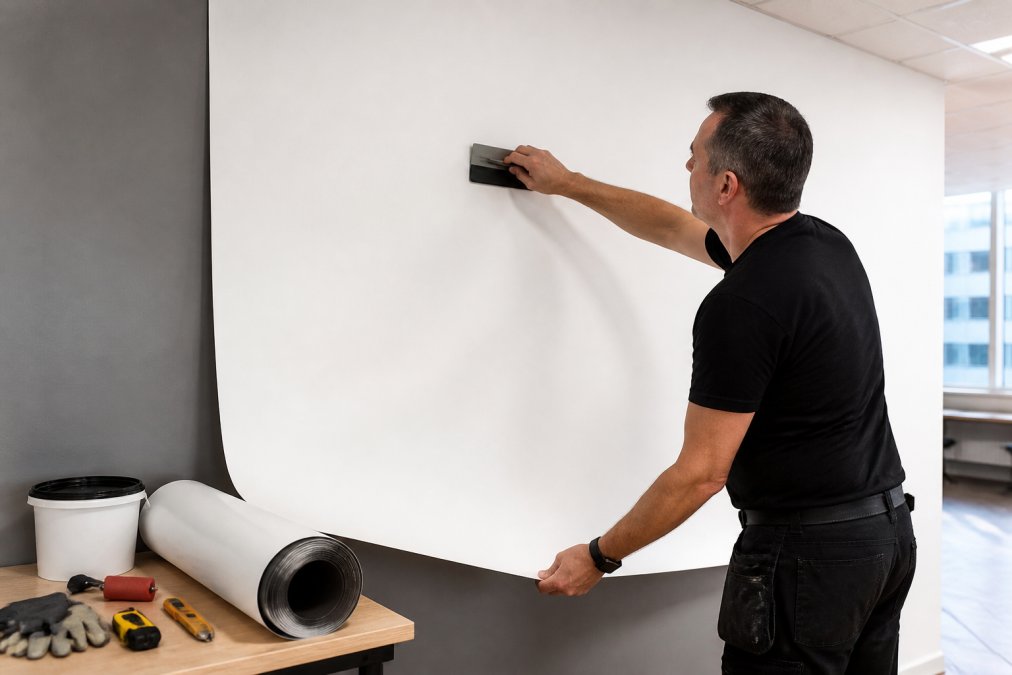
Magnetic wallcovering typically comes in rolls 120cm wide and up to 12 metres long. Measure your wall, cut the material to size, apply adhesive to the wall (not the wallcovering), and carefully position the material. Using a smoothing tool, work from the centre outward to remove air bubbles. Seams must be butted together precisely; overlapping seams create visible lines.
Installation takes 4-8 hours for a standard office wall (3-4m²), or 12-16 hours for a full-wall installation. The adhesive requires 24-48 hours curing before the surface is fully functional.
Traditional Whiteboard Mounting
Traditional whiteboard installation is substantially simpler. Locate wall studs, drill pilot holes, install brackets, and hang the whiteboard. The entire process takes 30-60 minutes. This simplicity appeals for rental spaces, but mounting holes remain visible if you remove it later.
Durability and Long-Term Performance
Ghosting Resistance and Stain Performance
Ghosting, the faint shadow left after repeated writing and erasing, is the enemy of any dry-erase surface. Quality magnetic wallcovering uses nano-coating technology that creates an exceptionally smooth, non-porous surface resisting ghosting far more effectively than traditional whiteboards. Most premium magnetic wallcoverings carry a 10-year guarantee against ghosting and staining.

Traditional whiteboards vary widely. Budget whiteboards show visible ghosting within 6-12 months of heavy use. Premium whiteboards resist ghosting better, but even the best show noticeable marks after 3-5 years of continuous use. For healthcare settings or classrooms in constant use, magnetic wallcovering's superior ghosting resistance means it remains crisp and professional-looking for a decade.
Magnetic Strength Over Time
Magnetic wallcovering's ferrous backing doesn't degrade with age. A 10-year-old installation holds magnets as reliably as a new one. Traditional whiteboards maintain consistent magnetic strength, but the frame and mounting system may loosen over years of movement in busy spaces.
Cost of Magnetic Wallcovering vs Whiteboard: True Investment Analysis
Upfront cost comparison is misleading because it ignores what happens over 10 years.
Initial Purchase and Installation Costs
For a 3m² office wall:
- Magnetic wallcovering: Material cost approximately £150-210 (at £50-70/m²). Professional installation adds £200-400. Total: £350-610.
- Traditional whiteboard (120cm × 90cm): £46-100 for the unit. DIY mounting costs virtually nothing. Total: £46-100.
For a larger space needing 12m² of writable surface, you'd need four whiteboards at £75 each (£300), plus mounting hardware. Magnetic wallcovering covering the same 12m² costs £600-840 in material, plus professional installation (£400-600). Total: £1,000-1,440. The cost gap narrows significantly when accounting for coverage area.
Long-Term Maintenance and Replacement Costs
Over 10 years:
- Magnetic wallcovering: Minimal maintenance. No replacement needed within the 10-year lifespan. Cost: £0 in replacements.
- Traditional whiteboard: Replacement every 5-8 years due to ghosting or surface degradation. Two replacement cycles in 10 years equals £100-200 in new units, plus mounting labour and ongoing marker costs (£30-50 annually). Total: £200-350 over 10 years.
For busy environments, magnetic wallcovering delivers lower total cost of ownership despite higher upfront investment.
Magnetic Whiteboard Maintenance Tips and Surface Care
Daily and Weekly Cleaning Routines
Clean your magnetic wallcovering regularly using a microfibre cloth and whiteboard-specific cleaner. Spray the cleaner on the cloth (never directly on the wall), then wipe in circular motions. Weekly, use a slightly damp microfibre cloth with 70% isopropyl alcohol, then dry immediately.
Avoid paper towels or rough cloths, which scratch the surface. Never use scouring pads, acetone, or harsh solvents; these damage the nano-coating.
Preventing Damage and Extending Lifespan
Magnetic wallcovering's biggest vulnerability is moisture. Install in dry environments and avoid spraying water directly on the surface. In healthcare settings where moisture is inevitable, ensure proper ventilation and use moisture-resistant primer during installation.
Avoid permanent markers or abrasive erasers. Don't overload the magnetic surface; distribute magnetic attachments across the surface rather than clustering them in one spot. For traditional whiteboards, ensure mounting brackets remain secure, especially in high-vibration environments.
Surface Area, Productivity and Collaboration Impact

The difference between a 1.2m² whiteboard and a 12m² magnetic wall is profound. Teams don't just write more on larger surfaces; they think differently.
A traditional whiteboard constrains collaboration. Space fills quickly, ideas compete for real estate, and erasure becomes necessary before capturing everything. Magnetic wallcovering eliminates this constraint. A full wall becomes a visual workspace where ideas accumulate, connect, and evolve. Brainstorming sessions produce richer outputs because participants aren't racing to erase sections.
In healthcare settings, larger writable surfaces mean clinicians can document patient workflows and care coordination more comprehensively. In classrooms, wall-to-wall magnetic surfaces transform passive learning environments into interactive ones.
The magnetic component adds another dimension. Teams pin photographs, diagrams, task cards, and reference materials directly to the wall, creating a three-dimensional information landscape. This is particularly valuable in Agile environments and patient care coordination where visual workflow management is essential.
Removal, Wall Damage and Environmental Considerations
Removal Without Permanent Damage
Magnetic wallcovering adheres permanently, but it's designed for removal without leaving permanent damage if done correctly. Heat the edges with a heat gun, then carefully peel back the material. Once removed, residual adhesive can be cleaned with warm water and fabric softener or adhesive remover. The wall will be ready for repainting within hours.
In rental spaces, this is a concern. If your lease prohibits permanent changes, magnetic wallcovering isn't suitable. Traditional whiteboards leave only mounting holes, a far less disruptive removal process.
Environmental Impact and Sustainability
Magnetic wallcovering's environmental profile depends on material composition. Quality products use non-toxic, low-VOC adhesives and ferrous coatings. The durability advantage translates to environmental benefit: a magnetic wallcovering lasting 10 years requires fewer replacements than traditional whiteboards replaced every 5-8 years.
However, magnetic wallcovering isn't infinitely recyclable. At end-of-life, the composite material isn't easily separated. Traditional whiteboards, being primarily steel, are more readily recyclable. For organisations prioritising sustainability, the calculation is: fewer replacements over time (environmental win) versus end-of-life recyclability (environmental loss). The net benefit typically favours magnetic wallcovering.
Which Option Works Best for Your Space?
Choose magnetic wallcovering if:
- You need to cover more than 3m² of wall space
- Your facility will remain in the same location for 5+ years
- You want a seamless, design-integrated collaborative surface
- Daily usage is heavy (classrooms, busy offices, healthcare environments)
- You value long-term cost efficiency over upfront savings
- Your wall can accommodate permanent installation
Choose traditional whiteboards if:
- You need discrete, portable writing surfaces
- You're in a rental space with restrictions on permanent modifications
- Your space will change frequently
- You have limited wall space (under 3m² of required coverage)
- Upfront cost is the primary constraint
For most modern collaborative environments, magnetic wallcovering represents the better long-term investment. The upfront cost is higher, but durability, maintenance simplicity, and expanded collaborative capacity justify the investment over 5-10 years.
MagScapes' magnetic wallcoverings offer premium durability and design flexibility. Our MagWrite™ range comes in gloss and matt finishes, with proven nano-coating technology that resists ghosting and staining for a decade. For spaces requiring flexibility, our MagPivot™ and MagCaddy™ freestanding magnetic whiteboards on wheels combine magnetic functionality with portability.

The real decision isn't between two similar products, it's between a static tool and a dynamic environment. Magnetic wallcovering transforms how teams think and collaborate. For facilities seeking to future-proof their spaces, magnetic interior design solutions represent the sophisticated, adaptable choice.
For healthcare settings, NHS guidance on clinical workspace design emphasises visual communication tools that support care coordination and patient safety. Magnetic wallcovering aligns with these principles by providing seamless, durable surfaces that facilitate the visual workflows modern healthcare demands.
Educational institutions considering collaborative learning environments should review Ofsted research on effective classroom design, which highlights the importance of flexible, interactive surfaces in supporting diverse learning modalities. Magnetic wallcovering delivers that flexibility at scale.
Frequently Asked Questions
What's the main difference between magnetic wallcovering and a traditional whiteboard?
Magnetic wallcovering transforms entire walls into writable, magnet-receptive surfaces using ferrous or nano-coating technology, offering seamless coverage and flexibility. Traditional whiteboards are framed units with fixed dimensions and locations. Wallcovering provides wall-to-wall installation, while whiteboards occupy defined spaces. Both support dry-erase writing and magnetic attachments, but wallcovering enables larger collaboration areas and better spatial integration.
How do I install magnetic whiteboard wallpaper, and is it a DIY job?
Magnetic wallcovering installation resembles standard wallpapering: prepare the wall, apply adhesive, hang the material, and smooth out air bubbles. It requires wall preparation, primer application, and careful alignment. Most facilities teams can handle this, though professional installers ensure better results. Traditional whiteboards need only wall anchors and mounting brackets, making them simpler for DIY installation. Wallcovering demands more skill but creates superior long-term results.
Is magnetic wallcovering worth the investment compared to buying multiple whiteboards?
Magnetic wallcovering costs £216-£248 per 3.6m² roll, while a single traditional whiteboard starts at £47. Over 10 years, wallcovering offers better value: it covers more surface area, eliminates replacement cycles, and reduces clutter. Whiteboards require periodic replacement, frame maintenance, and occupy valuable floor or wall space. For offices, classrooms, and healthcare settings with high collaboration needs, wallcovering delivers superior long-term ROI through durability and enhanced functionality.
Will magnetic wallcovering interfere with Wi-Fi, medical equipment, or electronics?
Modern magnetic wallcoverings use ferrous materials that do not emit electromagnetic radiation or interfere with Wi-Fi signals, routers, or sensitive medical equipment. Unlike older magnetic paint formulations, premium wallcoverings like MagWrite™ are tested for safety in healthcare and tech-heavy environments. The magnetic field is passive and localised to the wall surface, posing no risk to devices or equipment. Healthcare facilities have successfully deployed magnetic wallcoverings without incident.
How durable is magnetic wallcovering in high-traffic classrooms or busy offices?
Quality magnetic wallcovering with nano-coating or premium finishes resists ghosting, staining, and wear for 10+ years in heavy-use environments. MagWrite™ and similar commercial-grade products withstand constant writing, erasing, and magnet attachment without degradation. Traditional whiteboards also perform well under daily use but require frame maintenance and eventual replacement. Wallcovering's non-porous surface and integrated design make it more durable in high-traffic settings than individual boards.
This article was written using GrandRanker