


Table of Contents
- Why Magnetic Wall Solutions Are Ideal for Rented Offices
- Commercial Lease Interior Alteration Rules: What Tenants Need to Know
- Renter-Friendly Office Wall Decor: Damage-Free Options That Actually Work
- Types of Magnetic Wall Solutions: Panels vs. Wallcoverings
- Magnetic Wallcovering Installation Guide: DIY vs. Professional
- Maintenance, Durability, and Acoustic Considerations
- Conclusion
- Frequently Asked Questions
Last Updated: September 16, 2026
Why Magnetic Wall Solutions Are Ideal for Rented Offices
Magnetic wall solutions are ferrous wallcoverings, panels or freestanding boards that turn an ordinary wall into a writable, magnet-receptive surface without structural work. For tenants, the appeal is not just what the wall does, but what it leaves behind when you hand the keys back.
This guide from MagScapes covers how these systems work in leased commercial space, what your lease permits, and which options survive a move intact. We break down the damage-free routes first, because that is where most tenants waste money.
The case for renting office space magnetic wall solutions rests on three practical advantages over conventional whiteboards:
- No fixings into the fabric of the building. Paste-the-wall wallcoverings and freestanding boards avoid drilling, which is the alteration most leases actually prohibit.
- Whole-wall writing area. A 120cm-wide roll covers more usable surface per pound than a framed panel of the same footprint.
- Reversible at end of term. Wallcoverings can be stripped and the wall made good; mobile boards simply leave with you.
The trade-off is preparation: walls must be sound, clean and dry, and a listed or heritage building may restrict even adhesive-based finishes. Check the building's status before you specify anything.
Commercial Lease Interior Alteration Rules: What Tenants Need to Know
Most commercial leases in England and Wales restrict alterations through a standard covenant, so anything fixed to the structure needs the landlord's written consent. The clause, not general practice, governs your fit-out, it determines whether a magnetic wall is a £200 consumable or a five-figure reinstatement liability.
Three mechanisms usually apply:
- Alterations covenant. Typically prohibits structural alterations outright and requires consent for non-structural work. Cosmetic redecoration is often permitted without consent, but "cosmetic" is defined narrowly, a pasted ferrous wallcovering is usually treated as a decorative finish, whereas a drilled-in panel or partition is an alteration.
- Licence to alter. Where consent is needed, the landlord may grant it by licence with conditions: approved contractors, specified materials, reinstatement on exit, and occasionally a fee for the landlord's legal costs. Minor-works licences use a standard form and can be turned around in days if the request is well drafted.
- Dilapidations and reinstatement. At lease end, you may be required to return the premises to their original condition. A wallcovering that can be removed cleanly is far cheaper to reinstate than a partition wall. The RICS guidance on dilapidations and reinstatement sets out how surveyors assess end-of-term liability, and it is worth reading before you agree to any fit-out.
How to frame a landlord approval request
Open the conversation early and in writing. Landlords are more receptive to proposals that name a removable product, specify a competent decorator, and include a reinstatement plan. A request that lands well contains:
- A one-line description of the works, for example, "paste-the-wall ferrous wallcovering to one internal partition, no fixings into the substrate."
- The product and its removal method, name the material, the adhesive, and how it strips (warm water and a stripping knife, wall washed and made good).
- A named contractor or a statement that you will use a competent decorator, with insurance details if the lease requires them.
- A reinstatement commitment, state that the wall will be returned to its existing decorative finish at your cost before the term ends.
- A completion date and a point of contact for the building manager.
A short covering email with those five points, plus a product data sheet and a fire classification certificate, is usually enough for consent to a non-structural, reversible finish. Where the lease is silent on decorative finishes, ask the landlord to confirm in writing that the works fall within permitted redecoration rather than seeking a formal licence, it is faster and cheaper for both sides.
Where the lease is genuinely restrictive
Some leases, particularly in listed or heritage buildings, or where the landlord controls the building's appearance, refuse any wall-fixed finish regardless of removability. The honest answer is a freestanding board: it touches no wall, needs no consent, and leaves with you. Treat the lease as the specification, not an obstacle.
Renter-Friendly Office Wall Decor: Damage-Free Options That Actually Work
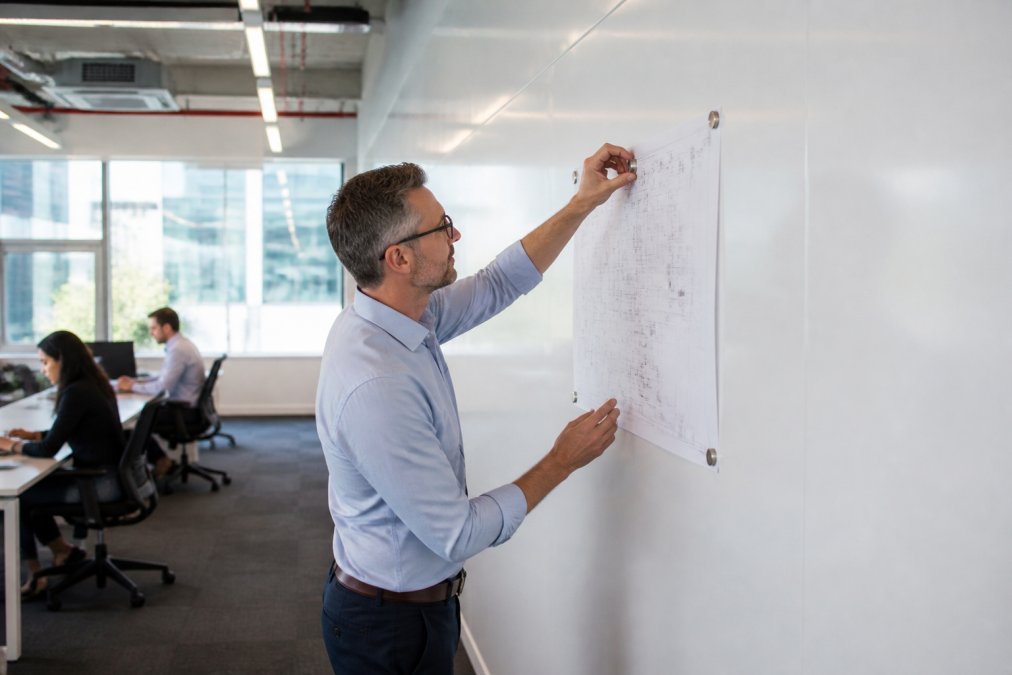
The best renter-friendly office wall decor creates a functional surface without penetrating the wall or leaving residue on removal. That narrows the field to three categories: paste-the-wall ferrous wallcoverings, freestanding magnetic boards, and adhesive-backed panels.
MagPivot™ Freestanding Magnetic →
| Option | Wall contact | Removal at end of term | Best for |
|---|---|---|---|
| Paste-the-wall ferrous wallcovering | Adhesive only | Strip, wash, make good | Whole-wall writing surfaces |
| Freestanding magnetic board | None | Wheel it out | Shared or temporary spaces |
| Adhesive-backed panels | Peel-and-stick backing | Peel off, patch if needed | Small feature areas |
Types of Magnetic Wall Solutions: Panels vs. Wallcoverings
- Dry-erase ferrous rolls. MagWrite™ Gloss White Ferrous Rolls (£216 for a 120cm by 3m roll) give a fast-erase gloss surface with 4/5 magnet receptivity. The matt version (£248) is non-reflective and works as a projection surface, which is why it tends to be specified in boardrooms.
- Chalkboard ferrous rolls. MagChalk™ Matt Black Ferrous Rolls (£322.56 for 120cm by 6m) suit creative studios and teaching spaces where chalk reads better than marker.
- Paintable ferrous rolls. MagPaintable™ Matt White Ferrous Rolls (£216) arrive pre-primed for emulsion, so you can match the wall to your brand colour. Used alone it scores 2/5 receptivity, which is enough for lightweight magnets; paired with MagLiner™ it reaches 4/5.
- Ferrous liner. MagLiner™ Matt Grey/Brown Ferrous Rolls (£66.64 for 61cm by 6m) is the highest-performing option at 5/5 receptivity. It goes on beneath paint, wallpaper, digital print or fabric, so the magnetic function is invisible and the decorative finish is entirely your choice.
Magnetic Wallcovering Installation Guide: DIY vs. Professional
The sequence is straightforward:

- Prepare the wall. Fill, sand and prime. Any unevenness telegraphs through a 0.6mm wallcovering.
- Measure and cut. Rolls run 120cm wide in 3m, 6m and 12m lengths; plan your seams to fall in the least visible positions.
- Apply adhesive to the wall, not the material. Work in manageable sections.
- Hang and smooth. Press out air from the centre outward.
- Trim at ceiling, skirting and corners while the adhesive is still workable.
- Leave to cure fully before writing on the surface or applying a topcoat.
Maintenance, Durability, and Acoustic Considerations
Magnetic surfaces are low-maintenance: a spray cleaner and microfibre cloth handle dry-erase and chalk finishes, and the ferrous layer does not degrade with cleaning.
Acoustic-magnetic hybrids: the gap most guides skip
- MagLiner as the base magnetic layer, giving 5/5 receptivity beneath any finish.
- Acoustic panels mounted in front, typically 20-40mm thick, absorbing mid and high frequencies.
- A writable band, MagWrite or a painted MagPaintable surface, at standing height for sprint boards and visual management.
Sustainability and material toxicity
Three practical checks before you buy:
- VOC content of the adhesive and the wallcovering. Low-VOC products are widely available; the data sheet will state the classification. This matters most in sealed, air-conditioned floors with no opening windows.
- Recyclability and end-of-life. Ferrous wallcoverings are predominantly PVC-based, so check whether the manufacturer operates a take-back or recycling route, and whether offcuts can be returned rather than sent to landfill.
- Fire classification. EuroClass ratings are the standard reference; a landlord or building control officer will ask for the certificate during a fit-out.
Two further points worth checking before you buy:
- Magnet compatibility. Receptivity ratings of 4/5 and 5/5 hold all standard magnet types, including neodymium. A 2/5 surface holds lightweight magnets only, so match the rating to what you plan to hang.
- Warranty terms. A 10-year warranty is only useful if it covers the failure modes you will actually see, lifting seams, surface scuffing, and loss of receptivity. Check what is excluded before you rely on it in a landlord conversation.
Conclusion
The hard part of fitting out a rented office is not choosing a surface, it is choosing one you can undo.
Frequently Asked Questions
Can you install magnetic wall solutions in a rented office without damaging the property?
Yes, many magnetic wall solutions are designed for damage-free installation. Products like MagWrite and MagLiner use a paste-the-wall adhesive that can be removed by a professional decorator, often without damaging the underlying plaster. This makes them suitable for rented spaces where avoiding permanent alterations is a priority. Always check your lease terms and use a professional installer to ensure the wall is left in a condition acceptable to your landlord.
Are magnetic wall solutions considered permanent fixtures under commercial lease agreements?
This depends on the lease and the installation method. A magnetic wallcovering applied with adhesive may be viewed as a permanent alteration, while freestanding options like the MagPivot are not. Under standard commercial lease interior alteration rules, you often need landlord consent for any physical changes. Discuss your plans with your landlord and get written approval before installation to avoid disputes over dilapidations.
How do magnetic wallcoverings compare to traditional whiteboards in office design?
Magnetic wallcoverings offer a seamless, floor-to-ceiling surface that eliminates the frames and fixed sizes of traditional whiteboards. They turn an entire wall into a writable, magnetic space for brainstorming and project planning. While a whiteboard is a standalone object, a magnetic wallcovering becomes part of the office interior design, providing more space and a more integrated, professional look for a collaborative workspace.
What is the best way to attach magnetic wall solutions to existing office partitions?
For existing partitions, freestanding magnetic whiteboards on wheels are the best damage-free option. The MagPivot and MagCaddy models require no installation and can be moved anywhere. If you need a wall-mounted solution, a magnetic wallcovering can be applied over a smooth, sound partition, but you must first confirm with your landlord that this is acceptable and use a recommended adhesive like MagFix.