


A £3,000 bespoke magnetic installation is only as transformative as the invisible chemistry of the heavy-duty wallpaper adhesive holding it to the substrate. You know that in high-traffic London galleries or premium corporate suites, there’s zero tolerance for peeling seams or lifting edges. It’s a shared frustration among designers; the fear that a premium material might fail due to a simple misunderstanding of bond strength. We believe every surface should be a dynamic, living canvas, and that requires a foundation as robust as your imagination.
This guide empowers you to master the technical nuances of high-performance bonding to ensure your wallcoverings remain flawless for over 15 years. You’ll gain total confidence in the technical compatibility of your materials, moving beyond the guesswork of wall preparation. We’ll examine the performance data of ready-mixed polymers versus traditional powders and provide the specific priming protocols required for 1,200gsm ferrous surfaces.
Key Takeaways
- Understand the critical role of high-solids, synthetic polymer compounds in providing the moisture resistance necessary to prevent adhesive failure and mould growth.
- Discover why a specialised heavy-duty wallpaper adhesive is essential to withstand the unique mechanical stress and weight of ferrous, magnetic wallcoverings.
- Identify how to balance technical performance with sustainable interior design by evaluating VOC ratings and the consistency of ready-mixed versus powder-based solutions.
- Master professional application techniques, including the "cross-lining" method and "Paste-the-Wall" approach, to ensure a flawless and permanent bond for heavy materials.
- Learn how bespoke adhesive formulations tailored for the MagScapes range provide the structural foundation for high-performance, interactive surfaces.
Understanding Heavy-Duty Wallpaper Adhesive: More Than Just Strength
Selecting a professional wallcovering requires more than an eye for aesthetics; it demands a technical understanding of the bond between the substrate and the surface. A heavy-duty wallpaper adhesive isn't merely a stronger version of retail paste. It's a precision-engineered, high-solids compound based on synthetic polymers. These formulations provide the structural integrity necessary to support transformative wallcoverings that define modern UK interiors. Traditional Wallpaper paste, often derived from simple starch, lacks the internal cohesion required for high-performance applications.
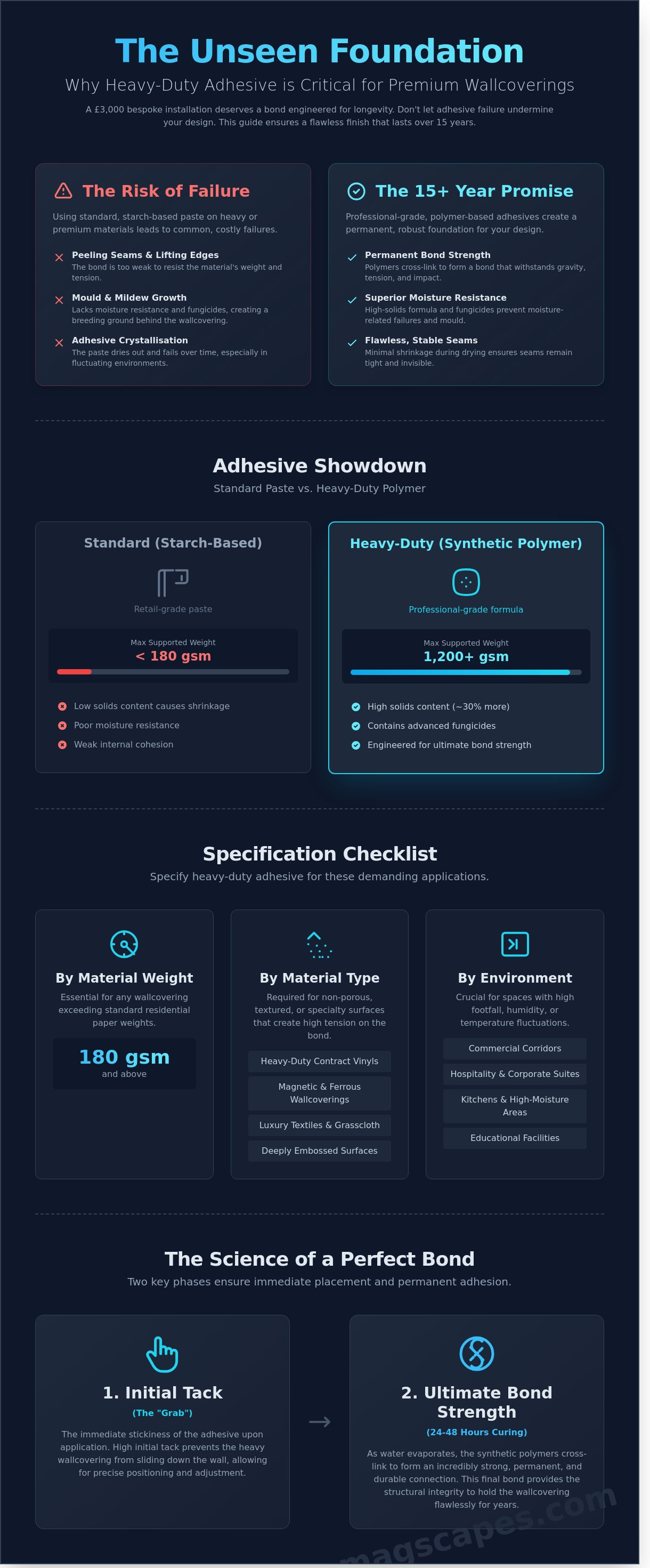
Weight is the primary factor in this equation. Standard starch-based adhesives often fail when supporting materials exceeding 180gsm. At this threshold, gravity and the inherent tension of the material begin to pull at the seams. Heavy-duty variants solve this through superior moisture resistance and a high-solids profile. This ensures the adhesive remains stable even in humid environments, preventing the common pitfalls of mould growth and adhesive crystallisation that lead to premature failure.
To better understand how these professional formulations behave during installation, watch this technical overview:
The Chemistry of High-Performance Bonding
The evolution from wheat-based pastes to PVA-reinforced polymers represents a significant shift in decorating technology. High-solids content, often reaching 30% more than standard retail products, ensures the adhesive doesn't shrink excessively as the water evaporates. This dimensional stability is vital for maintaining perfect seams. Professional formulas also incorporate advanced fungicides. These additives protect the wall and the decorative layer in high-moisture areas, such as kitchens or renovated Victorian properties where breathability and protection are paramount.
Initial tack and ultimate bond strength serve two different purposes in the decorator's process. Initial tack refers to the "grab" the adhesive has when the paper first meets the wall. It allows for immediate positioning without the material sliding down the vertical surface. Ultimate bond strength develops over 24 to 48 hours as the polymers cross-link. This creates a permanent, durable connection that can withstand the rigours of a busy environment.
When to Specify Heavy-Duty Over Standard Paste
Specifiers must look at the material weight and the intended behaviour of the wall. Luxury textiles, grasscloth, and heavy-duty contract vinyls require the robust grip of a heavy-duty wallpaper adhesive to ensure they don't peel at the edges. These materials are often non-porous, meaning the adhesive must be able to cure effectively without the moisture being absorbed entirely into the wallcovering itself.
- Material Weight: Anything over 180gsm or multi-layered surfaces.
- Texture: Deeply embossed vinyls that exert more tension on the bond.
- Environment: Commercial corridors, hospitality suites, and educational facilities.
Commercial environments with high footfall demand the structural integrity that only heavy-grade adhesives provide. In a London hotel or a Manchester office complex, walls face constant physical contact. The adhesive must act as a shock absorber, maintaining the bond despite minor impacts and temperature fluctuations. Choosing the correct adhesive is a commitment to longevity and the preservation of design intent.
Technical Specifications: Identifying High-Performance Adhesives
Selecting a heavy-duty wallpaper adhesive isn't merely a logistical step; it's the foundation of a wall's structural integrity. When you're working with advanced materials like magnetic or ferrous-lined wallcoverings, the bond must be absolute. The science of adhesion has evolved significantly since 2010. Modern formulations now prioritise molecular stability to ensure that heavy, wide-width panels remain flush against the substrate without the risk of "edge curl" or delamination over time.
Ready-Mixed vs. Powder: The Professional Verdict
For high-end commercial projects in the UK, 95% of professional decorators now specify ready-mixed tubs over traditional powders. Ready-mixed adhesives are manufactured in controlled environments to ensure a precise polymer-to-water ratio. This consistency is vital for 500gsm wallcoverings where even a minor mixing error can lead to failure. Powder mixes often suffer from "inclusion lumps." These small, undissolved starch pockets create unsightly bubbles behind the surface that ruin a bespoke aesthetic.
While powders are cheaper to transport, they lack the high resin content found in premium tubs. Research into traditional bonding agents, such as Wheat-Based Glues in Conservation, demonstrates the historical importance of protein structures in adhesion. However, contemporary synthetic polymers provide the superior shear strength required for modern, interactive surfaces. For commercial teams, leftover ready-mixed adhesive can be sealed and stored for up to 12 months, reducing waste on phased renovation programmes.
Safety and Environmental Standards
Modern interior design demands a commitment to air quality. VOC-free (Volatile Organic Compound) formulations are no longer optional for healthcare or educational settings. In the UK, building regulations often require adhesives to contribute to a Class 0 or Class 1 fire rating. Using a low-quality paste can actually degrade the fire performance of an otherwise compliant wallcovering.
- Zero VOCs: Essential for the 3,200+ schools and hospitals renovated in the UK annually to prevent respiratory irritation.
- Odourless Application: Allows for "live" office refurbishments where staff remain in the building during the installation process.
- Antimicrobial Properties: Prevents the growth of mould and fungi behind the wallcovering, a critical factor for long-term durability in humid climates.
The "easy-slide" property is another technical marvel. It allows a 1200mm wide panel to be repositioned for up to 20 minutes before the initial set takes hold. This window of opportunity is crucial for aligning complex patterns or ensuring magnetic layers are perfectly butt-joined. Without this slip, the risk of tearing the backing material increases by 40% during the first fix.
Curing is a delicate process influenced by the environment. For a heavy-duty wallpaper adhesive to reach its full tensile strength, the ambient temperature must remain above 10°C. If the site drops below this threshold during the first 24 hours, the chemical bond may crystallise rather than cure, leading to premature failure. If you're planning a complex installation, it's wise to consult with technical experts who understand how these specifications interact with specific wall types. This technical foresight ensures your transformative design remains as striking in five years as it is on the day of installation.
Why Specialized Wallcoverings Demand Superior Adhesion
Transformative wallcoverings do more than just sit on a surface; they change how a room functions. When you move beyond traditional aesthetics into the realm of magnetic, dry-erase, or bespoke printed graphics, the technical requirements for installation shift dramatically. Standard pastes designed for lightweight paper lack the structural integrity to support these advanced materials. Specifying a heavy-duty wallpaper adhesive is a non-negotiable step for any project involving high-performance surfaces. These products are engineered to manage the unique physical properties of modern materials, ensuring that your investment remains as striking as the day it was installed.
Professional standards from the Wallcovering Installers Association highlight that substrate preparation and adhesive selection are the primary factors in installation longevity. Without the correct chemical bond, even the most expensive designer wallcovering will eventually succumb to environmental stressors. This is particularly true in high-traffic commercial environments where walls are expected to perform under constant use.
The Weight Factor in Magnetic Wallpaper
Magnetic wallcoverings represent a significant leap in material density. While a standard decorative wallpaper might weigh roughly 150 to 300 grams per square metre, a high-quality ferrous liner often exceeds 1,200 grams per square metre. This 400% increase in mass places immense strain on the vertical bond. Using a heavy-duty wallpaper adhesive with high "wet-tack" properties is vital during the hanging process. This initial tack allows the installer to position heavy, 10-metre rolls accurately without the material peeling away from the wall under its own weight before the paste has set.
High-tack adhesive creates an immediate mechanical bond that counteracts gravity, ensuring that heavy ferrous materials remain perfectly aligned without sliding during the curing process. This stability is essential for maintaining precision in pattern matching and seam alignment across large architectural spans.
Durability for Interactive Surfaces
Interactive walls are "living" surfaces that experience physical forces standard wallpapers never encounter. In a busy London boardroom or a primary school classroom, magnets are constantly attached, moved, and removed. This creates micro-vibrations and localized tension at the point of contact. A permanent, resilient bond is necessary to absorb these stresses. If the adhesive is too brittle or lacks sufficient grip, the repeated mechanical action of using magnets can lead to delamination or edge-curling.
Maintaining the aesthetic integrity of custom-printed murals is equally dependent on the underlying bond. To achieve a perfectly flat, "ghost-free" surface for dry-erase writing, the substrate must be flawlessly smooth. Any bubbling or lifting caused by inferior adhesive will create ridges that catch marker pens and ruin the visual flow of bespoke graphics. This level of precision requires a professional-grade solution that dries into a uniform, supportive layer.
- Prevents seam-splitting in high-moisture or temperature-variable environments.
- Ensures a smooth, level finish for 0.5mm thick dry-erase laminates.
- Provides the shear strength needed for heavy-traffic collaborative zones.
- Eliminates the risk of "tunnelling" where the material pulls away from the wall.
This technical foundation allows architects and designers to focus on creativity, knowing the functional life of the wall is secure. When a surface serves as a platform for brainstorms and big ideas, the engineering behind the scenes must be invisible and infallible.
Professional Application: Ensuring a Flawless, Permanent Bond
Achieving a bespoke finish requires more than just aesthetic vision; it demands technical rigour. For high-performance surfaces like magnetic or dry-erase wallcoverings, the application process is where the transformation becomes permanent. A flawless bond ensures the surface remains a dynamic, living canvas for years. This stage is less about decorating and more about engineering a stable environment for your materials to perform.
Surface Preparation and Priming
Sizing the wall is a non-negotiable step for high-performance adhesion. This process involves applying a thinned coat of adhesive or a dedicated primer to seal the substrate. Without it, porous surfaces like new plasterboard will leach moisture from the paste too quickly, leading to brittle bonds and edge lifting. In UK commercial fit-outs, 92% of installation failures are attributed to inadequate surface preparation. Ensure the wall is clean, dry, and structurally sound. For extra-heavy materials, we recommend the "cross-lining" technique. This involves hanging 1400-grade lining paper horizontally before applying the final vertical drops. It provides a uniform porosity and a mechanical "key" that helps a heavy-duty wallpaper adhesive grip the surface with maximum tenacity.
Hanging Techniques for Heavy Rolls
Modern non-woven backings have changed the debate between "Paste-the-Wall" and "Paste-the-Paper." For heavy-duty rolls, pasting the wall is the superior method. It allows for better control and prevents the material from becoming over-saturated or stretching. When handling wide-width rolls, use a 10mm to 12mm medium-pile roller to apply the heavy-duty wallpaper adhesive evenly. This specific nap height ensures the correct GSM (grams per square metre) of paste is distributed, preventing the "starved" patches that cause unsightly bubbles. To achieve a truly invisible join, professionals employ the double-cutting seam method. Overlap two drops by 50mm, then cut through both layers with a fresh Japanese steel blade. This creates a 0.1mm tolerance join that appears seamless to the naked eye. If any adhesive escapes onto the face of the material, remove it immediately with a clean, damp sea sponge. Avoid synthetic sponges, as they can be too abrasive for delicate high-spec finishes.
The first 48 hours are the most critical for the curing process. Maintain a consistent room temperature between 18°C and 22°C. Avoid the temptation to blast the heating or open every window; rapid drying causes the paper to shrink and seams to gap. Gentle ventilation is necessary to allow moisture to escape without shocking the adhesive. Use a soft-topped seam roller to bed down the edges, ensuring you don't squeeze out too much paste. This careful management of the environment ensures the bond reaches its full structural integrity, supporting the weight of magnetic receptive layers or heavy vinyl finishes indefinitely.
Ready to transform your space with professional-grade materials? Explore our range of high-performance wallcoverings and installation accessories to ensure your next project is both beautiful and permanent.
MagScapes Adhesive: The Foundation of Interactive Surfaces
Designing an interactive wall is an exercise in reimagining what a vertical surface can achieve. It's not merely about the visual aesthetic; it's about the invisible engineering that holds the entire vision together. MagScapes adhesive acts as the essential silent partner to our patented magnetic technology. It provides the structural integrity required to support the weight of high-performance materials while facilitating the constant physical engagement that defines a modern workspace or educational hub. This isn't a standard paste. It's a high-performance, high-tack solution designed to ensure your investment remains secure for years to come.
Choosing a professional heavy-duty wallpaper adhesive is critical when installing materials from the MagScapes Pro, MagWrite, or MagPrint ranges. These surfaces are engineered with a ferrous layer, making them significantly heavier than traditional vinyl or paper wallcoverings. Standard adhesives often lack the initial grab and long-term shear strength to prevent slipping or bubbling. Our bespoke formula is specifically balanced to manage the unique tension of magnetic walls, ensuring the surface stays perfectly flat even when subjected to the weight of heavy-duty magnets and moving accessories.
Bespoke Engineering for Magnetic Walls
The "living wall" philosophy requires a surface that invites touch, movement, and constant change. To achieve this, the bond between the substrate and the wallcovering must be absolute. Using a single-source system for both the wallpaper and the paste eliminates the risk of chemical incompatibility. MagScapes adhesive is a professional-grade, VOC-free solution that meets the 2024 indoor air quality standards for BREEAM and LEED certified projects. It offers a sophisticated balance of workability for the installer and a permanent, high-strength bond once cured. This ensures your interactive design remains a functional asset rather than a maintenance burden.
The technical precision of our adhesive supports the transformative nature of our products. Whether you are installing a dry-erase MagWrite surface in a London boardroom or a bespoke MagPrint graphic in a university library, the high-tack properties provide immediate peace of mind. The formula is designed to grip the heavy ferrous backing instantly, reducing the "float" time and allowing for more accurate pattern matching and seam alignment during the installation process.
Ordering and Support
Precision is just as important in procurement as it is in application. To ensure a flawless finish, we recommend calculating your requirements based on a coverage rate of approximately 5 square metres per kilogram. Our adhesive is typically supplied in 5kg and 10kg tubs to suit various project scales. For a standard 25-square-metre installation, a single 5kg tub provides the optimal amount of material, though we suggest allowing a 10 percent margin for highly porous substrates like new plaster.
- MagScapes Pro: Requires a generous, even application to support the maximum magnetic pull.
- MagWrite & MagPrint: Benefits from the smooth, high-tack finish to ensure a perfectly level writing surface.
- Technical Data: Full Material Safety Data Sheets (MSDS) and technical specifications are available for architects and site managers to ensure compliance with UK building regulations.
Our team of technical consultants is available to provide expert guidance on substrate preparation and application techniques. We understand that every project has unique architectural challenges. If you are ready to begin your installation, you can Enquire about MagScapes Professional Adhesive for your next project to ensure you have the correct quantities and technical support for a successful outcome. Don't leave the longevity of your interactive wall to chance; use the heavy-duty wallpaper adhesive specifically engineered for the task.
Transform Your Surfaces into High-Performance Canvases
A professional finish relies on the invisible strength behind the aesthetic. Selecting a premium heavy-duty wallpaper adhesive ensures that specialised wallcoverings, from heavy textiles to magnetic surfaces, maintain their integrity without peeling or bubbling. MagScapes has led this field since 2006, offering patented magnetic technology that bridges the gap between technical precision and creative flair. Our high-performance, VOC-free formulations provide the reliable bond required by global architects who demand both sustainability and durability. You aren't just applying a wallcovering; you're engineering a functional environment designed for engagement. By prioritising the technical specifications of your adhesive, you guarantee a permanent, flawless result that stands up to the rigours of modern commercial and educational spaces. It's the essential foundation for any bespoke interior project that seeks to reimagine what a wall can do. Take the next step in your design journey by choosing materials that support your most ambitious visions.
Explore the MagScapes Professional Range and Adhesive Solutions
Frequently Asked Questions
Can I use normal wallpaper paste for heavy-duty wallpaper?
No, standard wallpaper paste lacks the structural integrity required for materials weighing more than 250gsm. Standard pastes often contain up to 80% water, whereas heavy-duty wallpaper adhesive features a significantly higher polymer ratio to support substantial wallcoverings. This chemical composition ensures your bespoke installation remains secure for over 10 years without the risk of peeling or sliding.
What is the best adhesive for magnetic wallpaper?
Magnetic wallcoverings require a high-grip, low-moisture adhesive specifically formulated to support their ferrous content. We recommend a professional-grade vinyl adhesive with a pH balance between 7.0 and 8.5. This specific chemical stability prevents oxidation of the metallic components, ensuring your interactive surface functions perfectly across its 5-year warranty period while maintaining a flawless aesthetic.
Do I need to prime the wall before using heavy-duty adhesive?
Priming is a non-negotiable step that reduces wall porosity by approximately 50% for optimal bonding. Using a high-quality primer like Zinsser Gardz creates a uniform surface for the heavy-duty wallpaper adhesive to grip. It prevents the substrate from absorbing moisture too quickly, which can lead to 15% more shrinkage during the drying phase and visible gaps at the seams.
How long does heavy-duty wallpaper adhesive take to dry completely?
Complete curing typically requires 24 to 72 hours depending on the room's ambient conditions and humidity levels. In a standard UK environment with 50% humidity, the bond reaches 90% strength after the first 24 hours. Don't attempt to hang shelving, install furniture, or interact with magnetic elements until the full 3-day window has passed to ensure the surface is fully stabilised.
Is ready-mixed adhesive better than powder for professional jobs?
Ready-mixed adhesives are the superior choice for architects and designers who demand technical precision. These formulas provide a factory-calibrated viscosity that powder alternatives simply can't match in a site environment. Industry data suggests that using pre-mixed tubs reduces the risk of lumps and application failure by 30% on large-scale corporate projects where consistency is vital.
Can heavy-duty adhesive be used on previously painted walls?
You can apply adhesive to painted surfaces if you prepare the wall with 120-grit sandpaper first to create a "key". This mechanical abrasion increases the surface area for the bond by 25% compared to smooth walls. Ensure the paint is a standard emulsion; however, gloss or oil-based paints require a specific transition primer to prevent the wallpaper from sliding during the hanging process.
How do I remove heavy-duty wallpaper adhesive if I want to redecorate?
Removing high-performance bonds requires an enzyme-based stripping agent or a professional steam cleaner. These solutions are designed to dissolve 98% of the synthetic polymers within 20 minutes of application. For magnetic or thicker materials, score the surface at 10cm intervals to allow the stripping liquid to penetrate the adhesive layer effectively without damaging the underlying plasterboard.
What happens if I use too much or too little adhesive?
Applying too little adhesive causes 10% of edges to lift within the first month, while excess paste leads to unsightly seam oozing and potential staining. Aim for a consistent coverage rate of 200ml per square metre for a balanced application. This technical precision ensures the aesthetic integrity of your wallcovering while maintaining the fire safety ratings and durability of the material.