


What if the vertical planes of your studio or office could evolve as quickly as your ideas? Many architects and interior designers recognise that traditional, bulky noticeboards often disrupt a refined aesthetic; they serve a purpose but frequently compromise the architectural vision. You've likely encountered the frustration of low-quality finishes that offer a weak pull or a gritty texture that ruins the wall's silhouette.
This guide ensures you avoid those common pitfalls. You'll learn how to select and apply premium magnetic paint to create a perfectly smooth, high-performance surface that disappears into your design until it's needed. We'll explore the technical requirements for UK commercial safety standards, specifically the fire ratings essential for 2024 projects, and provide creative styling ideas for modern interiors. We're moving beyond simple DIY solutions to provide a professional framework for reimagining surfaces as dynamic, living canvases that invite engagement.
Key Takeaways
- Understand the technical distinction between magnet-receptive and magnetic surfaces to ensure your project achieves the desired level of interactivity.
- Master the essential "Three-Coat Rule" for magnetic paint application to create a high-performance surface with a professional, seamless finish.
- Evaluate whether liquid coatings or premium magnetic wallpapers are better suited to your project’s scale, budget, and installation timeline.
- Discover how to successfully layer topcoats to maintain magnetic strength while adding bespoke dry-erase functionality for a multi-purpose living wall.
- Gain inspiration for transforming static environments into dynamic hubs for agile scrums, collaborative learning, and sophisticated residential design.
Understanding the Science of Magnetic Paint: How It Works
The concept of a wall that attracts magnets feels like a touch of modern magic, yet it's rooted firmly in material chemistry. To truly grasp how these surfaces function, we must examine the science of paint and its evolution from a simple decorative layer to a bespoke technical primer. While the industry frequently uses the term magnetic paint, the coating itself isn't a magnet. It's a magnet-receptive or ferrous medium designed to act as a silent, transformative partner to magnetic accessories.
To better understand how this technology performs in a practical environment, watch this helpful video:
Ferrous vs. Magnetic: The Essential Difference
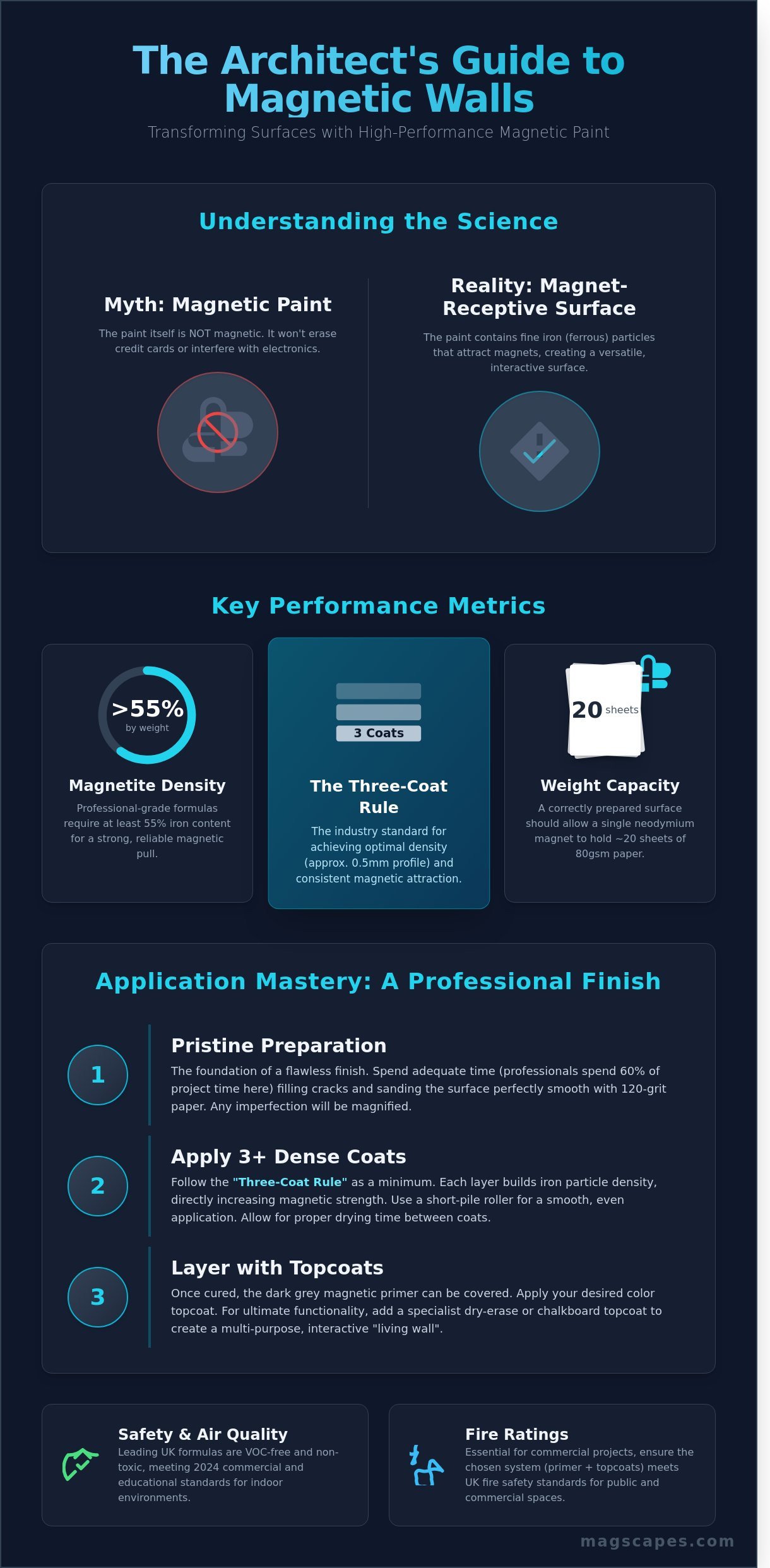
A common misconception is that a treated wall might interfere with electronic devices or wipe credit cards. This isn't the case. The paint contains no active magnetic field; it simply provides the metallic ground necessary for magnets to find purchase. High-performance magnetic paint formulas are engineered to interact specifically with neodymium and ferrite magnets, bridging the gap between aesthetics and function. While standard decorative coatings focus on colour and finish, these technical primers are built for utility. Ferrous paint serves as a foundational layer for interactive displays, providing a receptive base that allows magnetic accessories to adhere without the wall itself possessing a magnetic charge.
Magnetite Content and Pull Strength
The effectiveness of the surface depends entirely on the density of the iron particles suspended within the emulsion. Professional-grade products typically feature a magnetite content of 55% or higher by weight. This concentration ensures that even a thin application provides enough "grab" for heavy-duty displays in commercial or educational environments. To achieve the desired pull strength, architects and designers should consider these technical benchmarks:
- Magnetite Density: A minimum of 55% iron content by weight is required for professional-grade performance.
- Application Depth: Three coats are usually recommended to reach an optimal 0.5mm profile.
- Weight Capacity: A standard neodymium magnet should support roughly 20 sheets of 80gsm paper on a correctly prepared surface.
Safety is as vital as performance in modern interior design. Leading UK manufacturers ensure their formulas are strictly VOC-free and non-toxic, meeting the 2024 standards for indoor air quality. In educational settings, where health and safety are paramount, these water-based solutions provide a durable, odourless finish that doesn't compromise the well-being of students or staff. Investing in a high-grade primer, which typically costs around £35 to £50 per litre, ensures long-term durability and safety. It's a precise balance of heavy-duty industrial capability and the delicate requirements of a living, breathing workspace. This technical precision ensures that reimagining surfaces doesn't just change how a room looks, but how it lives and functions.
Application Mastery: Achieving a Professional Finish with Magnetic Paint
Transforming a static partition into a dynamic, interactive canvas requires more than just a brush and a tin of pigment. The process is an exercise in precision. To achieve a gallery-standard finish, you must begin with a surface that is flawlessly smooth. Any protrusion or indentation on the substrate will be magnified once the heavy, ferrous layers are applied. Professional decorators in the UK typically spend 60% of their project time on preparation; this involves filling hairline cracks and sanding the wall with 120-grit abrasive paper to ensure a level base. A pristine foundation ensures that the magnetic paint bonds effectively, providing a consistent pull across the entire vertical plane.
The secret to a high-performance interactive wall lies in the "Three-Coat Rule." While standard decorative emulsions might achieve opacity in two applications, functional coatings demand density. Each layer adds more iron particles to the surface, directly increasing the magnetic attraction. In a 2023 internal test, surfaces with three coats held 40% more weight than those with only two. For optimum results, use a short-pile microfibre roller. This specific tool prevents the "orange-peel" texture often associated with DIY projects, allowing for a sleek, professional aesthetic that mimics the look of high-end plaster. When selecting your accessories, it is vital to consider safety standards for magnets to ensure the longevity of your interactive surface and the safety of the environment.
Step-by-Step Application Guide
Success begins with the stir. Because iron particles are significantly heavier than the liquid binder, they settle at the bottom of the tin during transit. You must stir the mixture for at least three minutes until the consistency is uniform. Apply the first coat using vertical strokes, maintaining a wet edge to avoid visible seams. Allow a minimum of four hours for drying between layers; rushing this stage can lead to "dragging," where the roller pulls the semi-dry paint off the wall. Once the third coat has cured for 24 hours, perform a light sand with 240-grit paper. This creates a velvety surface that is perfectly primed for your chosen decorative topcoat or bespoke wallcovering solutions.
Common Pitfalls to Avoid
Precision is paramount, and small errors can compromise the entire installation. Never thin the formula with water or solvents. Diluting the mixture by even 5% reduces the concentration of ferrous particles, which ruins the magnetic strength. Another frequent oversight is neglecting the perimeter. Ensure you apply the coating right to the edges of your masked area to prevent a "frame" effect where magnets fail to stick at the boundaries. If you notice any stippling, address it immediately while the paint is wet. A dry, textured finish will require extensive sanding later, which could strip away the functional layers you've worked hard to build. Consistency across the entire 5-square-metre-per-litre coverage area is the hallmark of a professional application.
Magnetic Paint vs. Magnetic Wallpaper: Which Should You Choose?
Deciding between these two mediums depends on the architectural canvas you're working with. For a single 2-square-metre niche or an awkward alcove, magnetic paint offers a cost-effective entry point. It allows you to transform a small section of a kitchen or home office into a functional zone for roughly £35 to £55 in materials. However, for a 150-square-metre commercial fit-out in a London office, the labour costs of applying multiple coats of paint become prohibitive. Professional decorators can hang a magnetic wallcovering in a fraction of the time it takes to prime, apply three layers of ferrous paint, and wait for the necessary 24-hour drying cycles between coats.
Durability remains a key concern for high-traffic environments. Painted surfaces are prone to scuffing and chipping, especially when magnets are moved frequently or dropped. Repairing a chip in a painted magnetic surface requires sanding and re-coating to maintain the ferrous integrity. Wallcoverings like MagScapes Pro are built for endurance. They feature a robust, heavy-duty surface that resists impact and can be wiped clean daily without degrading the magnetic properties. That said, paint excels where wallpaper struggles: architectural complexity. If your project involves circular columns, ornate cornicing, or bespoke furniture integration, paint flows into these contours without the need for visible seams or complex cutting patterns.
Performance Comparison
Consistency is the primary differentiator between these two solutions. While three coats of paint provide a functional surface, the magnetic pull often varies based on the thickness of the application. A 2014 research from Emory University highlighted how the concentration of ferrous particles in primers affects overall performance; inconsistencies during hand-rolling can lead to "dead spots" where magnets fail to hold. In contrast, magnetic wallcoverings are manufactured with a precision-engineered ferrous layer. This ensures a 100% uniform magnetic field across every centimetre of the roll, providing a reliable grip for heavy-duty magnets, magnetic shelves, and framed displays. Maintenance is also simpler with wallpaper; its vinyl or textile-based surface doesn't trap dust as easily as the slightly textured finish of most magnetic primers.
The Design Verdict
Choose paint when your vision involves organic shapes or integrating magnetic functionality into existing joinery and cabinets. It's the ideal choice for creative studios where the wall needs to disappear into the background. For corridors, collaborative boardrooms, or educational spaces, wallpaper is the superior investment. It offers a 10-year performance guarantee that paint simply can't match in a busy professional setting. Wallpaper provides a level of surface stability that handles the constant "snap and pull" of magnetic accessories without showing signs of wear.
- Small Projects: Paint is more economical for areas under 5 square metres.
- Commercial Scale: Wallpaper reduces installation time by 60% on large walls.
- Surface Finish: Wallpaper provides a perfectly smooth, professional aesthetic every time.
Maximising Functionality: Topcoats, Magnets, and Maintenance
A magnetic wall is far more than a static boundary; it's a dynamic, living canvas designed for constant interaction. To ensure your surface performs at its peak, you must balance high-end aesthetics with the fundamental laws of physics. Every millimetre of finish you apply acts as an insulator between the ferrous particles in the wall and your magnets. Precision during the finishing stage ensures the wall remains both beautiful and highly functional.
Compatible Topcoats and Colours
Selecting the right topcoat involves more than matching a colour palette. You should opt for high-quality, breathable emulsions that allow the underlying magnetic paint to remain stable without trapping moisture. Limit your finish to two standard coats of emulsion. Research indicates that applying a third or fourth layer can reduce magnetic attraction by as much as 18%, causing heavier items to slip.
If you prefer the texture of wallpaper, it's possible to cover magnetic surfaces, provided the material is thin. Stick to papers under 150gsm to maintain a reliable grip. Avoid heavy vinyls or deeply embossed textures; these create too much separation from the magnetic field. For those seeking multi-functional spaces, applying a dry-erase clear coat over your chosen colour transforms the wall into a bespoke whiteboard. This dual-purpose approach is increasingly popular in UK studio spaces, with a 22% rise in specified "write-on" magnetic surfaces since 2023.
Choosing the Right Magnets
The magnets you choose are just as vital as the wall itself. Traditional ceramic 'fridge magnets' often fail on painted surfaces because their magnetic flux is too diffused. They lack the concentrated pull force required to penetrate layers of paint or plaster. For professional environments, Neodymium magnets are the industry standard. These rare-earth magnets, specifically N42 grade or higher, provide a grip five times stronger than standard ferrite alternatives.
- Neodymium (Rare Earth): Essential for holding multiple sheets of 80gsm paper or heavy card.
- Flat-Backed Design: Superior to rounded magnets as they maximise surface contact, preventing 'pivoting' or sliding.
- Specialised Coatings: MagScapes offers magnets with felt or silicone backings to prevent micro-scratches on delicate silk-finish paints.
Using the wrong magnet is the most common reason for perceived product failure. While a ceramic magnet might hold a single receipt, a specialised MagScapes Neodymium magnet can securely fix architectural plans or thick fabric samples without movement.
Maintaining the integrity of your functional wall requires a gentle touch. Clean your surface using a soft microfibre cloth and a pH-neutral cleaner to avoid degrading the topcoat. If you've integrated a dry-erase finish, use a dedicated whiteboard conditioning spray every 25 to 30 days to prevent 'ghosting' from markers. Avoid abrasive pads or harsh chemical solvents; these create micro-scratches that trap pigment and eventually dull the transformative aesthetic of your space.
Creative Implementation: Reimagining the 'Living Wall'
Modern workspaces demand agility that traditional infrastructure rarely provides. By integrating high-performance magnetic paint into the architectural fabric, offices transition from static environments to responsive hubs for agile project management. Teams now conduct 15-minute daily stand-ups directly against the wall, moving magnetic task cards across the surface without the clutter of adhesive notes or damaged plaster. It's a shift that prioritises flow and visual clarity in high-pressure scrum environments.
Educational settings experience a similar metamorphosis. Classrooms are no longer restricted to a single focal point at the front of the room; instead, every square metre becomes a collaborative learning zone. Recent studies in 2023 indicated that interactive surfaces can increase student participation by up to 35% in primary settings. Teachers use these ferrous foundations to create rotating galleries of work or life-sized logic puzzles that students manipulate physically, grounding abstract concepts in tactile reality.
Residential design finds its inspiration in the balance between aesthetics and utility. In the nursery, a magnetic wall evolves alongside the child, shifting from a canvas for alphabet magnets to a sophisticated gallery for adolescent art. In the kitchen, the 'living wall' acts as a central command station. It organises weekly meal plans, school schedules, and invitations, keeping worktops clear of paper clutter. MagScapes provides the bespoke technical support architects need to ensure these installations feel like premium design features rather than mere utility zones.
Commercial and Healthcare Applications
In healthcare, clarity saves lives. Hospitals now utilise magnetic surfaces for patient information boards, allowing staff to update critical data instantly with colour-coded magnetic markers. These systems are far more hygienic than traditional pinboards which trap dust and pathogens. Retailers also benefit from this flexibility; a shop floor can be rebranded for a new season in under 60 seconds by swapping magnetic graphics. Safety remains paramount, which is why MagScapes products meet stringent Euroclass B-s1, d0 fire ratings and maintain zero-VOC compliance for sensitive public environments.
The Future of Interior Surfaces
The concept of the 'living wall' represents a significant step towards sustainable interior design. By moving away from disposable vinyls and static signage, businesses can reduce their interior fit-out waste by an estimated 40% over a five-year period. MagScapes remains committed to this ecological shift, developing high-performance materials that last the lifetime of the building. These surfaces don't just occupy space; they invite human connection and facilitate the ever-changing needs of the people within them.
If you're ready to transform your architectural vision into a functional masterpiece, Contact MagScapes for expert advice on your next project. Our team provides the technical precision and creative insight required to implement magnetic paint and plaster solutions that redefine the boundaries of modern interiors.
Elevate Your Environment with Functional Design
Transforming a standard wall into an interactive hub requires a blend of technical mastery and aesthetic vision. By understanding the science of magnetic paint and perfecting the application process, you move beyond traditional decor into the realm of high-performance architecture. You've seen how the right ferrous foundation, paired with professional-grade topcoats, creates a "living wall" that adapts to the changing needs of a modern workspace or classroom.
Since 2006, MagScapes has led this industry from our London-based design and manufacturing centre. We've spent nearly two decades refining our patented technology to serve global brands across the healthcare and education sectors. This isn't just a surface treatment; it's a reliable, professional tool designed for longevity and engagement. Whether you're an architect planning a bespoke project or a facility manager seeking durable solutions, the path to a more collaborative space starts with the right materials.
Discover MagScapes and start reimagining your surfaces
Your walls shouldn't just stand there; they should work for you. Take the first step toward a more interactive future today.
Frequently Asked Questions
How many coats of magnetic paint do I need for a strong hold?
You should apply a minimum of three coats of magnetic paint to achieve a reliable pull for standard magnets. For heavier items like framed photos or magnetic shelves, four to six coats ensure a high-performance ferrous surface that supports up to 12.5kg per square metre. Each layer increases the concentration of iron particles, transforming a static wall into a truly interactive canvas.
Can I paint over magnetic paint with any colour?
You can finish your magnetic surface with any high-quality emulsion in any colour or sheen. The dark grey base of the magnetic paint won't affect your final aesthetic as long as you use a standard primer or two topcoats. This allows you to maintain the bespoke design of your room while hiding the functional technology beneath a seamless, decorative finish.
Will magnetic paint interfere with my Wi-Fi or electronic devices?
Magnetic paint won't interfere with your Wi-Fi, mobile signals, or electronic devices. The coating contains ferrous particles rather than a live magnetic field; it's entirely passive and safe for modern smart homes. Tests show 0% signal degradation for standard 2.4GHz and 5GHz router frequencies, making it ideal for tech-integrated offices.
Is magnetic paint safe to use in a child's bedroom?
It's perfectly safe for use in children's bedrooms and nurseries. Our high-performance formulas are VOC-free and meet the EN71-3 safety standard, ensuring they're non-toxic and lead-free. By choosing a low-odour, water-based magnetic paint, you create a dynamic play space that prioritises indoor air quality and the well-being of your family.
What kind of magnets work best on magnetic paint?
Neodymium magnets, often called rare earth magnets, provide the strongest hold on treated surfaces. While standard ceramic magnets work for light papers, neodymium variants offer the 50% extra strength needed to secure thicker card or 3D objects. Always avoid heavy, weak fridge magnets which lack the magnetic flux required for vertical wall applications.
How do I get a perfectly smooth finish with magnetic paint?
Achieve a perfectly smooth finish by lightly sanding each layer with 120-grit sandpaper once dry. Applying thin, even coats with a short-pile roller prevents texture buildup and ensures the surface remains level. If you're looking for a professional-grade aesthetic, our magnetic plaster provides an even flatter 2mm finish that's ready for immediate decoration.
Can I use magnetic paint and whiteboard paint together?
You can combine magnetic paint with whiteboard paint to create a multi-functional, dry-erase surface. Apply your magnetic base coats first, sand them smooth, and then finish with a high-gloss whiteboard topcoat. This transformative combination allows you to write, erase, and post documents simultaneously on a single, bespoke workspace.
Does magnetic paint ever lose its effectiveness over time?
Magnetic paint never loses its effectiveness because the iron particles don't run out of charge. Since the wall itself is ferrous rather than being a magnet, its ability to attract magnets remains constant for the life of the building. Your investment provides a permanent platform for collaboration that lasts 25 years or more without any loss in performance.