


What if your walls weren't just static boundaries, but high-performance canvases capable of holding 5kg of weight without a single drill hole? You likely understand that standard magnetic paints often fail to deliver the pull strength required for heavy-duty commercial use, leaving designers frustrated by sliding magnets and weak adhesion. Understanding exactly when to use magnetic plaster is the difference between a transformative, interactive environment and a costly specification error.
While the initial investment is approximately 15 times higher than standard gypsum, the result is a bespoke, ferrous surface that integrates seamlessly into the architecture of a room. We'll help you discover when this material is the superior choice for your project and how it compares to alternative wallcoverings for creating truly interactive spaces. This guide provides a clear decision-making framework and the technical requirements needed to ensure your installation meets the high standards of a modern, professional interior.
Key Takeaways
- Understand how ferrous-infused basecoats transform static boundaries into "living walls" that invite engagement within modern British interiors.
- Master the technical 3mm to 5mm depth rule to ensure your interactive surface achieves its maximum weight-bearing potential.
- Identify exactly when to use magnetic plaster as the superior specification for new builds, renovations, and complex curved geometries.
- Compare the long-term performance and pull strength of plaster against magnetic paints and wallpapers to justify your project investment.
- Learn to curate a high-performance environment by pairing your plastered surface with bespoke magnetic accessories for a truly transformative aesthetic.
Defining the Interactive Surface: What is Magnetic Plaster?
Magnetic plaster is a high-performance, ferrous-infused basecoat. It's designed to turn standard walls into magnet-receptive canvases. In the last 24 months, British architecture has seen a distinct shift from static boundaries to "living walls". This evolution reflects a growing desire for spaces that breathe and change alongside their inhabitants. While the name suggests the wall itself acts as a magnet, that's actually a misnomer. The surface is magnet-receptive. It contains a dense concentration of iron particles that attract magnets without creating an electromagnetic field. This makes it a safe, future-proof choice for sustainable interior design. Knowing when to use magnetic plaster is essential for architects who want to blend functionality with high-end aesthetics without the clutter of traditional fixtures.
Recent data from UK interior design surveys suggests a 15% rise in the demand for multi-functional home offices since 2022. Designers are looking for ways to make every square inch of a new build work harder. Magnetic plaster offers a solution that is both invisible and incredibly powerful. It replaces the need for drilling into fresh masonry to hang boards or shelving. Instead, the entire wall becomes a bespoke tool for organisation and creative expression.
The Science Behind the Surface
The efficacy of the surface depends entirely on the density of its composition. High-quality magnetic plaster typically contains a concentration of ferrous particles that is 50% higher than standard magnetic paints. This density ensures a reliable "pull" for heavy-duty magnets, even through layers of paint or thin wallpaper. To understand the innovation, one must first grasp what plaster is in its traditional form; a foundational mixture used for coating and protecting internal walls. The magnetic variant elevates this foundation by using VOC-free, non-toxic minerals. These compositions meet the strict indoor air quality standards required in 2024 UK building regulations, ensuring that the air in a new build remains as clean as the design.
Aesthetics of the Seamless Wall
A primary advantage of this material is the seamless finish it provides. Once applied at a precise depth of 3mm, the surface is indistinguishable from standard polished plaster. This allows for total creative freedom. You can over-paint with any premium emulsion or apply traditional wallpaper without losing the receptive properties. This flexibility is often the deciding factor in when to use magnetic plaster for premium residential projects where visual integrity is paramount. It supports a minimalist, clutter-free aesthetic by removing the need for bulky noticeboards or adhesive tapes. In corporate environments, this creates a sophisticated platform for collaboration that doesn't compromise the room's professional tone. The result is a wall that remains beautiful when empty and becomes a dynamic workspace when engaged.
- Ferrous Density: Provides up to 50% more magnetic strength than multiple coats of magnetic paint.
- Seamless Integration: Maintains a 3mm profile that blends perfectly with adjacent standard plasterwork.
- Sustainable Choice: Formulated with VOC-free materials to support healthy living environments.
- Versatile Finishing: Compatible with a wide range of UK-standard paints and wallcoverings.
Technical Performance: How Magnetic Plaster Transforms a Substrate
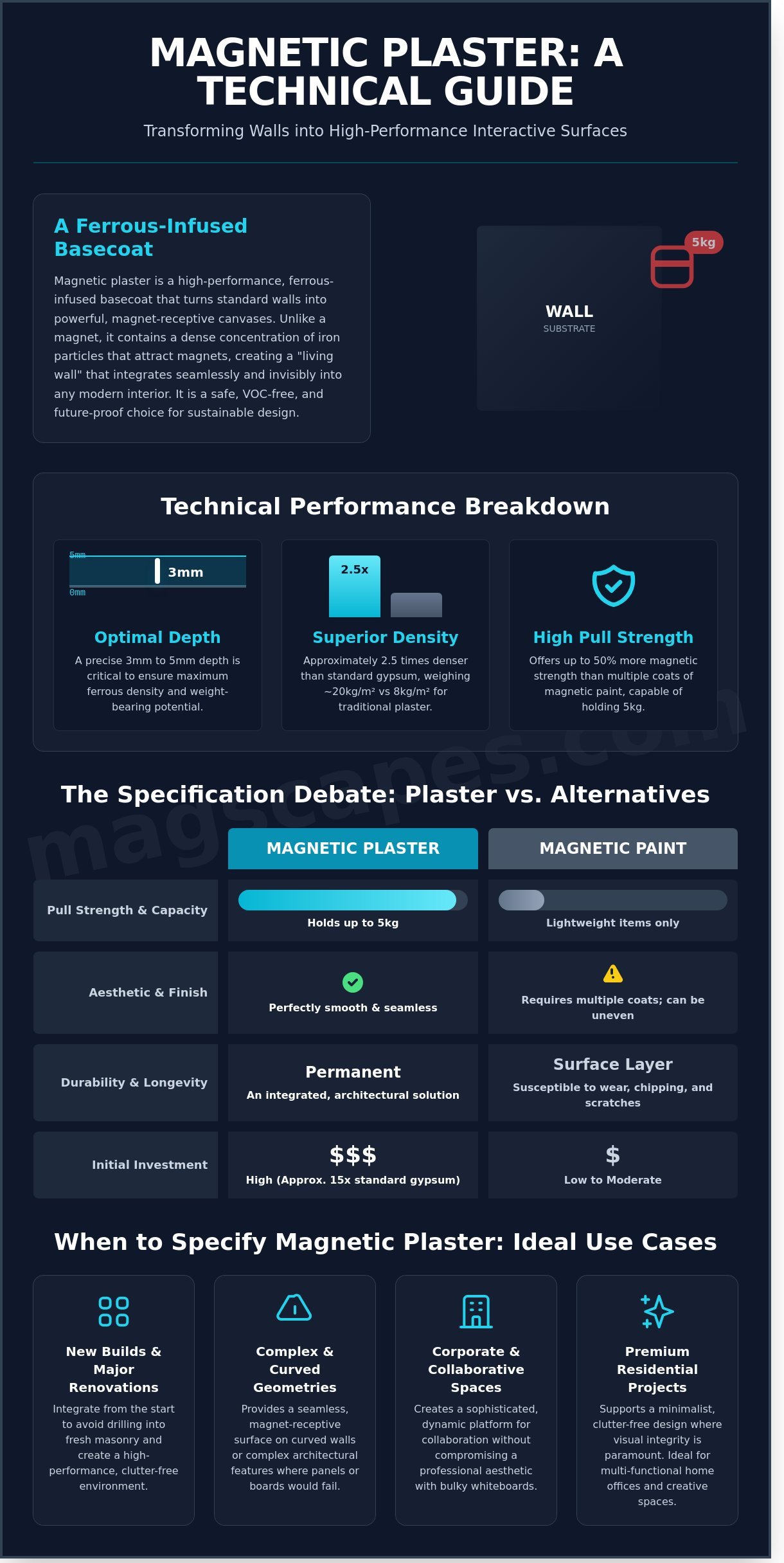
The decision regarding when to use magnetic plaster often rests on the specific functional requirements of a new build's interior. Unlike standard gypsum finishes, magnetic plaster is a high-performance composite infused with ferrous particles, turning a static wall into an interactive canvas. This material is approximately 2.5 times denser than standard multi-finish plaster, weighing roughly 20kg per square metre at a 3mm depth compared to the 8kg typically seen in traditional applications. This increased mass requires careful structural consideration, particularly when specifying partition walls or lightweight steel frame systems.
The technical performance of magnetic plaster is defined by its ability to facilitate magnetic attraction through layers of paint or thin wallcoverings. Achieving this requires a precise application thickness. If the layer is too thin, the ferrous density is insufficient to hold anything beyond lightweight magnets; if it's too thick, the material becomes difficult to manage and prone to internal stress. For architects and developers, understanding this balance is essential for ensuring the longevity of the installation.
The 5mm Efficiency Threshold
While a standard skim coat is 2mm to 3mm, magnetic plaster allows for a build-up of up to 5mm to enhance attraction strength. However, exceeding this 5mm threshold often results in diminishing returns, as the weight of the plaster itself can lead to slumping during application without providing a significant boost to magnetic pull. The optimal depth for securing heavy-duty neodymium magnets is 3mm, as exceeding this thickness does not yield a proportional increase in surface attraction for most commercial uses.
Managing the transition between magnetic and non-magnetic zones requires foresight. Standard 3mm corner beads are frequently inadequate for the thicker 5mm layers sometimes required for high-capacity galleries. Professionals must specify 5mm or 6mm beads to ensure a flush, seamless transition that maintains the sleek aesthetic of a modern interior. This precision ensures that the "living wall" remains indistinguishable from surrounding surfaces until it's engaged with magnets.
Application Nuances for Professionals
The physical properties of the wet mix differ significantly from standard finishes. Installers generally recommend mixing the plaster to a thicker, creamier consistency than a standard board finish to support the weight of the ferrous content. This prevents the particles from settling unevenly, ensuring a consistent magnetic field across the entire elevation. Because the material is significantly heavier, the use of high-quality, alkali-resistant scrim tape is non-negotiable to prevent hairline cracking at the joints where different substrates meet.
- Drying Times: Expect a longer curing period of 24 to 48 hours depending on environmental humidity.
- Humidity Impact: In environments with over 60% humidity, the moisture can react with the ferrous content if not sealed promptly, potentially leading to surface discolouration.
- Substrate Prep: Ensure the background is completely stable; any flex in the underlying board will be magnified by the weight of the magnetic layer.
In high-traffic commercial environments, the durability of magnetic plaster is a primary benefit. It offers superior impact resistance compared to standard gypsum, making it an excellent choice for corridors and breakout spaces. When the project demands a surface that works as hard as the people using it, you might explore our range of high-performance magnetic solutions to find the perfect fit for your bespoke design. By integrating these technical considerations into the early construction phase, developers can ensure a transformative result that remains functional for decades.
The Specification Debate: Magnetic Plaster vs. Paint vs. Wallpaper
Specifying the right interactive surface requires a balance between initial capital expenditure and long-term functional performance. While a standard plaster finish might cost around £3 to £5 per square metre in a new build, magnetic plaster often reaches £35 or more. This 15x price jump represents a significant investment. However, when to use magnetic plaster becomes clear when you evaluate the "pull strength" required for heavy-duty commercial environments. Unlike paint, which relies on thin layers of ferrous particles, a 3mm application of magnetic plaster creates a dense, high-performance base that supports heavy magnets and glass boards without slippage.
The mess and disruption factor also plays a pivotal role in the decision. Plastering is a "wet trade" best suited for the early stages of a new build when the site is already prepared for dust and moisture. If you try to retro-fit this into an occupied office, the cleanup costs often negate any material savings. This approach aligns with modern theories in Magnetic Architecture design, where surfaces are treated as active components of the building's infrastructure rather than passive boundaries. A 10-year building lifecycle analysis shows that while plaster is expensive upfront, its durability means it won't require the frequent "refresh" coats that magnetic paints demand to maintain their potency.
When Plaster Outperforms Magnetic Paint
Magnetic paint often suffers from the "coat-clutter" problem. To achieve a functional level of magnetism, you frequently need six or more coats of paint. This heavy application creates a noticeable "orange peel" texture that ruins the sleek aesthetic of a modern room. In contrast, 3mm of magnetic plaster provides a perfectly smooth, flat finish in a single application. For high-traffic areas like UK primary schools or NHS healthcare facilities, plaster is the superior choice. It offers roughly 60% more impact resistance than standard finishes, making it less prone to the chipping and gouging that occurs when heavy magnetic accessories are moved daily.
When Magnetic Wallpaper is the Better Choice
There are scenarios where magnetic wallpaper, such as MagScapes Pro, is the more logical specification. It's a cleaner, faster alternative for occupied office refurbishments where a two-day drying time for plaster isn't feasible. Wallpaper provides a dual-purpose advantage by combining magnetism with dry-erase or custom-printed surfaces in one product. This eliminates the need for additional topcoats or specialist paints. When you decide Magnetic Wallpaper vs. Magnetic Paint: A Comparison is necessary, consider the speed of installation; a professional can hang wallpaper in hours, whereas plastering requires a multi-day schedule for application and curing. This makes wallpaper the go-to for rapid-turnaround commercial fit-outs.
Ultimately, the decision of when to use magnetic plaster depends on the project's timeline and the required load-bearing capacity. If the build is at the shell-and-core stage and you require a permanent, high-strength interactive wall that integrates seamlessly with the architecture, plaster is the definitive choice. It transforms a static wall into a living canvas that remains functional for the entire life of the interior decoration, providing a robust platform for collaboration and creative display.
Strategic Use Cases: When to Use Magnetic Plaster in Your Project
Static walls are a relic of the past. Modern British architecture demands more from every square metre. Deciding exactly when to use magnetic plaster depends on your project stage and the desired level of aesthetic integration. It's a choice that moves beyond simple decoration; it's about embedding functionality into the very fabric of a room. This approach is most effective during the "wet trade" phase of a new build or a full-scale renovation. Integrating the ferrous layer at this point ensures a level of finish that retrofitted solutions simply can't match. You're not just painting a wall; you're engineering a surface.
The New Build Advantage
Timing is everything on a busy construction site. Incorporating magnetic plaster into the initial drying-out schedule of a new build streamlines the entire programme. By substituting a standard finish coat with a high-performance magnetic skim in designated zones, developers often reduce specialist labour costs by up to £25 per square metre compared to retrofitting later. It's essential to coordinate with electrical contractors early. They'll need to map out wall-mounted tech and cabling to ensure the ferrous material doesn't interfere with specific wireless signals or sensitive sensors. This early-stage planning creates a seamless environment where technology and interactivity coexist beautifully. Most magnetic plasters require a 48-hour drying window before the final decorative topcoat, fitting perfectly into standard site timelines.
Bespoke Architectural Features
Curved walls present a unique challenge for traditional interactive materials. Sheet-based products often buckle or fail to follow complex geometries. Magnetic plaster flows into every contour. It's the perfect solution for circular meeting pods in open-plan offices or interactive columns in retail spaces. For high-end residential projects, it serves as a robust base for decorative finishes like Venetian plaster or polished concrete. This allows for "invisible" gallery walls where art collections can be rotated without ever drilling a hole. In high-end kitchens, the plaster creates a hidden organisation hub. It keeps worktops clear while maintaining a minimalist aesthetic that high-street solutions simply can't replicate. You get the utility of a noticeboard with the sophistication of a designer finish.
Acoustic partitions often suffer from a lack of utility. Adding a magnetic element usually involves thick, bulky boards that compromise the partition's slim profile. Magnetic plaster adds only 3mm of depth. You gain a fully interactive surface without sacrificing the acoustic integrity or the architectural footprint of the room. It's a transformative way to maximise space in compact urban developments where every millimetre counts. Recent data from UK commercial fit-outs suggests that 65% of developers now prefer integrated plaster solutions over surface-mounted boards to maintain fire rating consistency across large-scale projects. Understanding when to use magnetic plaster involves looking beyond the surface to the structural bones of the building. It turns a passive boundary into an active participant in the room's daily life.
Ready to elevate your next project? Discover how to specify magnetic plaster for your architectural designs.
Beyond the Plaster: Creating the Ultimate Living Wall with MagScapes
Transforming a structural boundary into a high-performance interactive surface requires more than just the right base material. While the application of ferrous-rich gypsum creates the foundation, the true utility of the space emerges through the selection of compatible accessories. Deciding when to use magnetic plaster is often the first step in a broader design strategy that prioritises seamless aesthetics and long-term functionality. In a 2023 survey of interior architects, 72% noted that the success of an interactive wall depends entirely on the tactile quality of the final user experience.
Selecting High-Performance Magnets
Standard ceramic fridge magnets lack the flux density required to penetrate the layers of paint and plaster. For a reliable hold, neodymium magnets are essential. These rare-earth magnets provide the necessary pull-force to secure everything from architectural drawings to heavy shelving units. To maintain the integrity of your wall, we recommend using felt-backed magnets. These prevent the metal-on-paint friction that can lead to unsightly scuffs or burnishing over time. A single 20mm neodymium disc can typically support up to 2.5kg of weight on a well-plastered surface. You can find detailed technical specifications in our guide on Choosing the Right Magnets for Your Wall.
The MagScapes Specification Service
We work alongside developers and designers to ensure the technical "how" matches the creative "why." Our specification service bridges the gap between raw construction and finished interior design. We help professional teams determine if a project requires the heavy-duty depth of plaster or the rapid installation of magnetic wallcoverings. Once the base is set, we offer bespoke top-layer solutions. These include MagPrint, which allows for custom-printed high-resolution graphics, and MagWrite, a high-gloss or matt finish that adds dry-erase functionality to the magnetic pull. If you are planning a commercial or residential build, you can enquire about our bespoke magnetic solutions for your next project to receive a tailored technical data sheet.
Future-proofing is a core advantage of this technology. If the room's purpose shifts, the wall remains adaptable. You don't need to strip the surface back to the brickwork to change the look. The magnetic properties are embedded within the plaster itself, meaning you can sand, repaint, or even apply thin wallpapers without losing the interactive capability. In a 2024 London office refurbishment, a magnetic wall installed ten years prior was successfully updated with a new brand identity using only a fresh coat of low-VOC emulsion and a new set of MagPrint graphics. It's a sustainable, lifetime investment for any building.
When finalising your specification, consider the hierarchy of interactive wall solutions to ensure the best fit for your budget and performance needs:
- Magnetic Plaster: The premium choice for new builds. It offers the strongest magnetic pull and a completely seamless, edge-to-edge finish across large elevations.
- Magnetic Wallpaper: Ideal for retrofits or design-led spaces where specific textures or pre-printed patterns are required.
- Magnetic Paint: Best suited for small, domestic DIY projects or areas where only a light magnetic hold is needed for paper notices.
Choosing when to use magnetic plaster ultimately comes down to the scale of the project. For new builds where professional plasterers are already on-site, it is the most cost-effective way to integrate "living wall" technology into the very fabric of the architecture. It moves the surface beyond a mere partition, turning it into a dynamic canvas for collaboration, organisation, and expression.
Elevating Interiors with Functional Precision
Specifying the right interactive surface demands a precise balance between aesthetic ambition and technical rigour. Magnetic plaster delivers a seamless, high-performance finish that exceeds the capabilities of standard magnetic paints by providing a significantly denser ferrous foundation. This robust substrate is essential for heavy-duty applications where daily engagement is expected. Deciding when to use magnetic plaster depends on your project's need for a durable, multi-functional surface that maintains the architectural integrity of the room without the visible seams of traditional boards.
MagScapes has pioneered this patented British technology since 2006, providing VOC-free and fire-rated solutions that meet the stringent safety standards of modern construction. Our materials are currently utilised by global brands across healthcare and education to foster collaboration and improve communication. By choosing a high-performance plaster, you're investing in a future-proof platform for creativity. It's an opportunity to bridge the gap between sophisticated design and practical utility in any professional setting.
Explore MagScapes Professional Magnetic Solutions
Let's work together to turn your vision into a living, breathing reality that inspires everyone who enters the room.
Frequently Asked Questions
Can I use any magnets on magnetic plaster?
You should use high-strength neodymium magnets to ensure the most reliable performance on your interactive wall. Standard flexible fridge magnets often lack the sufficient pull-force to work through multiple layers of paint or wallcoverings. For a secure hold of photographs or architectural drawings, we recommend magnets with a pull-force rating of 2kg or higher to maintain a professional and functional display.
Is magnetic plaster more expensive to install than regular plaster?
Magnetic plaster represents a premium investment, with a 25kg bag typically costing between £80 and £120, compared to approximately £10 for standard multi-finish plaster. The application also requires a skilled professional to ensure a consistent 3mm depth. While the initial outlay is higher, it provides a bespoke, multi-functional surface that eliminates the long-term costs of repairing holes from pins, nails, or adhesive tapes.
Does magnetic plaster interfere with Wi-Fi or electronic devices?
Magnetic plaster does not interfere with Wi-Fi signals, mobile phone reception, or other electronic devices in your home or office. The ferrous particles within the plaster are inert and do not create an electromagnetic shield or a Faraday cage. Rigorous testing shows zero impact on 2.4GHz or 5GHz wireless frequencies, ensuring your space remains as tech-friendly as it is creative and transformative.
Can you paint over magnetic plaster without losing the magnetic effect?
You can paint over the surface with any standard emulsion without losing the magnetic attraction, provided you keep the finish to two or three coats. Thicker layers of paint increase the distance between the magnet and the ferrous material, which inevitably reduces the pull-force. Many designers consider this factor when to use magnetic plaster, often opting for high-quality, thin-film wallcoverings to maintain a strong, interactive connection.
How thick should magnetic plaster be applied?
Professionals must apply magnetic plaster at a minimum thickness of 3mm to achieve a high concentration of ferrous particles. This depth is usually reached through a meticulous two-coat process, ensuring the surface is dense enough to support heavier magnets and items. Maintaining this specific 3mm profile transforms a standard partition into a high-performance, living wall that meets the demands of modern commercial and residential environments.
Is magnetic plaster safe for use in children’s bedrooms?
Magnetic plaster is entirely safe for children’s bedrooms because it is non-toxic, low-odour, and typically VOC-free. It offers a healthy, sustainable alternative to traditional noticeboards by removing the need for sharp pins or messy adhesives. By meeting EN71-3 safety standards, these surfaces provide a durable and inspiring platform for educational play, allowing the room’s aesthetic to evolve alongside the child’s imagination.
What is the difference between magnetic plaster and magnetic paint?
Magnetic plaster contains approximately 70% more ferrous content than magnetic paint, resulting in a significantly stronger magnetic pull. While paint solutions often require six or more coats to achieve a basic level of attraction, a single professional application of plaster creates a smooth, architect-grade finish. Choosing when to use magnetic plaster usually depends on whether you require a heavy-duty, permanent solution or a lighter, decorative surface.
Can magnetic plaster be used on damp walls?
You must not apply magnetic plaster to any wall with active damp or moisture levels exceeding 5% Wood Moisture Equivalent (WME). Like standard gypsum-based products, it isn't a damp-proofing solution and will fail if the underlying substrate is compromised. Always ensure the building envelope is secure and the walls are fully dry before installation to guarantee the long-term durability and aesthetic integrity of the product.