


Table of Contents
- Understanding Magnet-Receptive Wallpaper for Creative Spaces
- Types of Magnet-Receptive Wallcoverings and Their Applications
- Best Magnets for Magnetic Wallpaper: Assessing Pull Force and Material
- Magnetic Wallcovering Installation Guide: Surface Preparation and Technique
- Magnetic Whiteboard Wallpaper Benefits for Collaborative Environments
-
Durability, Maintenance, and Removal Considerations
- [Assessing long-term performance and wall damage](#assessing long-term-performance-and-wall-damage)
- Cleaning and care for different surface finishes
- Design Aesthetics and Selecting the Right Finish for Your Studio
- Conclusion
Last Updated: August 28, 2026
Understanding Magnet-Receptive Wallpaper for Creative Spaces
Magnet-receptive wallpaper transforms ordinary walls into functional, interactive surfaces that respond to magnetic objects without requiring permanent installation or specialised equipment. Unlike traditional magnetic paint, modern magnet-receptive wallcoverings provide reliable ferrous backing that holds magnets securely from day one.

The technology works through a ferrous-infused substrate embedded with iron particles that create consistent magnetic receptivity across the entire surface. This backing allows standard magnets, neodymium magnets, and ferrite magnets to adhere reliably, making the wall a genuine workspace tool.
Creative studios benefit because interactive walls eliminate friction between idea generation and visual organisation. Teams can sketch, pin, and rearrange directly on the wall instead of hunting for separate whiteboards or pinboards. Educators see similar gains: magnetic whiteboard wallpaper turns classrooms into spaces where every student's work becomes part of the learning environment. A magnetic wall doesn't require maintenance like traditional boards and doesn't take up floor space.
How ferrous backing creates magnetic surfaces
Aferrous-backed wallcovering achieves magnetic receptivity through multi-layer construction. The visible surface layer sits atop a substrate containing finely dispersed ferrous particles that create a magnetic field attracting and holding magnets in place. Most commercial magnet-receptive wallcoverings achieve a magnet receptivity score between 4/5 and 5/5, reliably holding standard office magnets and photographs.
Surface preparation matters because ferrous particles only work in direct contact with magnets. A wall with dust, moisture, or uneven primer underneath will show dead spots where magnets won't grip. Installation technique directly affects performance.
Why creative studios benefit from interactive walls
Static walls waste potential. A blank surface in a creative studio is a missed opportunity for visual management and brainstorming. Magnetic wallcovering changes this equation.
In design studios, teams can post mood boards, colour palettes, and client feedback directly on walls without tape or adhesive damage. In advertising agencies, campaign concepts live on walls rather than buried in email. When ideas are visible on a wall rather than locked in notebooks, collaboration accelerates. Team members build on each other's thinking in real time.
Types of Magnet-Receptive Wallcoverings and Their Applications
The market offers several distinct types of magnet-receptive wallcoverings, each optimised for different use cases.
Dry-erase magnetic wallpaper
Dry-erase magnetic wallcovering combines a ferrous backing with a wipeable surface designed for marker use. This is the most versatile option for collaborative spaces because it supports both magnetic objects and written content simultaneously.
Dry-erase surfaces come in gloss and matt finishes. Gloss finishes are easier to clean and resist smudging, ideal for high-traffic areas. Matt finishes work better in spaces with projectors or video conferencing because they reduce glare. MagScapes offers the MagWrite™ range in both finishes: the Gloss White version (£216.00 per roll) excels in collaborative brainstorming rooms, while the Matt White version (£248.00 per roll) suits spaces where presentations matter, design studios, and classrooms.

Magnetic chalkboard wallcoverings
Chalkboard wallcovering appeals to educators and creative studios seeking a distinctive aesthetic. Chalkboard surfaces accept chalk and chalk markers equally well, with ferrous backing identical to dry-erase versions. The trade-off is maintenance: chalk dust accumulates and requires more aggressive cleaning. MagScapes's MagChalk™ Matt Black Ferrous Rolls (£322.56 per roll) deliver consistent magnet receptivity with a traditional chalkboard aesthetic.
Magnetic liners for customisation
A magnetic liner is a ferrous-backed wallcovering without a pre-finished surface. You apply your own finish, paint, wallpaper, or fabric over the magnetic substrate, offering maximum flexibility to match your studio's colour scheme. MagScapes's MagLiner™ Matt Grey/Brown Ferrous Rolls (£66.64 per roll) serve as the foundation with a magnet receptivity score of 5/5, the highest available.
Best Magnets for Magnetic Wallpaper: Assessing Pull Force and Material
Not all magnets perform equally on magnetic wallcoverings. Understanding magnet types and pull force requirements ensures reliable performance.
Neodymium versus ferrite magnets
Neodymium magnets are rare earth magnets engineered for exceptional strength relative to their size, making them ideal for holding heavier items, stacks of papers, or large printed displays. Ferrite magnets are ceramic-based, less expensive, and adequate for lighter loads like photographs and small notices.
Pull force is measured in kilograms (kg) of weight a magnet can support vertically (International Organization for Standardization). Account for safety margin and use magnets rated for double the expected load. If holding a 500g stack of papers, use a magnet rated for 1kg or higher.
Calculating pull force requirements for your workspace
Start by identifying what you'll hold: papers (approximately 5g each), photographs (10-20g), printed documents (5-10g). Group items by weight category. Light items (under 100g) need only 0.5kg pull force magnets. Medium items (100-500g) need 1-2kg rated magnets. Heavy items (over 500g) need 2kg+ magnets.
Apply a safety factor: never use a magnet rated exactly for your load weight. Use magnets rated for at least 1.5 times your expected maximum load. For most creative studios, a mix of 0.5kg and 1kg ferrite magnets covers 95% of use cases.
Magnetic Wallcovering Installation Guide: Surface Preparation and Technique
Installation quality determines whether your magnet-receptive wallpaper performs reliably or develops dead spots. Poor preparation is the most common cause of installation failure.
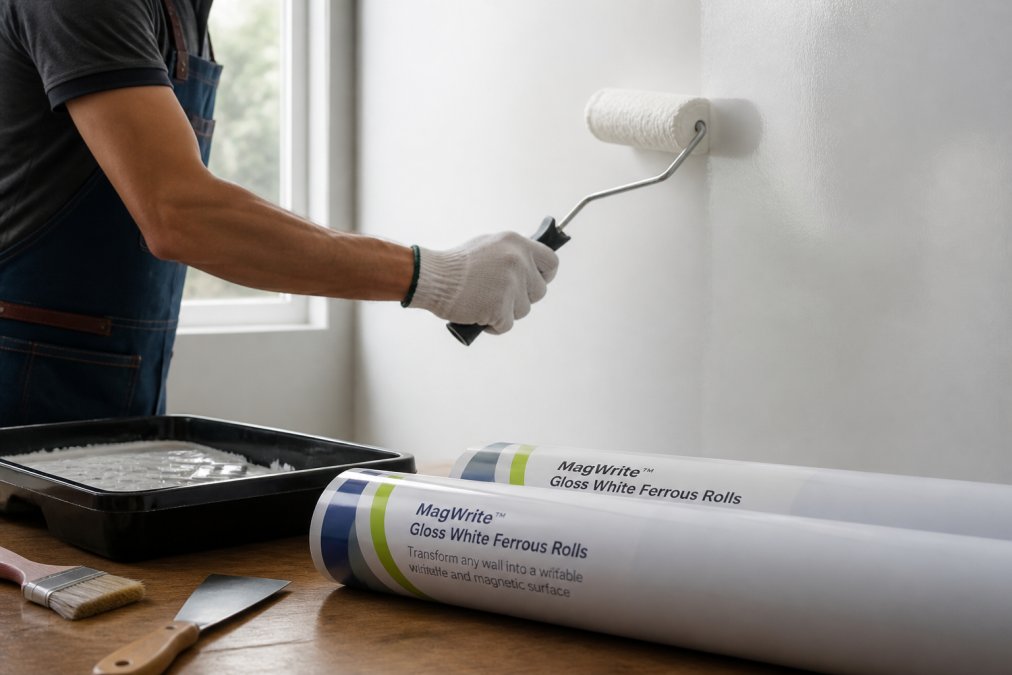
Preparing walls and assessing substrate compatibility
Begin by inspecting your wall's current condition. Existing wallpaper, paint, or finishes must be removed completely. Any remaining residue creates gaps between the ferrous backing and the wall, preventing proper adhesion and creating magnetic dead zones.
For painted walls, sand lightly to improve adhesion. For wallpapered walls, strip completely. For textured surfaces, consider filling and sanding smooth. Check for moisture and allow damp walls to dry completely. Prime the entire wall with quality adhesive primer to seal the substrate and ensure ferrous particles maintain magnetic contact.
Step-by-step installation process
Step 1: Measure and plan layout. Measure wall height and width. Mark vertical lines using a plumb bob or laser level at 60cm intervals.
Step 2: Prepare adhesive. Use adhesive formulated for heavyweight wallcoverings. Mix according to manufacturer instructions and let it slake for 15 minutes.
Step 3: Apply adhesive. Use a paint roller to apply an even coat to the wall in manageable sections (1.5 to 2 metres wide).
Step 4: Position wallcovering. Carefully unroll and position at the top of the marked area. Press firmly from top to bottom, smoothing out air bubbles as you work downward.
Step 5: Trim and overlap. At ceiling and floor lines, trim excess material with a sharp utility knife. For seams between rolls, overlap slightly and cut through both layers simultaneously.
Step 6: Allow curing. Most adhesives require 24-48 hours to cure fully before the wall is ready for use.
Avoiding common installation mistakes
Insufficient wall preparation is the most frequent error. Inadequate adhesive coverage is the second common mistake. Incomplete smoothing creates air pockets that trap moisture and reduce magnetic contact. Seam misalignment causes visible gaps and potential moisture ingress. Never install in damp conditions or immediately after painting.
Magnetic Whiteboard Wallpaper Benefits for Collaborative Environments
Magnetic whiteboard wallpaper, typically dry-erase surfaces with ferrous backing, delivers specific advantages in collaborative settings that fixed whiteboards cannot match.
Transforming static walls into visual management tools
Visual management means making work, progress, and decisions visible to everyone simultaneously. Magnetic whiteboard wallpaper consolidates scattered whiteboards and bulletin boards into a single, always-visible surface. A project timeline lives on the wall, updated in real time. A design studio posts client feedback, competitor research, and concept sketches on the same wall. The permanence matters: a wall-sized magnetic whiteboard is impossible to ignore and becomes part of the environment, a constant visual anchor that keeps priorities visible.
Magnetic objects and colour-coded labels add another layer of organisation. A hospital might use red magnets for urgent items, yellow for pending review, green for completed tasks.
Enhancing workspace productivity and communication
Visible work accelerates decision-making. When everyone can see the same information simultaneously, meetings become shorter and more focused. Asynchronous communication improves as team members leave notes or sketches on the magnetic wall without scheduling meetings. Accountability increases subtly when work is visible and progress becomes measurable. Creativity benefits from visible iteration as designers sketch, erase, and modify without creating waste.
Durability, Maintenance, and Removal Considerations
Magnet-receptive wallcovering is durable, but performance depends on proper maintenance and understanding realistic lifespan expectations.
Assessing long-term performance and wall damage
Quality magnet-receptive wallcovering maintains consistent ferrous backing performance for 10+ years under normal use. The visible surface layer may show wear sooner. Dry-erase surfaces develop minor ghosting after 3-5 years of heavy daily use, but this doesn't affect magnetic performance (research on material durability). The ferrous particles themselves don't degrade; what changes over time is the adhesive bond between the wallcovering and the wall.
Removal requires patience and care. Using a heat gun to soften adhesive, then carefully peeling the material away, works best. For rental spaces, discuss with your landlord before committing to permanent installation.
Cleaning and care for different surface finishes
Dry-erase surfaces require regular cleaning to maintain appearance. Weekly wiping with a microfibre cloth removes dust and light residue. Monthly deep cleaning with appropriate dry-erase cleaners removes marker ghosting. Never use abrasive scouring pads or harsh chemical solvents.
Chalkboard surfaces need regular dusting to prevent chalk accumulation. Weekly dusting with a soft brush keeps the surface clean. Matt finishes show dust and fingerprints more readily than gloss finishes and require more frequent light cleaning. Magnetic performance requires no maintenance; the ferrous backing doesn't degrade with cleaning.
Design Aesthetics and Selecting the Right Finish for Your Studio
Beyond function, magnet-receptive wallcovering contributes to your studio's visual identity. Choosing the right finish and colour ensures the wall enhances rather than detracts from your space.
Gloss versus matt finishes and their impact on usability
Gloss finishes reflect light, creating visual brightness and a more polished appearance. They're easier to clean because residue doesn't absorb into the surface. The trade-off is glare, which can cause discomfort in brightly lit spaces or when projectors shine on the wall.
Matt finishes eliminate glare entirely and are ideal for spaces with projectors or video conferencing. Matt finishes show dust and fingerprints more readily, requiring more frequent light cleaning. For dry-erase surfaces, gloss is generally preferable unless you have specific glare concerns.
Colour options and interior design integration
Standard magnet-receptive wallcoverings come in white (dry-erase) and black (chalkboard). White maximises contrast for marker visibility. Black provides dramatic visual impact and works well in creative studios seeking a distinctive aesthetic.
For custom finishes using magnetic liners, any colour is possible. Soft greys integrate seamlessly into minimalist spaces. Consider how the magnetic wall relates to your overall interior. Lighting affects colour perception significantly, so view samples under your actual studio lighting before committing.
Choosing magnet-receptive wallpaper requires balancing functional requirements, pull force, surface type, and installation complexity with aesthetic preferences and long-term durability expectations. The right solution transforms your creative studio into an environment where collaboration, visibility, and iteration become embedded in the physical space. MagScapes's range of ferrous wallcoverings, from the versatile MagWrite™ dry-erase options to the customisable MagLiner™ system, delivers the magnetic performance and design flexibility that creative professionals demand. Start with your use case: what will you hold on this wall, and how will it support your team's workflow? From there, surface type and finish follow naturally.
Frequently Asked Questions
What is the difference between magnetic paint and magnet-receptive wallpaper?
Magnetic paint requires multiple coats and lengthy application time, often resulting in uneven magnetic strength and poor magnet holding power. Magnet-receptive wallpaper like MagWrite and MagChalk arrives ready to install with consistent ferrous backing rated 4-5/5 for magnetic intensity. Wallpaper provides superior durability, cleaner aesthetics, and reliable performance from day one without the application headaches or inconsistent results that plague magnetic paint.
How strong do magnets need to be for magnet-receptive wallcoverings?
Pull force depends on what you're holding. For lightweight items like sticky notes or small cards, standard ferrite magnets (pulling 0.5-2kg) suffice. For heavier whiteboards, charts, or daily-use tools in busy creative studios, neodymium magnets (pulling 5-15kg+) are recommended. Test your specific magnets on a sample of your chosen wallcovering before full installation. Most magnet-receptive wallpapers score 4-5/5 for magnetic receptivity, meaning they work with many magnet strengths.
Can magnet-receptive wallpaper be applied over existing surfaces, and what happens when we move offices?
Yes, magnet-receptive wallcoverings can be installed over existing wallpaper, paint, or drywall if the substrate is smooth and sound. For rental spaces, installation is non-permanent: the wallpaper can be carefully removed without permanent damage to walls when you relocate. Proper surface preparation with drywall primer ensures clean removal. MagLiner, a magnetic liner product, can be applied beneath any wallpaper or fabric, offering flexibility for temporary or permanent installations.
Does magnet-receptive wallpaper interfere with electronic equipment like Wi-Fi routers or medical devices?
Magnet-receptive wallcoverings use ferrous materials and magnets, which operate at low magnetic fields and do not interfere with modern Wi-Fi, routers, or sensitive medical equipment. Healthcare facilities and offices with electronic equipment use these wallcoverings safely. If you have specific concerns about sensitive medical devices, consult your equipment manufacturer, but standard magnet-receptive wallpaper poses no documented risk to modern electronics.
This article was written using GrandRanker