


Table of Contents
- What Is Magnetic Wallcovering Installation?
- How to Prepare Walls for Magnetic Wallpaper
- Professional Installation Techniques for Magnetic Wallcovering
- Magnetic Wallpaper Installation Cost: What to Expect in 2026
- Fire Safety Regulations for Commercial Wallcoverings
- Durability, Maintenance, and Troubleshooting
- Applications Across Offices, Schools, and Healthcare
- Conclusion
Last Updated: August 11, 2026
What Is Magnetic Wallcovering Installation?
Magnetic wallcovering installation transforms ordinary walls into interactive, magnet-receptive surfaces that hold notes, displays, and creative materials without nails or adhesive strips. Unlike traditional wallpaper, magnetic wallcovering contains ferrous particles or backing that allow magnets to grip securely, turning static walls into functional collaborative tools.
The technology sits at the intersection of interior design and practical workspace engineering. A properly installed magnetic wallcovering system comprises three layers: a primer or adhesive base, the ferrous wallcovering itself, and often a decorative topcoat (paint, wallpaper, or dry-erase finish). The ferrous layer is what creates the magnetic receptivity, it's the critical component that determines how well magnets will hold and how long the system will perform.
What makes this different from earlier magnetic paint solutions is precision. Magnetic paint requires multiple coats, often four to six layers, and magnetic strength degrades with each topcoat application. Wallcovering products like those from MagScapes, the inventor of premium magnet-receptive wallcoverings, deliver consistent magnetic performance in a single application, eliminating the guesswork and labour intensity that frustrated early adopters.
Installation quality determines durability and functionality. Poor surface preparation, incorrect adhesive selection, or sloppy seam work will compromise magnetic performance within months. Conversely, professional installation following industry standards ensures the system performs reliably for years, holding everything from lightweight reminder cards to heavier metal fixtures.
How to Prepare Walls for Magnetic Wallpaper
Wall preparation determines whether your magnetic wallcovering installation will succeed or fail. Most installation failures trace back to inadequate surface prep, not product defects.
Start by assessing the existing wall substrate. Drywall, plaster, concrete, and brick all accept magnetic wallcovering, but each requires different preparation. Drywall is the most common and forgiving substrate. Plaster walls must be checked for stability, loose or flaking plaster must be scraped away and patched. Concrete and brick are porous and absorb moisture; they need a moisture barrier primer before wallcovering application.
Remove all existing wall coverings, paint, and adhesive residue. Use a putty knife or scraper to strip away old wallpaper, then sand the wall smooth with 120-150 grit sandpaper. This step cannot be rushed. Bumps, ridges, or residual adhesive will prevent proper contact between the ferrous wallcovering and the wall surface, creating air pockets that weaken magnetic strength.
Fill all holes, cracks, and gaps with lightweight joint compound. Sand these repairs smooth once dry. A perfectly flat, smooth surface is non-negotiable, the ferrous layer must make complete contact with the substrate to deliver consistent magnetic performance across the entire wall.
Clean the wall thoroughly with a damp cloth to remove dust and debris. Allow it to dry completely before applying primer. Many professionals use a high-grab adhesive primer specifically formulated for wallcovering installation. This primer serves dual purposes: it seals the substrate and creates the adhesive base for the ferrous wallcovering.
Check wall plumb and level using a laser level or plumb line. Mark reference lines on the wall where you'll begin installation. Magnetic wallcovering installation requires precision, even slight deviations compound across large wall areas, resulting in visible misalignment and seam problems.
Professional Installation Techniques for Magnetic Wallcovering
Surface Preparation and Substrate Assessment
Professional installers begin every job with a detailed site survey. They assess wall condition, measure square footage precisely, check for moisture problems, and identify any structural issues that might affect adhesion. This upfront assessment prevents costly surprises mid-installation.
Substrate compatibility is critical. Magnetic wallcovering adheres differently to drywall, plaster, brick, and painted surfaces. Drywall with existing paint requires light sanding to break the gloss; glossy surfaces reject adhesive. Plaster walls need stabilisation primer if they show any cracking or powder. Brick and concrete require moisture barriers because these porous substrates absorb water, which weakens adhesive bonds and can cause wallcovering to bubble or separate over time.
Professional installers laser-level the wall to identify high and low spots. Walls that appear flat to the eye often have 10-15mm variations. These irregularities must be addressed with joint compound before wallcovering application. Skipping this step results in poor contact between the ferrous layer and the substrate, creating weak zones where magnets won't hold effectively.
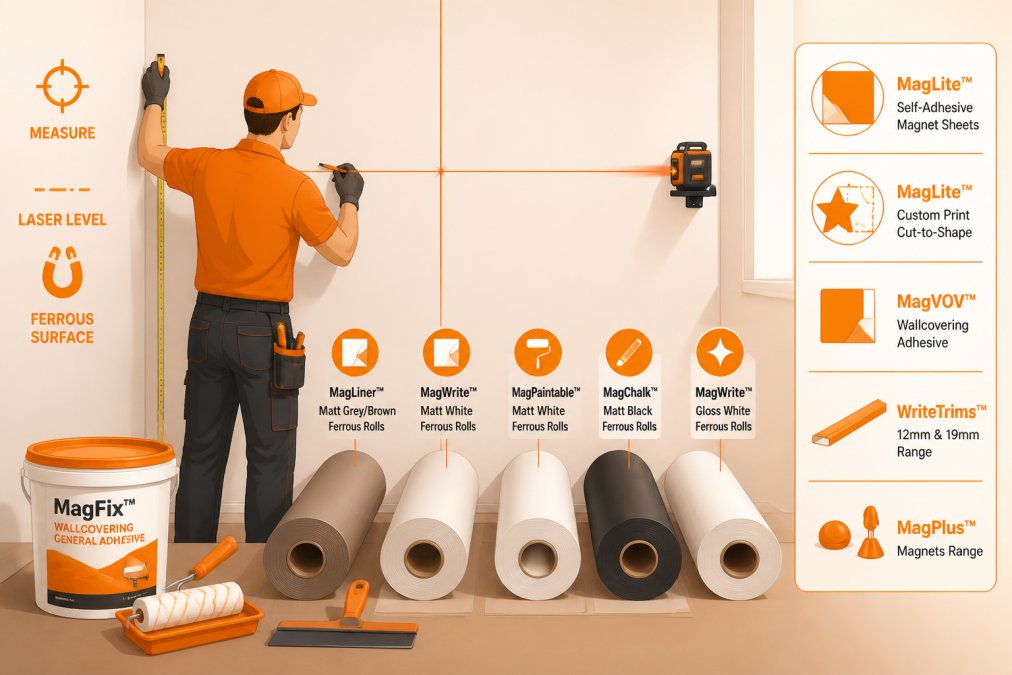
Adhesive Application and Precision Hanging
High-grab adhesive is the standard for magnetic wallcovering installation. This adhesive grips immediately upon contact, allowing the installer to position the wallcovering accurately without slippage. Application method matters enormously.
Professionals apply adhesive using a notched trowel or roller, creating uniform ridges across the wall. The ridges collapse when the wallcovering is pressed into place, creating full contact without air pockets. Insufficient adhesive leads to bubbling and separation; excessive adhesive creates squeeze-out at seams and edges, which is messy to clean and can weaken seams if not managed carefully.
The ferrous wallcovering must be hung with laser precision. Installers use plumb lines and laser levels to ensure the first strip is perfectly vertical. Subsequent strips must align horizontally with no vertical drift. Even 2-3mm of drift across a 2.4-metre wall becomes visually obvious and compromises the finished appearance.
Pressure application is the final critical step. After positioning the wallcovering, installers use a plastic smoother or brush to press out air pockets and ensure full adhesive contact. This pressure must be firm but controlled, excessive force can tear the wallcovering or squeeze out too much adhesive.
Seam Alignment and Trimming
Seam quality separates professional work from amateur attempts. Wallcovering seams must butt tightly without overlapping, gaps, or visible ridges. Poor seams allow moisture penetration, which weakens adhesive bonds and can cause the wallcovering to separate.
Professional installers use a seam roller, a specially designed tool with rounded edges, to compress seams without damaging the wallcovering. The seam roller is applied with moderate pressure along the entire seam length, multiple times, to ensure the adhesive has fully set and the seam is bonded securely.
Trimming at edges, corners, and around fixtures requires a sharp utility knife and steady hand. Dull blades tear the wallcovering; unsteady cuts create visible gaps. Professional installers use a straight edge or metal guide to ensure clean, straight cuts. Around corners and inside angles, the wallcovering must be cut and fitted precisely, gaps or overlaps at corners are immediately obvious and difficult to repair without re-hanging the entire section.
Magnetic Wallpaper Installation Cost: What to Expect in 2026
Installation costs vary significantly based on wall condition, room size, and labour rates. Understanding the cost breakdown helps you budget accurately and avoid surprises.
Material costs depend on product selection. MagScapes' MagLiner™ Matt Grey/Brown Ferrous Rolls start at £66.64 per roll (0.61m × 6m coverage), making it a cost-effective base layer if you plan to paint or wallpaper over it. For finished surfaces, MagWrite™ Gloss White Ferrous Rolls and [MagPaintable(/products/magpaintable)™ Matt White Ferrous Rolls | magscapes.com] are priced at £216.00 per roll. These premium products deliver superior magnetic performance and durability compared to magnetic paint alternatives.
Labour costs typically range from £150-£250 per square metre for professional installation, depending on wall condition and regional rates. A standard office conference room (20 square metres) would cost £3,000-£5,000 in labour alone. Complex installations, walls with existing damage, multiple corners, or fixture cutouts, command premium rates.
Surface preparation adds cost but is essential. Budget £20-£40 per square metre for wall repair, priming, and levelling if walls are in poor condition. Neglecting this step often results in premature failure and costly remediation.
Total project cost for a typical office installation ranges from £5,000-£8,000 for a 20-square-metre space, including materials and labour. Larger commercial projects (100+ square metres) often negotiate lower per-square-metre rates.
Fire Safety Regulations for Commercial Wallcoverings
Commercial wallcoverings in the UK must meet fire safety standards defined by British Standards and building regulations. This is non-negotiable for offices, schools, hospitals, and any public-facing space.
Magnetic wallcovering products must achieve Euroclass B fire rating or better, as defined by EN 13501-1 fire classification standard. Euroclass B materials have limited contribution to fire development and smoke production. Products rated C or lower are unsuitable for commercial applications and may violate building codes.
MagScapes products are engineered to meet these standards. MagScapes Pro wallcoverings carry a Euroclass B-s1, d0 fire rating, which makes them suitable for high-traffic commercial and public spaces. The MagPaintable product has a Euroclass D-s1, d0 fire rating. Verify that any magnetic wallcovering product you specify carries current fire certification documentation. Installers should request and review test certificates before purchasing.
Building control authorities inspect commercial installations. Non-compliant materials can result in installation rejection, costly removal, and project delays. Always confirm fire ratings with your supplier and provide documentation to building control before work begins.
Durability, Maintenance, and Troubleshooting
Properly installed magnetic wallcovering performs reliably for 7-10 years or longer, depending on use intensity and maintenance. Healthcare and education environments with heavy daily use may see reduced lifespan, while lightly used office walls can exceed 10 years.
Magnetic strength remains consistent throughout the lifespan if the wallcovering remains intact and properly adhered. Unlike magnetic paint, which loses strength with each topcoat, wallcovering products maintain full magnetic performance even with multiple cleaning cycles.
Maintenance is straightforward. Wipe the surface regularly with a damp, lint-free cloth to remove dust and marks. For dry-erase surfaces, use standard whiteboard cleaner and a soft cloth. Avoid abrasive scrubbers that can damage the surface finish.
Common problems include bubbling, seam separation, and loss of magnetic hold. Bubbling indicates air pockets or inadequate adhesive contact, it typically appears within weeks of installation if surface preparation was poor. Small bubbles can sometimes be repaired by carefully lifting the edge, re-applying adhesive, and pressing down firmly. Larger areas require section replacement.
Seam separation occurs when adhesive fails, usually due to moisture penetration or inadequate initial pressure. Repair requires lifting the separated section, cleaning away old adhesive, applying fresh high-grab adhesive, and re-pressing. Prevention is far easier than repair, proper surface prep and thorough seam rolling during installation eliminate most seam problems.
Loss of magnetic hold suggests the ferrous layer has separated from the substrate or the adhesive has failed. This is rare with premium products but can occur if walls are subjected to extreme moisture or temperature fluctuations. Affected sections require replacement.
Applications Across Offices, Schools, and Healthcare
Magnetic wallcovering transforms how organisations use wall space. The technology is particularly valuable in collaborative environments where visual communication drives productivity and engagement.
In offices, magnetic walls create dynamic collaboration zones. Teams use magnets to display project timelines, brainstorming notes, process diagrams, and visual workflows. Conference rooms with magnetic wallcovering report improved meeting efficiency because information remains visible throughout discussions. Open-plan offices benefit especially, magnetic walls break up blank spaces and encourage informal collaboration.

Schools and universities use magnetic wallcovering to transform classrooms into interactive learning environments. Teachers display lesson materials, student work, and visual learning aids. Magnetic surfaces encourage hands-on learning and allow quick reconfiguration for different teaching approaches. Early childhood settings benefit from the durability, young children interact with walls constantly, and magnetic wallcovering withstands this wear far better than traditional displays.
Healthcare facilities use magnetic wallcovering for patient communication, staff coordination, and wayfinding. Hospital corridors with magnetic wallcovering allow staff to post patient information, shift schedules, and operational updates. Patient rooms benefit from visual communication aids that reduce anxiety and improve engagement. The hygienic, wipeable surface meets infection control standards and is easier to maintain than traditional bulletin boards.
Homeowners increasingly specify magnetic wallcovering for home offices, children's rooms, and kitchens. The interactive surface encourages creativity and organisation while maintaining sophisticated aesthetics. Unlike magnetic paint, wallcovering products deliver consistent performance without the labour-intensive application process.
Magnetic wallcovering installation represents a significant upgrade from static walls, but success depends entirely on proper execution. Professional installation following these standards ensures your investment performs reliably for years. If you're considering this upgrade for your office, classroom, or healthcare facility, start with a detailed site assessment and specify products from manufacturers with proven performance records. MagScapes offers premium magnetic wallcovering solutions engineered for demanding commercial environments, explore their full product range to find the right solution for your project.
| Installation Phase | Key Requirement | Cost Impact | Common Failure Point |
|---|---|---|---|
| Surface Prep | Wall must be flat, clean, and primed | £20-£40/m² | Skipped or rushed |
| Adhesive Application | High-grab adhesive, proper notch pattern | Included in labour | Wrong adhesive type |
| Hanging | Laser-level precision, controlled pressure | Labour-intensive | Vertical drift, air pockets |
| Seam Work | Tight butt seams, proper rolling pressure | Included in labour | Gaps, overlapping, moisture entry |
| Fire Compliance | Euroclass B certification minimum | Included in material cost | Non-compliant products specified |
| Maintenance | Regular cleaning, early damage detection | Minimal | Neglect leading to adhesive failure |
Frequently Asked Questions
How much does professional magnetic wallcovering installation cost in 2026?
Installation costs vary based on wall area, surface condition, and labour rates. MagScapes products range from £66.64 per roll for MagLiner™ to £322.56 for MagChalk™. Professional installation typically adds £20-£40 per square metre depending on site complexity, substrate preparation needs, and contractor experience. A 10-square-metre office wall might cost £400-£800 installed. Request site surveys and quotes from certified installers to compare pricing for your specific project.
What fire safety regulations apply to magnetic wallcoverings in commercial spaces?
Commercial wallcoverings must comply with BS EN 13823 and BS EN ISO 1182 for fire performance classification. MagScapes products achieve Euroclass B certification, meeting most workplace safety standards. Healthcare and educational facilities often require higher classifications. Always verify compliance with your local building control authority and insurance provider before installation, as requirements vary by sector and building type.
Can magnetic wallcovering be installed over existing wallpaper or damaged walls?
Installation over existing wallpaper is not recommended due to adhesion and durability risks. Walls must be clean, dry, and structurally sound. Damaged areas require repair and primer application before hanging. Professional installers assess substrate compatibility during site surveys and may recommend wall repair or removal of old finishes. This preparation step is critical for a seamless finish and long-term magnetic strength.
How long does a magnetic wallcovering installation typically take?
Installation time depends on wall area, surface condition, and complexity. A standard office or classroom wall (10-20 square metres) typically takes one to two days with professional contractors. This includes surface preparation, primer application, adhesive application, hanging, seam alignment, and trimming. Drying time varies by adhesive type; most projects allow 24-48 hours before magnets are applied for full strength and durability.
This article was written using GrandRanker