


Table of Contents
- What Is Custom Magnetic Wallcovering for Designers?
- Magnetic Wallpaper UK: Design Flexibility and Customisation Options
- Flexible Display Solutions UK: Interactive Workspaces and Creative Environments
- Magnetic Wallcovering Installation UK: Step-by-Step Implementation for Designers
- Commercial Magnetic Wallcovering UK: ROI and Business Applications
- Custom Magnetic Wallcovering for Designers: Technical Specifications and Performance Standards
- Comparing Magnetic Wallcovering to Traditional Alternatives
- Smart Integration and Future-Proofing Your Design
Last Updated: July 28, 2026
What Is Custom Magnetic Wallcovering for Designers?
Custom magnetic wallcovering transforms ordinary walls into interactive, functional surfaces combining aesthetic appeal with practical utility. Unlike traditional wallpaper or paint, magnetic wallcoverings contain a ferrous-backed substrate that enables magnets, metal accessories, and interactive elements to adhere directly to walls without drilling or damage. A thin, flexible ferrous layer (typically 0.5-1mm thick) remains invisible once installed, while custom printed graphics, branding patterns, or solid colours layer on top, creating visually stunning yet functionally dynamic surfaces.
For design professionals, walls are no longer static backdrops but evolving surfaces that adapt to different uses throughout the day and support actual work happening in the space. Whether in corporate offices, educational institutions, healthcare facilities, or creative studios, custom magnetic wallcovering offers flexibility traditional solutions cannot match.
How Magnet-Receptive Surfaces Work
A magnet-receptive surface functions through electromagnetic attraction between the ferrous material in the wallcovering and attached magnets. Magnetic adhesion strength depends on ferrous layer thickness and quality, magnet strength, and object weight. Well-specified ferrous wallcovering can reliably hold items weighing 5-10kg per magnet, making surfaces suitable for lightweight signage to heavier architectural elements. MagScapes ferrous wallcoverings maintain consistent magnetic performance over 15+ years with daily use, while cheaper alternatives degrade within 2-3 years.
Magnetic Wallpaper UK: Design Flexibility and Customisation Options
Magnetic wallcoverings can be custom printed with virtually any design while maintaining full ferrous functionality underneath, combining aesthetics and utility simultaneously.
Custom Printed Designs and Branding Patterns
Custom printed magnetic wallcoverings integrate brand identity, wayfinding systems, or artistic installations directly into wall finishes using high-resolution digital or flexographic techniques, achieving 1200+ dpi resolution. Corporate offices can feature brand colours and logos; healthcare facilities can use calming imagery with magnetic display surfaces for patient information; educational spaces can showcase curriculum-related artwork while functioning as collaborative learning tools.
The design process begins with your artwork in standard formats (PDF, AI, EPS, or high-resolution raster files). MagScapes produces custom samples for approval before full production, with turnaround typically 3-4 weeks for standard orders. Minimum order quantities are usually one roll (covering 10-15 square metres), making custom printing accessible for smaller projects.
Colour, Finish, and Aesthetic Integration
Magnetic wallcoverings are available in standard finishes integrating seamlessly into any design scheme. Matt finishes provide sophisticated, contemporary appearance without light reflection or glare. Textured finishes add tactile interest and disguise minor imperfections. Some ferrous wallcoverings are paintable, allowing custom colour application after installation for flexibility in colour matching or future repainting.
Quality ferrous wallcoverings feature design-forward finishes competing visually with premium wallpapers and architectural treatments. The ferrous layer remains completely invisible; only the top finish layer is visible, which can be as refined as any high-end interior material.
Flexible Display Solutions UK: Interactive Workspaces and Creative Environments
Magnetic wallcovering transforms static walls into active, responsive surfaces supporting how people actually work, learn, and collaborate.
Transforming Static Walls Into Active Collaboration Tools
In open-plan offices, magnetic wallcovering eliminates constraints of traditional whiteboards, pin boards, and mounted shelving. The entire wall becomes a collaboration surface where teams display project timelines, brainstorm ideas, and coordinate initiatives. Information remains visible and accessible without cluttering desks, and walls become shared cognitive tools supporting actual workflow.
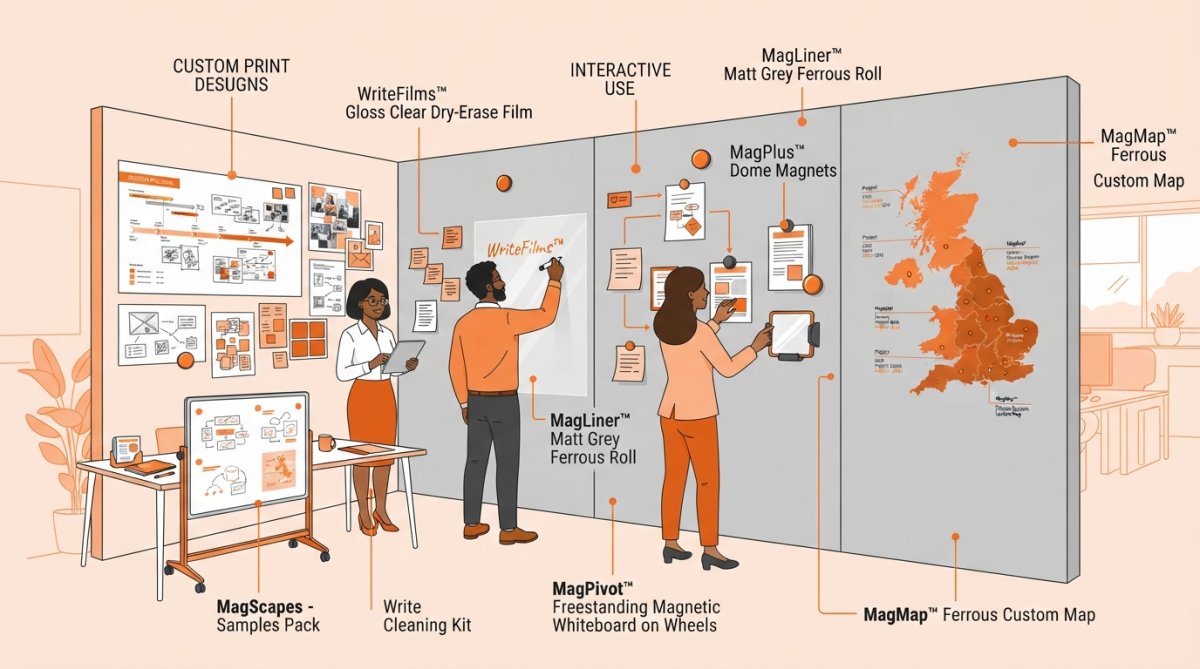
Educational environments benefit equally. Teachers display student work, curriculum materials, and assessment data on magnetic walls that become teaching tools themselves. Healthcare settings use magnetic wallcoverings for patient schedules, care coordination, wayfinding graphics, and staff communication, supporting patient care work while maintaining professional, calming aesthetics.
Multi-Functional Wall Applications
A single magnetic wall serves multiple functions simultaneously: branding backdrop, information display, interactive learning surface, and functional storage for lightweight items. In residential settings, designers create family command centres, kitchen organisation systems, or creative spaces. Retail and hospitality environments use magnetic wallcoverings for product displays and promotional graphics that change quickly without adhesive or hardware.
Magnetic Wallcovering Installation UK: Step-by-Step Implementation for Designers
Installation quality directly determines longevity and performance. Poor installation results in bubbling, peeling edges, uneven magnetic performance, and premature failure.
Surface Preparation and Substrate Requirements
Walls must be clean, smooth, dry, and stable before installation. Existing wallpaper, loose paint, and surface contaminants must be removed completely. Walls should be sanded to smooth finish (120-150 grit) ensuring good adhesive contact. Dust must be vacuumed and wiped away; residual dust creates voids weakening adhesion.
For walls with significant imperfections, applying primer or lining paper creates uniform surfaces. Moisture is critical, walls must be completely dry before installation. Moisture trapped behind wallcovering causes adhesion failure and mould growth. Moisture meter testing should show readings below 12%.
Temperature and humidity during installation matter significantly. Ideal conditions are 15-25°C with 40-60% relative humidity. Installation in cold, damp conditions or excessive heat compromises adhesive performance.
Installation Process and Timeline
Installation typically follows this sequence: wall measurement and layout marking, adhesive application, wallcovering placement, smoothing and bubble removal, and final edge sealing. For typical rooms (20-30 square metres), professional installation takes 2-3 days depending on wall complexity.
Acrylic-based or vinyl-specific adhesives are recommended; solvent-based products can damage ferrous wallcoverings. Paste is applied to walls using paste rollers or brushes, ensuring even coverage. Wallcovering is positioned carefully from top downward, with air bubbles smoothed using plastic smoothers or squeegees, working from centre outward. Edges are sealed with sealing compound preventing lifting or moisture infiltration.
Drying time typically ranges 24-48 hours before walls can bear weight or have magnets attached. During this period, rooms should remain undisturbed at stable temperature and humidity.
Common Installation Mistakes to Avoid
Frequent errors include insufficient adhesive application creating voids and weak bonding, rushing bubble-removal trapping air pockets, and applying adhesive to wallcovering rather than walls. Failing to account for wall obstacles, electrical outlets, and architectural features creates visible seams or awkward cuts. Temperature fluctuations during curing cause adhesive failure. Unsuitable substrates (crumbling plaster, overly porous concrete, unprimed metal) prevent successful installation.
Commercial Magnetic Wallcovering UK: ROI and Business Applications
For commercial projects, investment must be justified by measurable business outcomes.
Cost-Benefit Analysis for Office and Institutional Projects
Total installation costs include material (typically £60-150 per square metre depending on customisation) and labour (£40-80 per square metre). For typical 100-square-metre office spaces, total installed cost ranges £10,000-£23,000 depending on complexity.
This compares favourably to alternatives: traditional whiteboards cost £300-800 each occupying floor space; magnetic paint requires multiple coats with inconsistent results; standard wallpaper plus separate magnetic systems requires multiple products creating visual fragmentation.
ROI calculations include labour savings from improved communication, space savings from eliminating separate display furniture, and productivity gains from better information visibility. Organisations implementing magnetic wallcoverings report teams spend less time searching for information and brainstorming sessions are more efficient.
Educational institutions see benefits in learning outcomes. Classrooms with magnetic wallcoverings show increased student engagement and better concept retention.
MagScapes offers custom ferrous solutions starting at £99 for small custom prints, ranging to several thousand pounds for full-room installations. The MagScapes product range includes MagLiner™ (basic ferrous backing), MagWrite™ (ferrous wallcovering with whiteboard-compatible surface), MagPaintable™ (ferrous wallcovering for custom paint finishes), and MagPrint™ custom printing services.
Real-World Applications in Healthcare, Education, and Corporate Spaces
A hospital ward implemented magnetic wallcovering in patient care areas, creating surfaces for displaying care plans and medication schedules. Staff reported 15-20% reduction in time locating patient information; patients felt more informed about care. A secondary school created a science classroom with magnetic walls displaying the periodic table and key formulas, allowing students to manipulate elements directly during lessons. A technology company redesigned open-plan offices with magnetic wallcovering in collaboration zones, replacing three whiteboards and a bulletin board, reporting improved cross-team communication and faster decision-making.
Custom Magnetic Wallcovering for Designers: Technical Specifications and Performance Standards
Understanding technical characteristics ensures magnetic wallcovering performs as expected over its lifespan.
Magnetic Strength, Load-Bearing Capacity, and Durability
Standard ferrous wallcoverings typically support 3-8kg per magnet, sufficient for most office, educational, and retail applications. Durability depends on ferrous material's oxidation and delamination resistance. Quality ferrous wallcoverings with protective coatings maintain magnetic properties for 15+ years. Cheaper alternatives using unprotected steel degrade within 2-5 years, losing magnetic strength and developing discolouration.
Sustainability, VOC-Free Standards, and Environmental Impact
Modern ferrous wallcoverings are often manufactured to VOC-free standards, ensuring no harmful chemical off-gassing. This is particularly important for healthcare and educational settings. Look for products certified to ISO 16000 or equivalent standards.
Ferrous material is typically steel or iron-based, both recyclable. Durability is an environmental factor often overlooked; wallcovering lasting 15 years has significantly lower environmental impact than products requiring replacement every 3-5 years.
Maintenance, Cleaning, and Long-Term Performance
Magnetic wallcovering surfaces clean easily with mild soap and water or standard commercial cleaning products. Slightly abrasive sponges can address stubborn marks without finish damage, making it ideal for healthcare or food-service settings.
Magnetic performance doesn't degrade with normal use. Magnets can attach and detach thousands of times without weakening the ferrous layer. Long-term performance issues are rare with quality ferrous wallcoverings on properly prepared substrates. The most common problem is edge lifting from adhesive failure, preventable through proper installation and edge sealing.
Comparing Magnetic Wallcovering to Traditional Alternatives
Understanding trade-offs with other wall treatment and display solutions informs specification decisions.
Magnetic Wallcovering vs. Whiteboard Paint and Magnetic Paint
Magnetic paint requires multiple coats (typically 3-4) making application labour-intensive and expensive. Performance is inconsistent, with holding capacity varying by application thickness. Many projects result in weak magnetic performance insufficient for practical use. Appearance is typically industrial or clinical, lacking design sophistication.
Ferrous wallcovering provides consistent, reliable magnetic strength from first installation, integrates finished design aesthetics, and maintains appearance over years without staining or ghosting. Higher upfront cost is justified by superior performance and aesthetics.
| Solution | Magnetic Strength | Design Flexibility | Durability | Cost | Best For |
|---|---|---|---|---|---|
| Magnetic Wallcovering | Consistent, 3-8kg per magnet | Unlimited custom designs | 15+ years | £60-150/m² installed | Professional spaces requiring aesthetic + function |
| Magnetic Paint | Inconsistent, 1-3kg per magnet | Limited to solid colour | 2-5 years | £30-50/m² installed | Budget-conscious projects with low aesthetic requirements |
| Whiteboard Paint | None (non-magnetic) | Limited to solid colour | 1-3 years | £40-60/m² installed | Spaces needing writing surface only, not magnetic hold |
| Standard Wallpaper + Separate Displays | None | Design dependent on paper choice | 5-10 years | £40-80/m² installed | Traditional aesthetic spaces with no interactive requirements |
Magnetic Wallcovering vs. Standard Wallpaper and Wall Graphics
Standard wallpaper is purely decorative, providing no functional capability. Wall graphics add visual interest but lack functionality. Both require separate solutions for display, collaboration, or interactive needs.
Magnetic wallcovering combines aesthetic finish with functional capability, eliminating need for additional display systems. Walls can be both beautiful and functional simultaneously.
Smart Integration and Future-Proofing Your Design
As workplaces become increasingly technology-integrated, magnetic wallcovering's compatibility with digital and IoT systems becomes relevant for creating spaces adapting to future needs.
Compatibility with Smart Office Technology and IoT Devices
Magnetic wallcovering is compatible with smart office technology through magnetic mounting systems. The ferrous layer holds lightweight IoT sensors, small display panels, or wireless communication devices using magnetic mounts, allowing technology integration without permanent installation or visible wiring.
Advanced applications include magnetic mounting systems for modular display panels repositionable as office configurations change. The ferrous layer doesn't interfere with wireless communication (Wi-Fi, Bluetooth, cellular signals) in normal applications.
Addressing EMI Concerns and Safety Testing in Sensitive Environments
Electromagnetic interference (EMI) is a legitimate concern in healthcare settings with sensitive medical equipment, laboratories, or research facilities. Quality ferrous wallcoverings are manufactured and tested ensuring they don't create problematic EMI. Testing to standards such as IEC 61000 confirms safety requirements for sensitive environments.
In practice, ferrous wallcovering positioned several metres from sensitive equipment rarely causes problems. Magnetic field strength decreases dramatically with distance, and properly shielded equipment is unaffected. The ferrous layer is non-toxic, poses no health or safety risk, doesn't off-gas, and requires no special handling or disposal.
Magnetic wallcovering represents genuine innovation in how interior spaces function. Rather than choosing between beautiful design and practical workspace capability, designers create surfaces excelling at both. Whether designing corporate offices, educational facilities, healthcare environments, or creative spaces, magnetic wallcovering offers flexibility traditional solutions cannot match. MagScapes' ferrous wallcovering solutions, including MagLiner™, MagWrite™, MagPaintable™, and custom MagPrint™ services, provide technical foundation and design sophistication to bring these concepts to life. Start with a consultation to explore how magnetic wallcovering can transform your next project into a space that's both visually stunning and functionally dynamic.
Frequently Asked Questions
How is custom magnetic wallcovering different from magnetic paint, and will it actually hold magnets securely?
Custom magnetic wallcovering uses ferrous-based wallcovering with superior magnetic strength compared to paint solutions. Magnetic paint requires multiple coats, lengthy application times, and often fails to hold heavier objects reliably. Wallcovering products like MagWrite™ and MagLiner™ provide consistent, tested magnetic receptivity across the entire surface, ensuring secure adhesion for whiteboards, displays, and accessories without the durability issues users report with paint alternatives.
Will magnetic wallcovering interfere with medical equipment, Wi-Fi routers, or sensitive electronics in my office or healthcare facility?
Magnetic wallcovering uses passive ferrous materials that do not emit electromagnetic fields or radiation. Unlike active electromagnets, these wallcoverings do not generate EMI (electromagnetic interference) and pose no risk to medical devices, Wi-Fi systems, or office technology. Magnetic wallcovering has been successfully installed in healthcare settings without equipment interference. If you have specific medical devices, consult your equipment manufacturer's documentation and conduct site testing before installation.
What is the actual cost per square metre for custom magnetic wallcovering, and how does it compare to replacing whiteboards or traditional wall finishes over time?
MagScapes ferrous wallcovering rolls start from £216-£248 depending on finish type (MagPaintable™, MagWrite™). Custom printed designs (MagPrint™) begin at £99. Installation and substrate preparation add labour costs. Over a 5-10 year period, magnetic wallcovering typically costs less than repeatedly replacing whiteboards, magnetic boards, or wall graphics, whilst offering superior functionality. Request a project quote for accurate commercial pricing tailored to your space dimensions and customisation needs.
How durable is magnetic wallcovering in high-traffic areas like classrooms or busy offices, and will it become stained or stop holding magnets after heavy use?
Quality ferrous wallcoverings are designed for commercial durability and withstand daily use in schools, offices, and healthcare settings. The magnetic receptivity does not degrade with normal use. Staining and scuffing depend on finish type, matte finishes show marks more readily than wipeable or paintable options. MagWrite™ (whiteboard surface) resists marker stains, whilst MagPaintable™ allows protective topcoat application. Proper maintenance and appropriate finish selection ensure long-term performance in high-traffic environments.
This article was written using GrandRanker