


Table of Contents
- Step 1: Assess Your Ward's Communication Gaps Before Choosing Boards
- Step 2: Choose the Right Communication Boards for Your Clinical Setting
- Step 3: Use Bedside Communication Board Templates to Standardise Information
- Step 4: Implement Patient Safety Communication Strategies That Stick
- Step 5: Maintain Hygiene and Durability of Communication Boards
- Step 6: Track Staff Compliance and Board Effectiveness
- Conclusion: Making Communication Boards Part of Your Safety Culture
- Frequently Asked Questions
Last Updated: September 14, 2026
Step 1: Assess Your Ward's Communication Gaps Before Choosing Boards
Improving patient safety with communication boards starts with measurement, not procurement. Spend a week documenting where information breaks down.
Too many trusts order boards first, ending up with a whiteboard nobody updates beside a digital screen nobody checks.
Here's a practical audit framework:
- Shadow a shift handover and note every verbal-only instruction
- Record how many patients ask the same question three times in a day
- List every piece of information staff rewrite from memory each shift
- Identify which patients cannot see or reach their current bedside notes
- Check whether agency and bank staff can find key information without asking
Gaps fall into three categories: information that exists but isn't visible, information that's visible but out of date, and information never written down. Each needs a different fix.
The NHS England guidance on reducing harm in hospital care sets out the national patient safety agenda your board project should align to. Map your audit findings against it before you shortlist anything.
Step 2: Choose the Right Communication Boards for Your Clinical Setting
Board selection should follow your audit, not your supplier's catalogue. A busy surgical ward needs different functionality from a quiet palliative care bay; the wrong choice creates work.
Ask three questions for each clinical area:
- Who reads this board, staff or patients?
- What information changes hourly versus daily?
- Can the surface be cleaned between patients without damage?
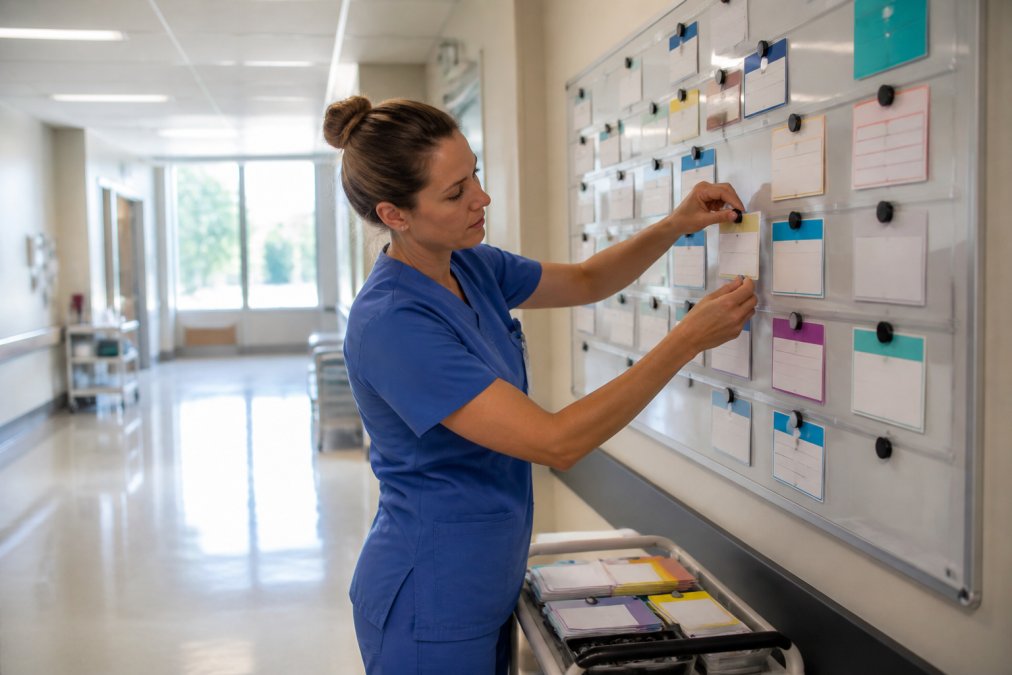
Analog vs Digital Boards: What Works on Busy Wards
Analog boards win on reliability; digital boards win on integration. Most wards benefit from a hybrid approach.
Magnetic boards never lose power or lock a nurse out at 3am. Digital screens pull live data from your electronic patient record and push alerts automatically, but fail when the network does and cost more to maintain.
Many teams split it: analog boards for bedside and handover information, digital screens for ward-level metrics. A network outage then never removes information a nurse needs to keep a patient safe.
Magnetic Wallcoverings for Flexible, Hygienic Surfaces
Magnetic wallcoverings are ferrous-backed wall finishes that accept magnets while also working as a dry-erase or projection surface, replacing the whiteboard with a continuous, wipe-clean wall that adapts as needs change.
MagScapes manufactures magnet-receptive wallcoverings for environments where walls need to do more than divide space. The MagWrite™ Gloss White Ferrous Rolls (£216.00) give a cleanable dry-erase surface with 4/5 magnet receptivity, so status magnets, patient cards and handover notes stick securely. The MagWrite™ Matt White Ferrous Rolls (£248.00) offer a non-smudging, projector-friendly finish.

For wards that need to reconfigure frequently, the MagPivot™ Freestanding Magnetic Whiteboard on Wheels (£1,195.00) moves between bays without any fixing to the wall. It's a sensible option for temporary cohorts or isolation areas.
Step 3: Use Bedside Communication Board Templates to Standardise Information
Standardised templates are the biggest driver of consistent board use. When every board shows the same fields in the same order, any member of staff can find what they need in seconds.
A bedside communication board template should carry, at minimum:
- Patient name and preferred name
- Named nurse and named care assistant for the shift
- Mobility and falls risk status
- Allergies and dietary requirements
- Estimated discharge date
- Communication needs, including interpreting or hearing support
Keep the template to six or seven fields. Boards with fifteen fields get partially completed; boards with six get fully completed.
NHS England's guidance on personalised care and support planning supports the principle that patients should see and contribute to the information recorded about them.
The same logic applies to ward-level boards: standardise the layout, then let content vary. Compliance tracking becomes easier when you can tell at a glance whether a board is complete.
Step 4: Implement Patient Safety Communication Strategies That Stick
Patient safety communication strategies fail for one reason: they add work without removing any. Implementation must be net-neutral on staff time, or it will quietly stop.
Three strategies that hold up in practice:
- Build board updates into existing handover. Don't create a separate task. Tie the update to the bedside shift report so it happens as part of a routine staff already follow.
- Assign ownership by shift, not by role. Every shift has a named person responsible for the board. Ambiguous ownership means no ownership.
- Use structured communication frameworks. SBAR gives staff a consistent way to escalate concerns, and the board can prompt it.
Train Staff on Structured Communication and Board Updates
A 20-minute session per shift is enough. Cover what each field means, who updates it, and what to do when information is missing.
Train at the board itself, not in a classroom. Walk new starters and bank staff through a live board during induction so they use it correctly from day one.
The real difference between a board that works and one that doesn't comes down to whether updating it is part of the handover ritual. If it's a separate task, it's the first thing dropped on a busy shift.
Step 5: Maintain Hygiene and Durability of Communication Boards
Hygiene protocols determine whether your boards survive contact with a working ward. Boards that can't be cleaned properly between patients become infection control risks, and IPC teams will ask you to remove them, the section most board guides skip.
Match the Cleaning Agent to the Surface Finish
Not all disinfectants are compatible with all board surfaces. The three families you will meet on a ward behave differently:
- Chlorine-releasing agents (typically 1,000 ppm available chlorine for general near-patient surfaces, 10,000 ppm for blood and body fluid spillage) are effective against a broad range of organisms but are corrosive to some metals and will dull a gloss finish over time if left to dry (the NHS).
- Alcohol-based wipes (usually 70% isopropyl or ethanol) are fast-acting and kind to most laminates and ferrous wallcoverings, but they are not sporicidal, so they are unsuitable where Clostridioides difficile or norovirus is a concern.
- Peracetic acid and accelerated hydrogen peroxide products sit between the two: broader spectrum than alcohol, less aggressive to surfaces than chlorine, but with a higher unit cost.
Whatever you choose, follow the manufacturer's stated contact time, the surface must stay wet for the full dwell time. A common error is to spray and immediately wipe, removing the agent before it has done its job.
Set a Cleaning Schedule That Mirrors Your Environmental Routine
Boards are near-patient surfaces, so clean them as often as the bed rail, bedside table and call bell:
- Twice daily as part of the routine environmental clean
- After every patient contact where the board has been touched by staff or visitors
- On discharge or transfer of a patient, before the next occupant's details go up
- Immediately if visibly soiled
Build the board into your existing cleaning schedule rather than creating a separate one; as a standalone task it will be dropped first when the ward is short-staffed.
Durability: What Actually Fails First
In clinical environments, boards rarely fail because the surface wears out. They fail because:
- The edge seal lifts where the wallcovering meets a corner or a door frame, allowing moisture behind the surface.
- The ferrous layer delaminates if the wall behind it was not properly prepared or if the board is repeatedly exposed to standing water.
- The print or coating fades in direct sunlight, which is why boards in south-facing corridors should be specified with a UV-stable finish.
A gloss ferrous wallcovering is engineered for repeated wiping; a cheap laminate board is not. In high-traffic corridors, expect scuffing and plan for touch-up rather than replacement.
Accessibility: Design for the Patient, Not the Standing Nurse
A board that only works for a standing member of staff excludes the patients who need it most. Two rules:
- Mount height: the primary information zone should sit within the reach and sightline of a seated patient. As a working guide, keep the top of the patient-facing content no higher than roughly 1.4 m from the floor, and the key fields (name, named nurse, mobility status) between 1.0 m and 1.3 m.
- Contrast and type size: use high-contrast text (dark on light, or light on dark) and a minimum body size that a patient with mild visual impairment can read from the bed. Avoid pale yellow on white, which looks clean on a design mock-up and disappears on a ward.
For patients with low health literacy or a preferred language other than English, pair the board with a translated or symbol-based overlay rather than expecting them to interpret clinical shorthand. Plain words, "who is looking after me today" rather than "named nurse allocation", are read more often and understood more accurately.
Step 6: Track Staff Compliance and Board Effectiveness
You cannot improve what you don't measure, and most wards that abandon communication boards do so because nobody checked whether they were used. Here is an audit method that fits existing ward routines.
Audit in Real Time, Not in Retrospect
A monthly review of a board last updated three weeks ago tells you nothing. Compliance must be observed at the point of care, during the shift in which the board should be current.
The most reliable method is a short, structured spot-check built into the shift. A senior nurse or practice educator walks the bay at a fixed point, typically mid-morning and again after handover, and records four things for each bed space:
- Is the patient's name and preferred name correct?
- Is the named nurse for this shift shown?
- Is the mobility and falls risk status current?
- Is the estimated discharge date either accurate or deliberately left blank?
That is a two-minute check per bay. Ten beds takes twenty minutes and gives a defensible completion rate for the shift.
Separate Process Failure from Training Failure
When completion rates drop, the instinct is to retrain, usually the wrong response. Before booking training, ask three questions:
- Is the board in the right place? If staff have to walk to the corridor to update it, they won't.
- Are there too many fields? Boards with fifteen fields get partially completed; boards with six get fully completed. If your template has grown, cut it back.
- Is ownership ambiguous? "The nurse looking after the patient" is not an owner. A named person per shift is.
Only if all three are answered correctly and compliance is still poor should you assume a knowledge gap and retrain.
A Practical Indicator Set
| Indicator | How to Measure | Frequency | Target |
|---|---|---|---|
| Board completion rate | Spot-check 10 boards per shift against the four core fields | Weekly | 90%+ fields complete |
| Update timeliness | Compare board to the record at handover | Daily | No outdated entries |
| Staff confidence | Two-question pulse survey at handover | Monthly | Most staff find it easy to use |
| Patient awareness | Ask patients to name their nurse | Monthly | Most patients can answer |
| Cleaning compliance | Check board against the environmental cleaning log | Weekly | No missed cleans |
Keep the data visible. A run chart on the staff room wall does more for compliance than a monthly report nobody reads. Annotate it, mark the week a field was removed or a new starter joined, so the ward sees cause and effect.
Close the Loop with the Team
Audit data never fed back is just surveillance. Build a five-minute slot into the monthly ward meeting to show the run chart, agree one improvement and stop one thing. Boards improve when staff see their input changes the board.
Conclusion: Making Communication Boards Part of Your Safety Culture
The hard part isn't choosing a board. It's making it part of how your ward communicates every day, on every shift, including the difficult ones.
MagScapes builds magnet-receptive wallcoverings for exactly this kind of environment, where the wall is a working tool rather than a backdrop. Our MagWrite™ ferrous rolls give a cleanable, magnet-receptive surface that stands up to clinical cleaning, and the MagPivot™ and MagCaddy™ mobile whiteboards let you take that surface wherever the clinical need is. Get started with MagScapes and turn your ward's walls into a communication system your team actually uses.

Frequently Asked Questions
What are the best practices for hospital communication boards?
Best practices include placing boards where staff and patients can see them, using standardised templates with clear headings, updating information at every shift handover, and assigning a named nurse responsible for updates. Boards should be wipe-clean, use magnets rather than adhesive notes, and avoid displaying confidential details. Involve the multidisciplinary team in designing the layout so it supports bedside shift reports and patient-centred care.
What information should be included on a bedside communication board template?
A bedside template should cover the patient's name, preferred name, date, named nurse and care team, planned interventions, mobility status, pain score, and any specific communication needs such as hearing or language support. Leave space for the patient to add questions or goals. Avoid clinical abbreviations that patients may not understand. Templates should be reviewed regularly with nursing staff to ensure they remain practical and support health literacy.
How do communication boards reduce medical errors and improve patient safety?
Boards reduce errors by making key information visible to the whole care team, supporting structured communication such as SBAR during handovers and reducing reliance on memory. When patients can see and confirm their care plan, they become active participants in safety checks. Boards also help flag risks like falls or allergies, and they support multidisciplinary team coordination, which is a core part of patient safety culture.
How can visual communication tools support the NHS patient safety strategy?
Visual tools like communication boards align with the NHS patient safety strategy by improving care coordination, reducing avoidable harm, and supporting patient engagement. They make care plan transparency visible at the bedside, which helps with risk mitigation and quality improvement. Boards also support the strategy's focus on a patient safety culture where staff and patients work together to identify and reduce risks.