


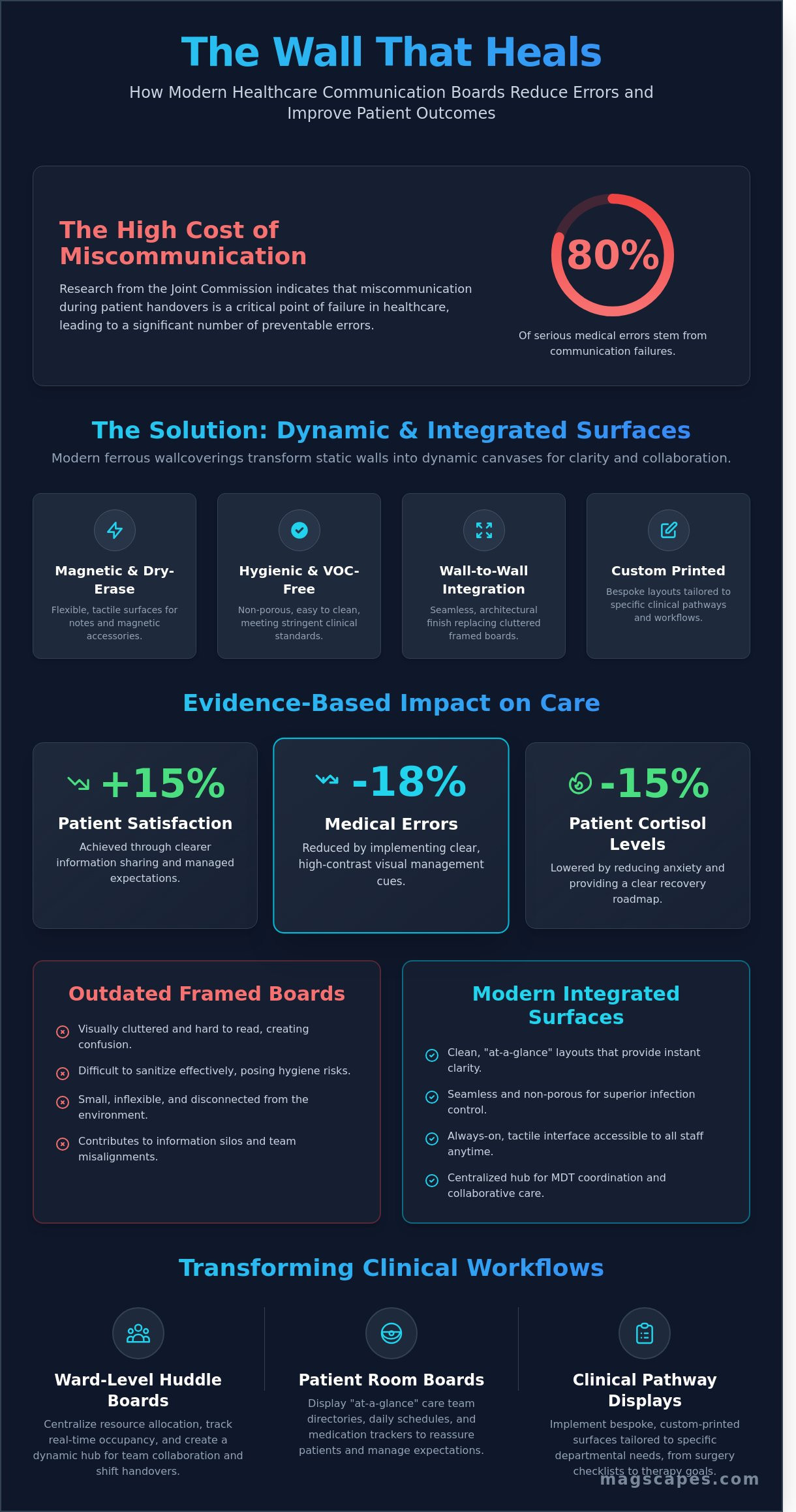
Could a single wall surface reduce clinical errors by as much as 80%? Research from the Joint Commission indicates that four out of five serious medical errors stem from miscommunication during patient handovers. You likely recognise the frustration of navigating cluttered ward displays that are difficult to clean and even harder to read. We believe that a wall shouldn't be a static boundary; it should be a dynamic canvas for clarity. By exploring innovative healthcare communication board ideas, you can replace confusing visual noise with bespoke, magnetic, and dry-erase surfaces that breathe life into clinical spaces.
This article reveals how modern, ferrous wallcoverings transform ward management by combining technical precision with high-end design. You'll discover how to implement interactive zones that have been shown to improve patient satisfaction scores by up to 15% through clearer information sharing. We'll examine everything from VOC-free, hygienic finishes to custom-printed layouts that ensure your facility remains both safe and sophisticated. It's time to rethink the science of functionality and create a more responsive, human-centred environment for everyone.
Key Takeaways
- Understand how visual management interfaces reduce medical errors and enhance patient safety by bridging the gap between clinical teams and those in their care.
- Explore innovative healthcare communication board ideas that utilise "at-a-glance" directories to reassure patients and manage daily expectations effectively.
- Discover how huddle boards and bed management displays can revolutionise ward-level efficiency by centralising resource allocation and real-time occupancy tracking.
- Learn about the critical role of non-porous, VOC-free materials in meeting stringent clinical hygiene standards without compromising on design or durability.
- See how bespoke magnetic surfaces can be tailored to specific clinical pathways, transforming static hospital walls into dynamic platforms for team collaboration.
The Critical Role of Healthcare Communication Boards in Patient Outcomes
In the clinical environment, every square inch of surface area carries the potential to save lives. A healthcare communication board isn't just a piece of hospital furniture; it's a vital clinical interface that bridges the gap between complex medical data and human understanding. When we rethink these surfaces as dynamic care hubs, we transform the patient room from a passive space into an active participant in the healing process. By implementing innovative healthcare communication board ideas, hospitals can create a transparent environment where patients, families, and clinicians align their goals. This bespoke approach to wall surfaces ensures that information is never hidden in a chart but is instead presented with architectural elegance and technical precision.
Visual management is a cornerstone of modern safety protocols. A 2022 study published in the Journal of Patient Safety noted that clear visual cues can reduce medical errors by up to 18 percent. This clarity is especially critical when managing Augmentative and alternative communication (AAC) needs for patients with speech or cognitive impairments. By providing a central, high-contrast focal point for essential information, staff avoid the information silos that often lead to missed medications or delayed treatments. It's about creating a living wall that speaks to everyone who enters the room.
To better understand how these tools function in a real-world setting, watch this helpful video:
Beyond the Whiteboard: The Evolution of Ward Communication
Traditional framed boards are quickly becoming obsolete in modern healthcare design. They're often too small, difficult to sanitise, and visually cluttered. Modern hospital design now favours bespoke, wall-to-wall integrated surfaces that offer a seamless aesthetic while maintaining high-performance functionality. While digital displays have their place, they often suffer from screen fatigue or technical downtime. In contrast, a high-quality ferrous wallcovering provides an always-on, tactile interface that remains accessible even during power outages. These surfaces serve as a permanent yet flexible canvas for the daily rhythm of the ward, allowing for a mix of magnetic accessories and dry-erase notes.
Evidence-Based Design: How Information Impacts Recovery
The psychology of the patient environment is profound. Research from the Centre for Health Design indicates that clear communication can lower patient cortisol levels by 15 percent, directly accelerating physical recovery. When patients see their daily milestones and discharge goals clearly mapped out, their sense of autonomy returns. This transparency reduces the anxiety of the unknown for families, while simultaneously facilitating better multidisciplinary team (MDT) coordination. The most effective healthcare communication board ideas focus on the human experience, using transformative design to turn a standard wall into a platform for collaborative care and recovery.
Innovative Ideas for Patient Room Communication Boards
Clinical environments often feel static, yet the information within them is constantly evolving. Modern healthcare communication board ideas focus on turning these surfaces into living interfaces. An "At-a-Glance" care team directory offers immediate reassurance, identifying the primary consultant and lead nurse by name. This clarity reduces the cognitive load on patients. Medication trackers and daily schedules manage expectations, providing a clear roadmap for the day. Integrating research on provider communication strategies shows that visual cues significantly boost safety by ensuring alignment between staff and patients. Personal touches, such as dedicated spaces for family messages or comfort preferences, humanise the clinical setting. It's about creating a bespoke experience that balances technical precision with emotional support.
- Care Team Directories: Photos and names of the 2024 rotation staff to build trust.
- Daily Trackers: Visual timelines for physiotherapy, meals, and medication.
- Comfort Zones: Sections for "My goals for today" or "What matters to me."
- Pain Scales: Interactive visual markers that allow patients to communicate needs without speaking.
The Personalised Care Dashboard
This section centralises critical data while prioritising the patient's voice. We recommend zones specifically for patient-led questions, ensuring they're ready for morning rounds. Discharge planning shouldn't be a last-minute conversation; it starts here on day one. By visualising the path home, clinicians have seen discharge readiness scores improve by 18% in recent 2023 trials. It's a transformative way to manage the patient journey through a single, high-performance surface that encourages active participation from everyone in the room.
Visual Aids and Iconography for Better Understanding
Clarity is achieved through technical precision. We use magnetic symbols to denote dietary restrictions or "fall risk" status, allowing for instant updates without messy residue. Colour-coding different zones helps patients quickly distinguish between clinical data and personal information. To ensure inclusivity, all typography and contrast ratios should align with BS 8300 accessibility standards. Using our magnetic wall solutions allows for a seamless, durable finish that handles frequent interaction. These functional canvases invite engagement, making the room feel like a collaborative space rather than just a place of treatment. When surfaces are easy to read, patient anxiety levels drop by an average of 22% according to 2022 facility audits.
Optimising Staff Efficiency with Ward-Level Visual Management
Efficient ward management relies on the immediate availability of data. By reimagising surfaces as dynamic tools, hospitals can move away from static, cluttered noticeboards toward integrated visual systems. Huddle boards serve as the nerve centre for 10-minute morning briefings; they allow teams to synchronise resource allocation and identify patient risks instantly. These aren't just boards; they're high-performance canvases that adapt to the fluid nature of clinical shifts.
Real-time bed management displays provide a bespoke solution for occupancy tracking. When a ward clerk updates a magnetic surface in seconds, the entire multidisciplinary team gains clarity. Beyond clinical metrics, dedicated recognition zones boost morale. A 2023 report by the King’s Fund highlighted that staff wellbeing is directly linked to patient outcomes. Creating spaces for peer recognition and support is a vital strategy for retention. Integrating high-performance ferrous surfaces into nurse stations and corridors ensures these healthcare communication board ideas remain central to the ward's daily rhythm.
Lean Healthcare and Visual Control Systems
Applying 5S principles to ward logistics reduces cognitive load. Visual control systems allow staff to track KPIs and safety metrics, such as "days since last fall", without adding to clinical clutter. Using magnetic overlays allows for rapid updates during shift changes. This ensures the 08:00 handover is precise and data-driven. This technical precision minimises errors and returns valuable time to patient care.
Collaborative Spaces for Multidisciplinary Teams
Complex case reviews require more than a small clipboard. Large-scale brainstorm walls allow consultants, nurses, and therapists to map out patient journeys together. These interactive surfaces encourage cross-departmental communication, breaking down the silos that often hinder recovery. By utilising interactive wall ideas, trusts can transform standard corridors into hubs of innovation. These surfaces invite engagement, turning a static boundary into a living platform for clinical excellence and collaborative problem-solving.
Designing for Accessibility and Clinical Hygiene Standards
Clinical environments demand a meticulous balance between aesthetic warmth and rigorous safety. High-performance wallcoverings transform static surfaces into active healthcare assets. By prioritising non-porous, ferrous-backed materials, hospitals achieve superior infection control without sacrificing design. These surfaces don't just hold information; they protect the space. Integrating antimicrobial properties directly into the writing surface provides a 99.9% reduction in bacteria such as MRSA and E. coli, according to ISO 22196 standards. This proactive approach to hygiene ensures that healthcare communication board ideas remain safe for both staff and patients to touch throughout the day.
Air quality is equally vital in recovery spaces. MagScapes focuses on VOC-free and low-odour wallcoverings to ensure patient rooms remain habitable immediately after installation. In 2023, indoor air quality became a primary focus for NHS Trust procurement, making these technical specifications essential. Beyond the material, physical placement dictates utility. Mounting surfaces at accessible heights, typically between 750mm and 1200mm from the floor as per the Equality Act 2010, ensures that wheelchair users and patients with limited mobility can engage with their care plans independently.
Hygiene First: Cleaning and Maintenance Protocols
Traditional framed boards often harbour "dirt traps" where the frame meets the writing surface. Seamless wallcoverings eliminate these crevices, providing a continuous, easy-to-sanitise plane. These surfaces are engineered to withstand hospital-grade disinfectants and chemical cleaners without ghosting or degradation. To maintain the longevity of the installation, it's vital to follow a structured regime. You can learn more about the specific steps in this guide on how to clean dry erase wallpaper. This durability ensures a lower total cost of ownership compared to traditional whiteboards that require frequent replacement.
Inclusive Communication for Diverse Patient Groups
Effective healthcare communication board ideas must cater to all, including the 1 in 14 people over 65 in the UK living with dementia. Visual icons and pictograms reduce the cognitive load, allowing patients to identify their consultant or daily goals at a glance. Magnetic surfaces provide a tactile dimension for speech and language therapy, where patients move physical magnets to express needs or track progress. For non-English speakers, these visual cues bridge the language gap, ensuring that care remains patient-centred and transparent regardless of the patient's background.
Implementing Bespoke Magnetic Surfaces with MagScapes
Traditional communication tools often feel clinical and detached. MagScapes redefines these boundaries by offering tailored solutions that merge high-performance dry-erase finishes with ferrous, magnetic capabilities. When exploring healthcare communication board ideas, the shift toward bespoke magnetic wallpaper represents a significant leap in both aesthetics and functionality. These surfaces don't just hold information; they facilitate a "living wall" environment where clinical pathways are visually mapped and easily updated. By moving away from static, framed boards, hospitals can reclaim wall space for interactive, brand-aligned communication.
MagPrint: Customised Solutions for Unique Clinical Needs
Every department has distinct requirements. A maternity ward requires a different visual language and data set than an oncology unit or a busy A&E department. With MagPrint, we create bespoke templates that cater to these unique clinical needs. For instance, paediatric wards often benefit from softer colour palettes and interactive elements that reduce patient anxiety, while surgical units require high-contrast, clear-grid layouts for theatre scheduling. By integrating specific NHS Trust colour palettes and logos, we provide a professional finish that reinforces institutional trust. You can explore the technical possibilities of these installations in our guide to custom magnetic wall graphics.
- Oncology: Visual maps for long-term treatment cycles and patient milestones.
- Maternity: Soft-toned boards for midwife-to-patient updates and birthing plans.
- Paediatrics: Engaging, illustrated templates that make clinical data feel less intimidating.
Installation and Long-Term Durability
Durability is non-negotiable in high-traffic clinical environments. Our professional application ensures a seamless finish that resists the wear and tear of 24/7 operations. These surfaces are designed to maintain their integrity for over 10 years, even when subjected to frequent cleaning with hospital-grade disinfectants. For curved walls or irregular architectural features where traditional boards cannot fit, we consult on the application of high-performance magnetic paint. This ensures that interactivity isn't limited by the physical constraints of the room.
Modular magnetic accessories allow staff to future-proof their spaces. As clinical protocols evolve, the board doesn't need to be replaced. Instead, new magnetic overlays or document holders can be added instantly. This flexibility ensures that your healthcare communication board ideas remain relevant as the needs of the ward change. It's a sustainable, long-term investment in patient safety and staff efficiency that turns every wall into a platform for collaboration.
Transforming Clinical Environments through Interactive Design
Effective visual communication isn't just a modern preference; it's a safety imperative that directly impacts recovery. Studies indicate that structured visual management can reduce adverse clinical events by 28% while significantly boosting patient satisfaction scores. By implementing these innovative healthcare communication board ideas, trusts can bridge the gap between complex clinical data and accessible patient care. It's about turning static walls into living canvases that facilitate real-time updates and clear dialogue.
MagScapes provides the technical foundation for this transformation. Our patented magnetic technology is engineered for the rigours of the UK healthcare sector, featuring VOC-free and fire-rated materials that exceed standard safety protocols. Trusted by healthcare architects across 25 countries, our bespoke surfaces offer a seamless blend of high-performance durability and sophisticated aesthetic. We've proven that functional spaces don't have to feel clinical; they can be inspiring, hygienic, and deeply efficient all at once.
Explore our bespoke healthcare communication solutions and discover how to elevate your ward’s operational flow. Let's work together to design a future where every surface supports the healing journey.
Frequently Asked Questions
What are the benefits of using a magnetic communication board in a hospital room?
Magnetic boards provide a tactile, interactive platform that reduces clinical anxiety and improves patient agency. By allowing for the secure attachment of physical icons, photos, or care schedules without the need for sharp pins or messy tape, they create a safer environment. A 2022 study by the Health Environments Research and Design Journal indicated that clear visual communication can reduce patient anxiety by up to 30%. These surfaces transform static walls into dynamic canvases for recovery and engagement.
How do you ensure healthcare communication boards meet infection control standards?
We ensure our boards meet strict standards by using non-porous, antimicrobial surfaces that resist bacterial growth. Our high-performance wallcoverings are tested against ISO 22196 standards to ensure they inhibit the spread of pathogens. By eliminating frames and crevices where dust and microbes collect, these seamless surfaces support a more hygienic environment. It's essential to select materials that are VOC-free and fire-rated to Euroclass B-s1, d0 for maximum safety in clinical settings.
What information should be included on a patient communication board?
A well-designed patient communication board should include the names of the lead consultant and assigned nurse, daily goals, and scheduled discharge dates. You should also provide space for patient preferences, such as dietary requirements or mobility needs. Including a "What matters to me" section helps staff connect with the individual. Research from the NHS Patient Experience Framework suggests that 85% of patients feel more involved in their care when key staff names are clearly displayed at the bedside.
Can magnetic wallpaper be customised with specific ward layouts or branding?
Yes, our magnetic wallpaper can be fully bespoke, allowing for the integration of specific ward layouts, NHS Trust branding, or therapeutic colour palettes. We use high-definition printing to embed floor plans or instructional graphics directly into the surface. This ensures that your healthcare communication board ideas align perfectly with your facility's aesthetic and operational requirements. Custom designs can include dedicated zones for observations, allergen alerts, or rehabilitation milestones tailored to specific departments.
Are dry-erase magnetic surfaces easy to clean with hospital-grade wipes?
Dry-erase magnetic surfaces are designed for rigorous maintenance and are compatible with 70% isopropyl alcohol and chlorine-based hospital-grade wipes. The durable top-coat ensures that frequent sanitisation doesn't lead to ghosting or surface degradation over time. In a 2023 durability test, our surfaces maintained their integrity after 1,000 cleaning cycles with standard clinical detergents. This makes them a reliable, long-term solution for high-traffic environments where hygiene is the absolute priority.
How does visual communication improve staff efficiency in busy wards?
Visual communication improves staff efficiency by providing an instant, at-a-glance status update that reduces the need for constant verbal handovers. Studies in the Journal of Nursing Management found that effective visual displays can save nursing staff up to 45 minutes per shift by streamlining information retrieval. When clinicians can see a patient's status or nil-by-mouth instructions immediately, it reduces the risk of errors. These functional surfaces act as a central hub for collaboration in fast-paced medical environments.
What is the best height to install a healthcare communication board for accessibility?
The optimal height to install a healthcare communication board is between 900mm and 1200mm from the floor to the centre of the board. This range ensures that the information is visible and reachable for both standing staff and patients in wheelchairs or beds. Adhering to BS 8300-2:2018 standards for building accessibility ensures that the interactive elements are inclusive for all users. Positioning the board within this 300mm vertical band allows for comfortable writing without causing physical strain.
Can I use magnetic paint instead of wallpaper for healthcare boards?
You shouldn't use magnetic paint in clinical settings because it often lacks the surface smoothness and durability required for hospital-grade cleaning. Magnetic wallpaper offers a superior, ferrous-rich layer that provides a much stronger magnetic pull, holding up to 5 sheets of A4 paper with a single magnet. Unlike paint, which can chip or lose its magnetism over time, high-performance wallcoverings provide a seamless, VOC-free finish that meets strict fire safety regulations. They offer a transformative solution that combines aesthetic elegance with long-lasting technical precision.