


Table of Contents
- What Are Interactive Wall Solutions for Classrooms?
- How Interactive Walls Support Active Learning and Engagement
- Magnet-Receptive Wallcoverings for Schools: A Practical Foundation
- How to Design an Interactive Classroom Wall That Works
- Sensory Wall Panels for Classrooms: Multisensory Learning Environments
- Installation, Maintenance, and Long-Term Durability
- Conclusion: Building Collaborative Learning Spaces
Last Updated: August 18, 2026
What Are Interactive Wall Solutions for Classrooms?
Interactive wall solutions are magnet-receptive surfaces that transform static walls into dynamic learning and collaboration tools. Rather than relying on fixed whiteboards or pin boards, these solutions allow educators to create flexible teaching environments where students actively engage with the wall surface itself. At MagScapes, we've designed magnet-receptive wallcoverings that let teachers and students write, display work, and organise information directly on the wall, turning the entire classroom boundary into an active learning participant.
A wall becomes a workspace: students attach worksheets with magnets, write equations with dry-erase markers, pin up collaborative project plans, and reorganise information in real time. Unlike traditional bulletin boards that serve a single purpose, interactive wall solutions combine writing surface, display area, and magnetic holder into one continuous, accessible expanse. A classroom wall can shift from a spelling practice surface in the morning to a project planning wall in the afternoon, then become a gallery for student artwork by day's end, aligning with modern pedagogical approaches that emphasise active learning and student-centred design.
How Interactive Walls Support Active Learning and Engagement
Active learning thrives when students can see, touch, and manipulate information. Interactive wall solutions directly support this by creating environments where abstract concepts become tangible. Research in educational psychology shows that multisensory learning, combining visual, tactile, and kinesthetic elements, improves retention and understanding. Interactive walls deliver all three: reading engages visually, physically placing a card engages tactilely, and moving elements around engages kinesthetically.
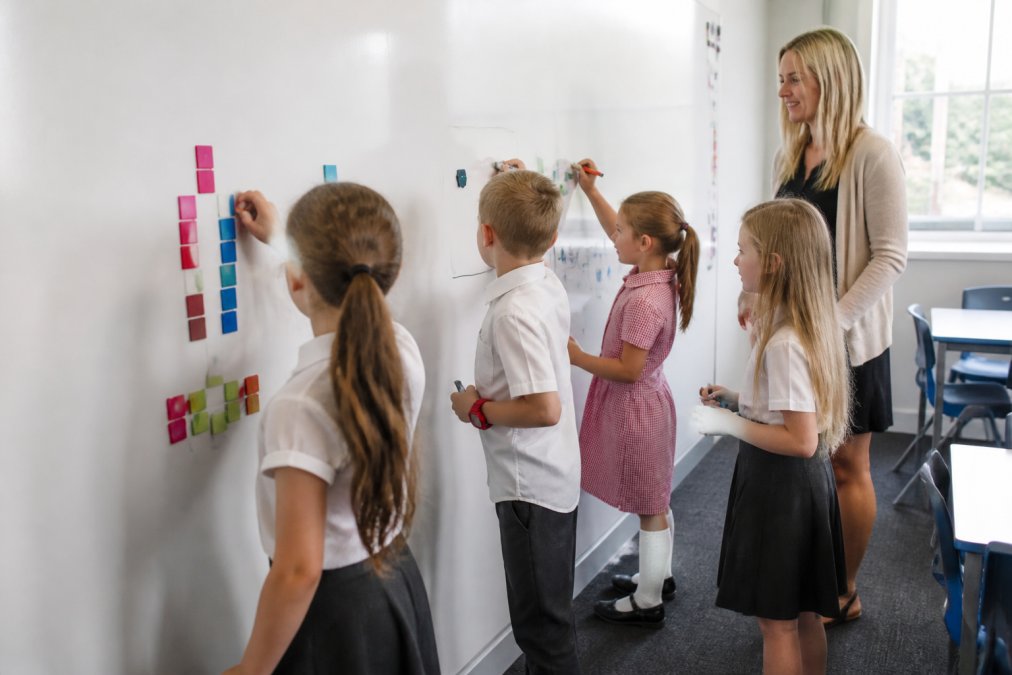
Collaborative problem-solving becomes natural on an interactive wall. When a group works on a maths problem, science investigation, or language activity, the wall becomes the shared workspace. Everyone can see work in progress, contribute ideas by adding or moving elements, and discuss approaches together. This transparency is a powerful learning driver that traditional individual worksheets cannot replicate.
The physical act of writing on a wall also changes classroom dynamics. Students who hesitate to raise their hands often participate freely when contributing to a wall-based activity. Teachers report that interactive walls reduce anxiety around public participation and increase engagement across all learner levels, particularly for students who benefit from spatial awareness and hands-on manipulation.
Magnet-Receptive Wallcoverings for Schools: A Practical Foundation
Magnet-receptive wallcoverings form the physical foundation of interactive wall solutions. These specially engineered surfaces accept both dry-erase markers and magnets, creating a dual-function wall that eliminates the need for separate writing surfaces, pin boards, and magnetic displays. MagWrite, our class-leading ferrous dry-erase wallcovering, delivers a 4 out of 5 magnet receptivity rating, holding all standard magnet types with the same reliability as a fridge door.

Purpose-built magnet-receptive wallcoverings offer consistency and durability over improvised solutions. Magnetic paint requires multiple coats, curing time, and application skill to achieve uncertain results. MagWrite is manufactured to fixed specification: every roll performs identically, installation is straightforward for professional decorators, and the surface maintains its magnetic performance and writing quality for years without degradation.
For schools, this reliability matters enormously. A classroom wall must function reliably through intensive daily use, hundreds of marker strokes, countless magnets placed and removed, and exposure to moisture and temperature changes. MagWrite's 0.6mm ferrous backing and hard-wearing dry-erase surface are engineered for this environment.
| Feature | MagWrite Gloss | MagWrite Matt | MagLiner |
|---|---|---|---|
| Magnet Receptivity | 4/5 | 4/5 | 5/5 |
| Writing Surface | Dry-erase (gloss) | Dry-erase (matt) | Paintable or raw |
| Best For | Classrooms with windows | Projection-compatible walls | Flexible finish design |
| Cost per 3m roll | £216 | £248 | £66.64 |
Installation uses a paste-the-wall method, the same approach professional decorators use for premium wallcoverings. Adhesive is applied to the prepared wall and the product is positioned and smoothed into place. A professional decorator can typically cover a standard classroom wall in a single day, and the surface is ready to use within 24 hours.
How to Design an Interactive Classroom Wall That Works
Designing an interactive classroom wall requires intentional planning. Begin by assessing your classroom's existing wall space and identifying which walls receive the most natural light and traffic. South-facing walls with direct sunlight can create glare on reflective surfaces, so consider matte-finish options like MagWrite Matt if your classroom has significant window exposure.

Height is critical. Interactive walls work best when the entire surface, from floor level to above eye height, is accessible to students. A wall extending from 30cm above the floor to 200cm creates a genuinely interactive space; a wall starting at 120cm height becomes display-only, defeating the purpose.

Plan zones within the wall space. Divide the wall into distinct areas for different activities: a collaborative problem-solving zone, a student-work display area, a vocabulary section, and a free-choice creative space. Physical markers or visual boundaries help students understand how to use different parts of the wall, preventing chaos and ensuring every area has clear purpose.
Consider the wall's relationship to your teaching workflow. If you run daily stand-ups or morning meetings, position the interactive wall where all students can see and reach it comfortably. Avoid placing it directly opposite the main entry door, where traffic flow will interfere with focused work.
Key design steps:
- Measure your target wall and calculate total surface area in square metres
- Identify which wallcovering product suits your needs
- Plan the layout with dedicated zones for different activity types
- Determine installation timing (ideally during a school holiday)
- Order supplies with 10% extra for trimming and future repairs
- Brief staff on maintenance protocols
Maintenance becomes part of the design. Set up a simple cleaning routine: wipe the dry-erase surface every 48 hours with a microfibre cloth and cleaning spray to prevent ghosting. Store magnets in a designated container near the wall. Keep marker pens in a wall-mounted holder. These small systems prevent the interactive wall from becoming neglected or cluttered.
Sensory Wall Panels for Classrooms: Multisensory Learning Environments
Sensory wall panels extend interactive walls by incorporating materials and textures that engage touch, sight, and sometimes sound. While magnet-receptive wallcoverings provide a smooth, writable surface, sensory panels add tactile dimensions: textured overlays, moveable elements, and materials with different physical properties that students can manipulate and explore.
Sensory panels are particularly valuable in classrooms serving students with special educational needs (SEND), neurodivergent learners, or younger primary students who benefit from multisensory input. A wall combining smooth writing surfaces with textured areas, moveable pieces, and colour variation engages a broader range of learners and supports different learning preferences.
Effective sensory wall design combines: a smooth writable base (MagWrite or similar magnet-receptive wallcovering), textured overlays (fabric patches, corrugated sections, or embossed materials), moveable components (cards, tiles, or shapes that students can rearrange with magnets), colour variation to define zones and highlight information, and optional sound elements (bells or chimes) that add auditory feedback.
For younger learners (Reception through Year 2), sensory walls support cognitive development by connecting abstract concepts to physical sensation. For students with SEND, sensory walls provide regulated input that can be calming or stimulating depending on materials and activities. The ability to control interaction, touching when ready and moving elements at their own pace, gives students agency and reduces anxiety.
Creating effective sensory walls requires careful material selection. Avoid anything sharp, fragile, or small enough to become a choking hazard. Use washable, durable materials that withstand frequent handling and cleaning. Secure all components firmly so they don't shift during use.
Installation, Maintenance, and Long-Term Durability
Installation quality directly influences how long an interactive wall performs effectively. Professional installation by experienced decorators ensures proper surface preparation, correct adhesive application, and secure attachment that will withstand years of use. Schools should expect professional installation to take one to two days for a standard classroom, depending on wall condition and room size. The cost of professional installation is worthwhile; a poorly installed surface will fail prematurely.
Once installed, maintenance determines longevity. A well-maintained interactive wall will perform reliably for 10 years or more. Key maintenance tasks are:
Cleaning schedule:
- Weekly: Wipe dry-erase surfaces with a damp microfibre cloth to remove dust and light marks
- Fortnightly: Use dry-erase cleaning spray and microfibre cloth to remove stubborn pen marks
- Monthly: Inspect for damage, loose magnets, or areas needing attention
Magnet care:
- Store magnets in a designated container to prevent scattering or wall damage
- Remove magnets regularly to inspect the wall beneath and prevent permanent indentations
- Replace any damaged or weakened magnets promptly
Marker management:
- Use only dry-erase markers intended for wallcoverings; permanent markers will stain and damage the surface
- Keep marker caps sealed to prevent drying out
- Replace markers when they begin to skip or fade
Damage repair:
- Minor scratches or scuffs are normal and do not affect function
- For larger damage (tears, punctures, or significant staining), contact the manufacturer for repair or replacement panels
- MagScapes offers repair services and can supply matching replacement sections
Long-term durability is influenced by usage intensity. A classroom wall in daily use will show more wear than one used occasionally, but the underlying magnetic performance remains constant. Schools that budget for proper installation, establish clear maintenance protocols, and train staff on correct use will find that interactive wall solutions deliver exceptional value over their 10-year lifespan.
Conclusion: Building Collaborative Learning Spaces
Interactive wall solutions represent a fundamental shift in how classrooms can be designed and used. By transforming static walls into active, writable, magnetic surfaces, schools create environments where learning becomes visible, collaborative, and physically engaging. The wall stops being a boundary and becomes a tool that supports active learning, accommodates diverse learning preferences, and adapts to different activities throughout the day.
The practical foundation rests on magnet-receptive wallcoverings like MagWrite, which deliver reliable magnetic performance and writing functionality through years of intensive classroom use. MagScapes' ferrous wallcoverings are purpose-built for educational environments, engineered to withstand daily use, and backed by a 10-year warranty. Installation is straightforward for professional decorators, and maintenance is simple enough for any school to manage effectively.
The real value emerges when interactive walls are integrated into intentional classroom design and teaching practice. Schools that plan thoughtfully, train staff on use and maintenance, and establish clear routines for keeping the wall organised and clean will see measurable improvements in student engagement, collaboration, and learning outcomes.
Frequently Asked Questions
What are the main benefits of interactive wall solutions in the classroom?
Interactive wall solutions transform static classroom surfaces into active learning tools. They support collaborative problem solving, allow students to physically manipulate content, encourage hands-on exploration, and improve visual stimulation. Magnet-receptive wallcoverings hold student work, learning aids, and reference materials securely whilst accepting dry-erase markers for writing. This dual functionality creates truly immersive learning environments where walls become teaching participants rather than passive boundaries.
How do magnet-receptive wallcoverings for schools compare to traditional whiteboards?
Magnet-receptive wallcoverings cover entire walls, offering unlimited writing and display space compared to fixed whiteboard panels. They accept all magnet types simultaneously, hold documents and visual aids without drilling, and integrate seamlessly into classroom design. Unlike traditional whiteboards, they support projection, accept chalk or dry-erase markers depending on the finish, and enable flexible spatial arrangement. Schools benefit from better classroom ergonomics, fewer installation constraints, and surfaces that grow with pedagogical needs.
Are interactive walls suitable for classrooms with special educational needs?
Yes. Interactive walls support inclusive education by accommodating diverse learning styles. Sensory wall panels engage tactile learners through hands-on manipulation, whilst visual stimulation benefits students with attention difficulties. Magnetic systems allow physical exploration without requiring fine motor precision, making them accessible for students with motor coordination challenges. The flexible, adaptable nature of interactive surfaces means teachers can adjust activities to meet individual needs, promoting spatial awareness and cognitive development across the learning spectrum.
How long do magnetic wallcoverings last in busy classroom environments?
Premium magnet-receptive wallcoverings like MagWrite carry 10-year warranties and are engineered for high-use commercial environments. The ferrous backing maintains consistent magnetic performance through years of intensive daily use. The dry-erase or chalkboard surface resists ghosting, staining, and wear when properly maintained with appropriate cleaning products. Regular care using the Write Cleaning Kit protects the surface, ensuring durability even in classrooms with constant student interaction and heavy daily use.
Get started with MagScapes and transform your classroom walls into dynamic learning environments. Our magnet-receptive wallcoverings provide the reliable, durable foundation that interactive teaching requires, with installation support and maintenance guidance included. Explore MagWrite dry-erase wallcoverings or discover how [EXTERNAL_LINK: sensory learning environments support student outcomes | education.gov.uk] across UK schools.
This article was written using GrandRanker