


Table of Contents
- Why Interactive Wall Solutions Matter in Healthcare Settings
- Patient Experience Benefits and Anxiety Reduction
- Clinical Efficiency and Operational Workflows
- Infection Control for Touch Screens in Hospitals
- Interactive Projection Systems for Hospitals
- Hardware Requirements and System Integration
- Cost Considerations and Long-Term ROI
- Conclusion
Last Updated: August 12, 2026
Why Interactive Wall Solutions Matter in Healthcare Settings
Interactive wall solutions have become essential infrastructure for modern healthcare facilities, transforming passive surfaces into dynamic communication tools that reduce patient anxiety, simplify staff workflows, and create therapeutic environments. Healthcare environments present unique challenges: walls must withstand constant cleaning, support rapid information updates, function without adding IT complexity, and accommodate diverse patient populations. Interactive walls address these gaps by enabling instant collaboration, creating immersive therapeutic environments, and improving how hospitals communicate internally and engage patients externally.
Patient Experience Benefits and Anxiety Reduction
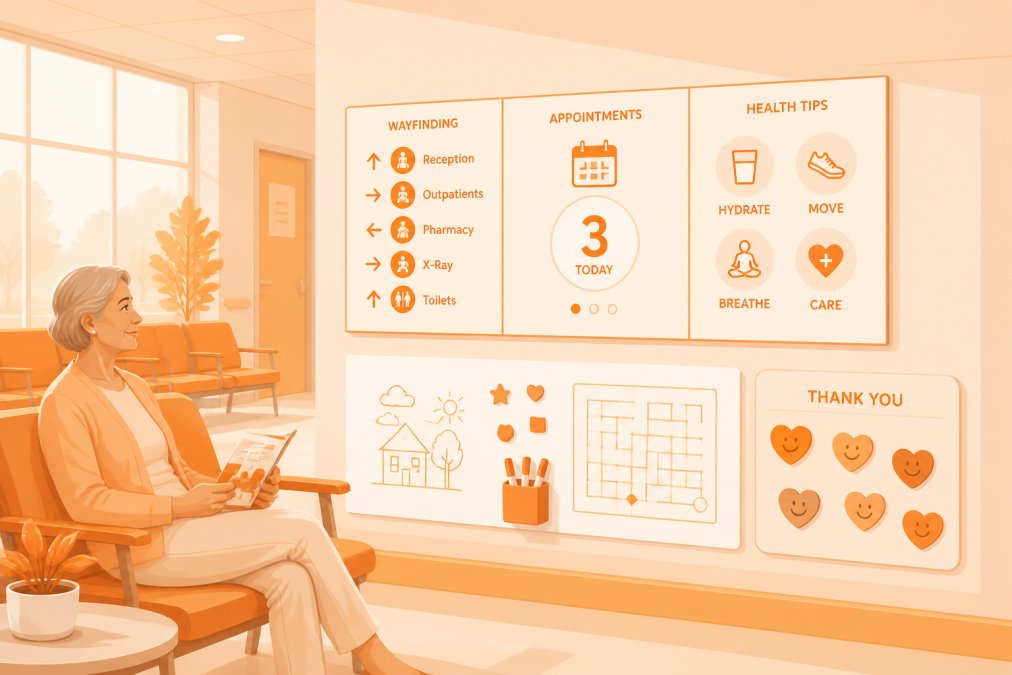
Patient anxiety stems partly from uncertainty, unfamiliar environments, and prolonged waiting. Interactive wall solutions directly address these drivers by creating engaging, informative, and visually calming spaces. Sensory systems embedded in interactive walls, motion-activated displays, colour-changing projections, or tactile magnetic elements, provide cognitive engagement that reduces stress responses. Pediatric patients particularly benefit from interactive projection systems that respond to movement, transforming waiting rooms into spaces where children feel control rather than passivity.
Research indicates that environmental design influences pain perception and recovery speed. Interactive walls that display calming visuals, provide real-time information about treatment progress, or enable patient participation in care planning contribute to measurable improvements in patient satisfaction scores and, in some cases, reduced length of stay. MagScapes magnetic wallcoverings exemplify this approach by creating tactile-friendly surfaces that reduce anxiety whilst meeting strict infection control standards, without requiring constant maintenance and software updates.

Clinical Efficiency and Operational Workflows
Interactive wall solutions simplify hospital workflows by centralising information and enabling real-time collaboration without requiring staff to navigate multiple software systems. Clinical efficiency gains emerge from three mechanisms: interactive walls serve as centralised information hubs where care plans and patient updates remain visible; they reduce friction of interdepartmental communication by enabling instant updates instead of emails or phone calls; and they eliminate duplicate data entry by consolidating information into a single visual reference point.
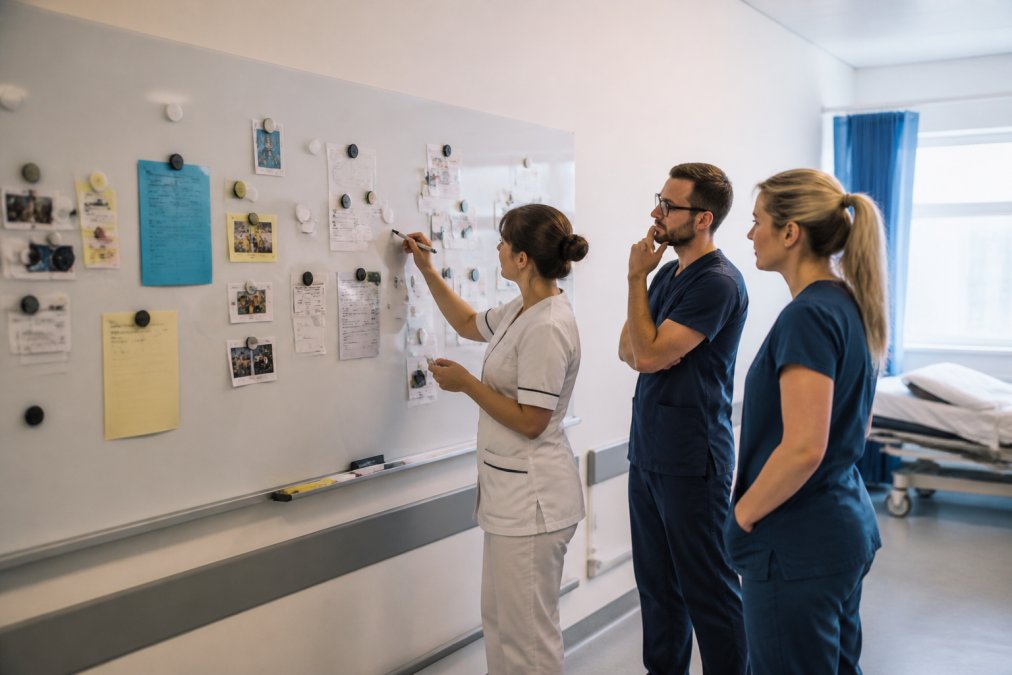
Specific improvements vary by department. In intensive care units, interactive walls display real-time vital signs and care protocols. In surgical departments, they coordinate scheduling and staff allocation. In maternity wards, they track patient progress and facilitate handoffs between shifts. MagScapes solutions support these workflows without introducing cybersecurity risks or network dependencies, allowing hospitals to update information using simple magnetic markers and writable surfaces.
Infection Control for Touch Screens in Hospitals
Touch screen displays in hospitals face a fundamental challenge: they must support frequent interaction whilst meeting stringent infection control protocols. Traditional touchscreens accumulate pathogens through repeated contact and require frequent disinfection that degrades screen responsiveness and longevity. Many interactive projection systems and touch-enabled displays fail infection control requirements because their materials deteriorate under harsh chemical exposure or repeated mechanical cleaning.
Solutions addressing this challenge employ several strategies: antimicrobial coatings that inhibit pathogen growth, touchless interaction methods using gesture recognition or motion sensors, and materials engineered for healthcare environments such as sealed glass or antimicrobial polymers. Magnetic wallcoverings bypass this challenge entirely, non-digital magnetic surfaces require only standard cleaning protocols compatible with infection control requirements and maintain full functionality indefinitely regardless of chemical exposure.
Interactive Projection Systems for Hospitals
Interactive projection systems create immersive visual environments by mapping responsive content onto large surfaces, enabling gesture-based interaction without physical contact. These systems excel at creating therapeutic environments in waiting areas, paediatric wards, and sensory rooms where visual engagement reduces anxiety and supports healing.
How Interactive Projection Works in Clinical Settings
Projection-based systems use motion sensors, depth cameras, or infrared tracking to detect user presence and movement, then respond by changing displayed content. A paediatric waiting room might display a calm underwater scene that responds to a child's hand gestures, creating a sense of control and engagement. Unlike touchscreen displays, projection systems require no physical contact, eliminating infection control concerns and supporting patients with mobility limitations. Content can be updated remotely, allowing hospitals to change therapeutic environments seasonally or adjust stimulation levels based on patient feedback.
Advantages for Healthcare Deployment
- Touchless interaction: Addresses infection control concerns by eliminating contact vectors.
- Therapeutic flexibility: Content can be tailored to specific patient populations, paediatric wards use playful visuals, adult recovery areas display calming nature scenes, dementia care units use familiar imagery or sensory stimulation.
- Non-permanent installation: Unlike wall-mounted displays, projection systems can be installed in rented spaces or temporary clinical areas without permanent modifications.
- Accessibility: Gesture-based interaction requires no fine motor control, benefiting patients with arthritis, tremors, or other physical disabilities.
Implementation Constraints
Projection systems introduce operational complexities: they require clear sight lines and appropriate throw distances (1-5 metres depending on projector type); brightly lit clinical spaces require higher-lumen projectors (3,000-5,000 lumens), which are more expensive and generate more heat; content management must either integrate with hospital information systems or operate independently with pre-loaded therapeutic content; and projector lamps typically last 1-2 years in continuous-use clinical environments, with replacement costs of £200-£500 per unit.
Real-World Deployment Patterns
Hospitals successfully deploying interactive projection typically use it in specific, high-impact applications: paediatric waiting areas and pre-operative rooms (reducing anxiety in children awaiting procedures), sensory rooms for dementia and autism care (creating controlled therapeutic environments), and patient education and wayfinding (reducing staff time spent on directions). Interactive projection systems represent a mid-range investment, with hardware costs typically ranging from £8,000-£25,000 per installation. Over a 5-year lifecycle, total cost of ownership often reaches £20,000-£50,000 for a single installation.
Hardware Requirements and System Integration
Interactive wall solutions in hospitals must meet clinical-grade hardware specifications and security frameworks that govern their deployment. Digital interactive systems must include display panels rated for continuous operation in high-humidity environments, network connectivity with redundancy, power management compatible with hospital electrical standards, antimicrobial casings resistant to cleaning chemicals, and processing power sufficient for responsive interaction without lag.
Data Security and NHS Data Security and Protection Toolkit Compliance
Interactive walls displaying patient information or integrating with electronic health records must comply with NHS Data Security and Protection Toolkit requirements. This introduces several non-negotiable constraints: encryption in transit and at rest for any system transmitting or storing patient data; access controls and authentication ensuring only authorised staff can view or modify patient data; audit logging documenting who accessed what information and when (typically retained for a minimum of six years); and network isolation separating interactive walls from clinical systems to minimise cybersecurity exposure.
Digital projection systems and touchscreen displays that connect to hospital networks introduce attack surfaces. Hospitals should require vendors to provide SAML authentication, role-based access control documentation, and evidence of penetration testing or third-party security audits. Non-digital solutions like magnetic wallcoverings eliminate integration complexity by avoiding electronics entirely, simplifying installation, eliminating network dependencies, removing concerns about electromagnetic interference with medical equipment, and avoiding compliance overhead.
Accessibility and Inclusive Design
Interactive wall solutions must accommodate patients and staff with varying physical and sensory abilities. Digital displays must support high-contrast modes, adjustable font sizes, and colour schemes compatible with colour-blindness. Touch-interactive surfaces must be positioned at heights accessible to wheelchair users (typically 76-122 cm from floor level). Information should use plain language, avoid jargon, and present content in short, scannable segments. Any audio content must include captions or transcripts. Magnetic wallcoverings inherently meet many accessibility requirements by eliminating technology barriers, though they still require thoughtful installation height, adequate lighting, and clear visual contrast.
Cost Considerations and Long-Term ROI
Investment in interactive wall solutions requires evaluating both capital costs and operational expenses over the system lifecycle. Digital interactive systems typically involve higher capital investment but lower per-unit costs at scale. A hospital deploying interactive projection across multiple departments might invest £40,000-£150,000 in hardware and installation, with annual software licensing and maintenance adding 10-15% of capital cost.
Magnetic wallcovering solutions represent a different cost model. MagScapes magnetic surfaces start at approximately £248 per roll for standard ferrous wallcoverings, with installation costs depending on wall area and complexity. A typical hospital department (500-1,000 square metres) might invest £2,000-£8,000 in magnetic wallcovering, with minimal ongoing maintenance costs. Complementary products like the MagPivot mobile whiteboard (£1,195) or MagCaddy storage unit (£2,063) add flexibility without significant operational overhead.

Long-term ROI calculations should account for software licensing, network infrastructure, technical support, and periodic hardware replacement for digital systems, versus minimal maintenance for magnetic systems. Smaller facilities or those with constrained IT resources often find magnetic solutions more cost-effective due to eliminated technology overhead. Larger systems requiring dynamic content integration may justify digital approaches despite higher operational complexity.
Interactive wall solutions address genuine gaps in how modern hospitals communicate, collaborate, and support patient wellbeing. The choice between approaches, digital projection, touch-enabled displays, magnetic surfaces, or hybrid combinations, depends on specific institutional needs, existing infrastructure, and operational capacity. MagScapes magnetic wallcoverings offer a proven, low-maintenance approach that healthcare facilities can implement immediately, transforming static spaces into collaborative environments without adding IT burden or infection control risk.
Frequently Asked Questions
How do interactive walls benefit hospital patients?
Interactive wall solutions reduce patient anxiety by providing engaging visual stimuli and entertainment in waiting areas and recovery spaces. They support cognitive exercises, facilitate therapeutic healing environments, and enable staff to communicate care plans directly at the patient's bedside. Tactile-friendly surfaces particularly help paediatric patients feel calmer and more engaged during treatment.
Are interactive wall systems compliant with NHS infection control standards?
Yes, magnetic and writable wall surfaces meet NHS infection control requirements without the high maintenance burden of digital hardware. Non-digital solutions like MagScapes magnetic wallcoverings require only standard cleaning protocols. For touch screen systems, antimicrobial glass and automatic data-wiping features ensure hygiene compliance. Always verify that any system you select meets current infection prevention and control guidance.
What types of interactive technology work best for paediatric wards?
Paediatric wards benefit most from tactile, sensory-rich solutions combined with visual engagement. Motion-activated displays, reversible sequin panels, and magnetic surfaces encourage exploration without overwhelming young patients. Interactive projection systems that respond to movement create immersive, calming environments. Non-digital tactile panels reduce anxiety better than screens alone, particularly for children with sensory sensitivities.
What are the maintenance requirements for hospital interactive displays?
Non-digital magnetic and writable surfaces require only standard cleaning with hospital-approved disinfectants, making them low-maintenance and cost-effective long-term. Digital solutions like touch screens need regular sanitisation using antimicrobial protocols, software updates, and occasional hardware servicing. Projection systems require dust management and lamp replacement. Magnetic solutions eliminate IT burden, reducing ongoing maintenance complexity and cost.
This article was written using GrandRanker