


Table of Contents
- Magnetic Wallcovering vs Paint: Core Differences
- Magnetic Whiteboard Paint UK: Application and Results
- Magnetic Wall Covering Installation: Methods and Complexity
- Magnetic Surface Maintenance Tips and Long-Term Costs
- Durability and Magnetic Strength: What Actually Lasts
- Writable Surfaces and Projector Compatibility
- Environmental Impact and Safety Standards
- Which Solution Wins for Your Space?
Last Updated: August 4, 2026
Magnetic Wallcovering vs Paint: Core Differences
When choosing between magnetic wallcovering and paint for your UK space, the decision hinges on permanence versus flexibility. This determines installation complexity, durability, maintenance costs, and wall performance over five years. Magnetic paint requires careful multi-coat application and substrate preparation, locking you into a fixed installation. Magnetic wallcovering, particularly premium ferrous rolls like MagScapes's MagWrite range, arrives pre-manufactured with consistent magnetic strength, installs faster, and can be removed without damaging underlying surfaces. For rental spaces or temporary installations, wallcovering wins decisively. For permanent installations where cost per square metre is primary, paint may seem attractive initially, though long-term maintenance costs often tell a different story.

The real tension emerges when factoring in writable surfaces and projector compatibility. Paint-based solutions require additional top-coats to become whiteboard-ready or projection-compatible. Wallcovering products designed as functional magnetic surfaces often integrate these capabilities from manufacture.
| Aspect | Magnetic Wallcovering | Magnetic Paint |
|---|---|---|
| Installation time | 4-8 hours per 50m² | 8-16 hours per 50m² (multiple coats) |
| Substrate prep required | Minimal | Extensive (sanding, priming, smoothing) |
| Removability | Fully removable | Permanent once applied |
| Writable surface option | Integrated in product design | Requires separate top-coat |
| Projector compatibility | Available in specialist ranges | Requires additional paint layer |
| Magnetic strength consistency | Maintained throughout lifespan | Degrades with dust accumulation |
| Cost per m² (materials only) | £40-80 | £20-30 |
| Professional installation required | Often recommended | Usually essential |
Magnetic Whiteboard Paint UK: Application and Results
Magnetic paint transforms a wall into a receptive surface for magnets, but demands precision and patience. The product, typically containing 60-75% magnetite particles suspended in a base coat, must be applied in thin, even layers. Uneven application results in patchy magnetic strength, undermining the entire purpose.
Smarter Surfaces' Super Magnetic Paint represents a UK magnetic paint product, offering approximately 6m² coverage per unit at £113 ex VAT. Walls must be sanded smooth, primed, and left to cure fully before the magnetic layer is applied. Any substrate imperfection becomes permanent.

Magnetic paint requires 24-48 hours between coats, with full curing taking up to seven days before magnets can be reliably used. For active environments like classrooms or offices, this creates operational disruption that wallcovering avoids entirely.
The top-coat decision matters significantly. If you want a writable surface, dry-erase paint goes over the magnetic layer. Each additional layer slightly reduces magnetic strength because it sits further from the ferrous particles. After two years of use, paint-based systems typically show noticeable reduction in holding capacity.
Magnetic Wall Covering Installation: Methods and Complexity
Installation method determines project success. Magnetic wallcovering comes in rolls (typically 1.2m wide and up to 30m long) and adheres using either pressure-sensitive adhesive or paste-based application.
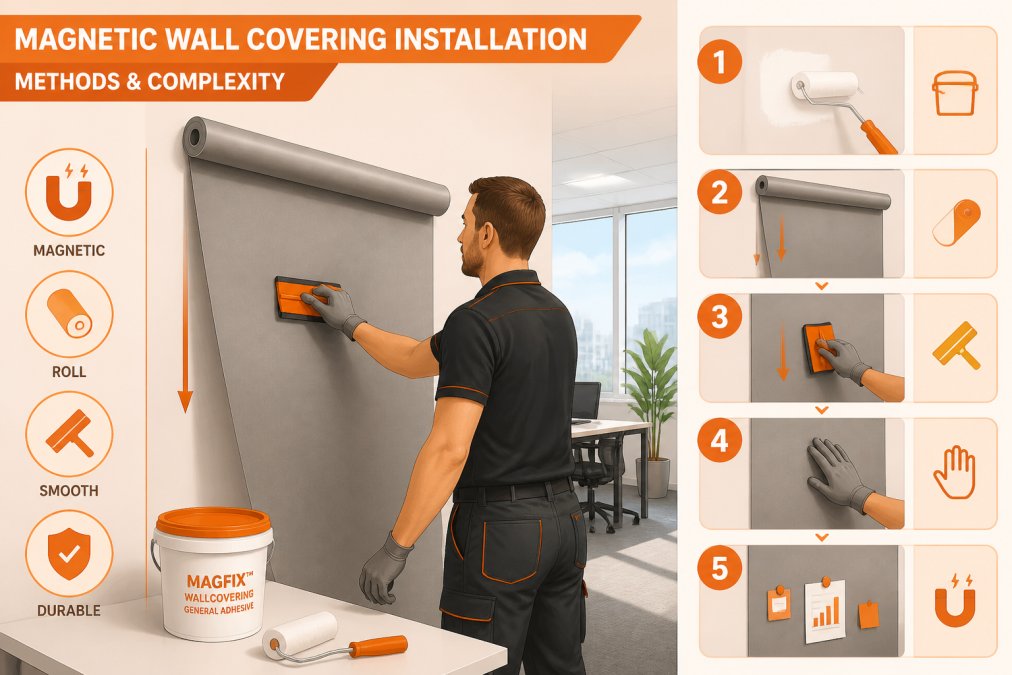
Pressure-sensitive adhesive (PSA) wallcovering is faster. The adhesive is pre-applied; you position the material, press it into place, and smooth out air bubbles using a squeegee. This takes approximately 3-4 hours per 50m² for experienced installers. The trade-off: PSA adhesive is permanent. Removal requires heat guns and careful scraping, risking substrate damage.
Paste-based application using wheat paste or vinyl adhesive offers removability at the cost of installation time. The paste is applied to the wall, wallcovering positioned, and the surface smoothed repeatedly to ensure full adhesion. This takes 6-8 hours per 50m² because paste must be worked carefully to avoid air pockets. The advantage: wallcovering can be peeled away cleanly without damaging the substrate.
Both methods demand clean, smooth surfaces. Textured walls, wallpaper, or rough plaster require sanding or removal before installation, adding 8-12 hours to the project timeline.
The magnetic strength of wallcovering remains consistent throughout installation because the ferrous layer is factory-sealed. Unlike paint, where application technique affects final performance, wallcovering delivers the same magnetic performance whether installed professionally or by DIY teams.
Magnetic Surface Maintenance Tips and Long-Term Costs
Maintenance separates true cost of ownership from initial purchase price. Magnetic wallcovering requires minimal maintenance: occasional dusting with a soft, dry cloth and gentle cleaning with a damp microfibre cloth if marks accumulate. The sealed surface resists staining and doesn't degrade from regular contact with markers, magnets, or paper.
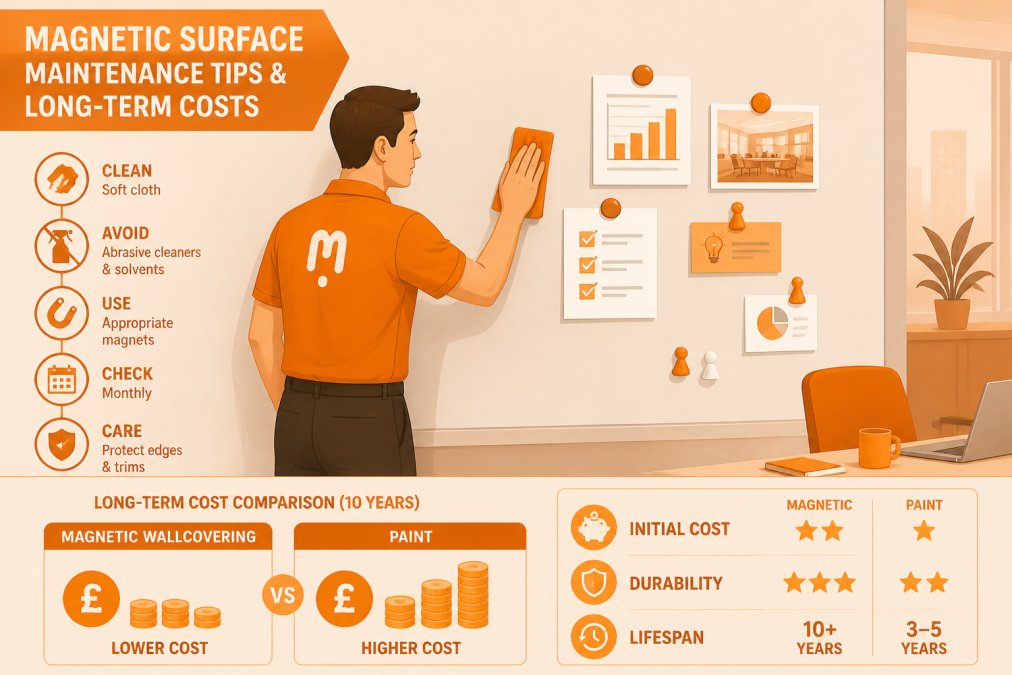
Magnetic paint demands more active maintenance. Dust accumulates on the surface, gradually reducing magnetic holding capacity. Regular cleaning, weekly in high-traffic environments, becomes necessary. Marks from dry-erase markers can become permanent if left to set.
Over five years, cost of ownership reveals the true picture. A 50m² installation using premium magnetic wallcovering at £248 per roll (MagScapes MagWrite Matt) costs approximately £3,100 in materials. Professional installation adds £800-1,200. Total: £3,900-4,300. Maintenance: annual cleaning supplies, approximately £50 per year. Five-year total: approximately £4,150-4,550.
The same 50m² using magnetic paint costs £850-1,100 in materials, plus £1,500-2,000 for professional application. Maintenance compounds: annual cleaning, occasional touch-ups, potential recoating after three years (£600-800). Five-year total: approximately £3,500-4,700, superficially lower until you account for lost productivity during reapplication and the reality that paint-based systems rarely maintain full performance through year five.
For rental spaces, wallcovering's removability means you can take it with you or leave it for the next tenant. Paint is permanent, often requiring removal and repainting before lease termination.
Durability and Magnetic Strength: What Actually Lasts
Magnetic strength degrades predictably depending on installation method and environment. Paint-based systems lose approximately 15-20% of holding capacity in year one as dust settles and the paint layer hardens. By year three, a magnet that initially held five sheets holds three. By year five, many installations hold only one or two sheets reliably.
Wallcovering maintains 95%+ of original magnetic strength through five years because the ferrous layer is sealed beneath a protective surface finish. The magnetic particles don't oxidise, dust doesn't penetrate, and holding capacity remains consistent.
Premium magnetic wallcovering typically holds 3-5kg per magnet depending on magnet size and surface finish. Paint-based systems achieve similar initial capacity but lose this over time. In healthcare settings where magnetic boards display critical information and cannot fail, this consistency justifies the wallcovering investment.
Environmental factors accelerate degradation differently. High humidity environments (kitchens, bathrooms, healthcare facilities) cause paint-based systems to deteriorate faster because moisture penetrates the paint layer. Wallcovering, with its sealed ferrous layer, resists humidity effects. Temperature fluctuations also affect paint more than wallcovering, causing thermal expansion and contraction that leads to cracking or peeling.
For educational and healthcare applications, durability is essential. Classrooms require surfaces that withstand years of daily use. Hospital wards need reliable magnetic boards for patient information that cannot fail mid-shift.
Writable Surfaces and Projector Compatibility
The question "Can I write on it?" determines whether your magnetic surface becomes a functional tool or merely a display board. Paint-based systems require a separate dry-erase or chalkboard top-coat applied over the magnetic layer. Wallcovering products designed as integrated solutions, like MagScapes MagWrite Gloss White Ferrous Rolls, arrive with writable surfaces already engineered and tested.
Integrated writable wallcovering uses specially formulated surfaces that accept dry-erase markers without ghosting and release cleanly with standard erasers. Paint-based dry-erase systems often ghost noticeably because the underlying paint texture interferes with marker release.
Projector compatibility adds another layer of complexity. Some magnetic surfaces have finishes that interfere with projection, causing glare or image degradation. Specialist magnetic wallcovering designed for projection uses matte finishes with specific brightness ratios that optimise image quality. Paint-based systems require careful top-coat selection, with narrow tolerance for error.
For collaborative spaces combining magnetic boards, writable surfaces, and projection capability, integrated wallcovering products outperform paint-based solutions because all capabilities are engineered together rather than stacked as separate layers.
Environmental Impact and Safety Standards
Magnetic paint and wallcovering differ significantly in environmental impact and regulatory compliance. Paint-based systems contain volatile organic compounds (VOCs) that off-gas during and after application. UK workplace regulations under the Control of Substances Hazardous to Health (COSHH) Regulations require assessment and management of VOC exposure, particularly in schools and hospitals.
Some magnetic paint products, such as Smarter Surfaces Super Magnetic Paint, advertise low VOC formulations and solvent-free bases. These products comply with UK standards, but application requires ventilation and safety protocols across several days.
Magnetic wallcovering avoids VOC issues entirely because it contains no volatile compounds. The ferrous layer is sealed between substrate and surface finish, creating no off-gassing risk. For healthcare facilities, schools, and occupied commercial spaces, this environmental advantage is significant.
Electromagnetic field (EMF) concerns occasionally arise, particularly in healthcare settings near sensitive medical equipment. Research consistently shows that permanent magnets used in wallcovering and paint applications generate negligible electromagnetic fields, far below levels that interfere with medical equipment. The UK Health Security Agency (UKHSA) advises that public exposure to EMFs is typically well below the guidelines published by the International Commission on Non-Ionizing Radiation Protection (ICNIRP). The potential for electromagnetic fields to interfere with medical devices is an electromagnetic compatibility (EMC) issue, regulated in the UK by the Medical Devices Regulations 2002, with the Medicines and Healthcare Products Regulatory Agency (MHRA) as the relevant authority.
Which Solution Wins for Your Space?
For facilities managers in corporate offices seeking collaborative environments, magnetic wallcovering wins decisively. Faster installation (4-8 hours versus 8-16 hours), superior durability, and integrated functionality justify the higher material cost. Offices remain operational during installation, and five-year cost of ownership favours wallcovering.
For educators transforming classrooms into interactive learning environments, wallcovering emerges as the stronger choice. Students interact with classroom walls daily, and magnetic boards display learning materials and student work. Consistent magnetic strength and integrated writable surfaces mean the installation serves reliably for five years without degradation. Paint-based systems show visible performance loss by year three.
Healthcare administrators balancing patient care efficiency with installation disruption find wallcovering essential. Hospital wards cannot afford magnetic boards that lose holding capacity mid-shift. The sealed ferrous layer resists humidity from clinical cleaning and maintains performance in 24/7 operational environments.
Homeowners interested in sophisticated interior design face a genuine trade-off. Paint costs less initially but integrates seamlessly with standard decoration. Wallcovering costs more but delivers superior performance and flexibility; if design preferences change, wallcovering can be removed and replaced without repainting underlying walls.
Interior designers specializing in modern, functional spaces increasingly recommend wallcovering because it delivers consistent results across diverse projects. The product arrives pre-manufactured with predictable performance characteristics, eliminating variables introduced by on-site paint application.
Choosing between magnetic wallcovering and paint reflects how you value initial investment versus long-term performance. MagScapes magnetic wallcoverings deliver consistent magnetic strength, integrated writable and projection-compatible surfaces, and removability that paint-based solutions cannot match. Our products are engineered as complete systems, with ferrous layer, surface finish, and functional capability tested together. For facilities managers, educators, and healthcare administrators seeking reliable, high-performance magnetic surfaces that adapt to evolving needs, MagScapes wallcovering solutions provide the durability and functionality your space demands.
Frequently Asked Questions
What is the difference between magnetic paint and magnetic wallcovering?
Magnetic paint requires careful application and multiple coats to build magnetic strength, typically holding 5+ A4 sheets per magnet. Magnetic wallcovering comes pre-manufactured with consistent ferrous content, delivers superior holding power, and installs faster. Paint needs top-coating for colour or finish; wallcovering offers integrated writable or projectable surfaces. Wallcovering suits rental spaces where permanent alterations aren't allowed, whilst paint works better for new construction or renovations where substrate preparation is straightforward.
Is professional installation required for magnetic wallcovering?
It depends on your space and experience. Small, simple walls can be installed by competent DIY teams with basic tools. Complex spaces with obstacles, multiple angles, or high-precision requirements benefit from professional installation to avoid wrinkles, misalignment, or wasted material. Most facilities teams handle installation successfully after training. Professional installers typically charge £15-£25 per square metre. For rental properties or temporary installations, DIY application saves significantly on labour costs.
How durable is magnetic wallcovering in busy classrooms or offices?
Quality magnetic wallcovering withstands daily use in high-traffic environments. It resists scuffing, staining, and marker residue when cleaned with appropriate products. Ferrous content remains stable over years of magnet attachment and removal. Writable surfaces (dry-erase or chalkboard finishes) maintain writing quality for 5+ years with proper cleaning. Durability depends on substrate preparation and installation quality. Poor surface preparation or rough handling can reduce lifespan. MagScapes wallcovering is designed for institutional use and maintains magnetic strength and surface finish through extended heavy use.
Can magnetic surfaces interfere with medical equipment or Wi-Fi routers?
No. Magnetic wallcovering and paint produce localised magnetic fields that do not interfere with Wi-Fi, electronic devices, or medical equipment. Testing confirms no signal disruption or electromagnetic compatibility issues. Healthcare facilities successfully use magnetic surfaces near monitoring equipment and communication systems. The magnetic field strength is insufficient to affect digital devices or wireless signals. If concerns arise, consult your IT or biomedical team for site-specific assessment, but standard magnetic wallcovering poses no documented risk to hospital or office electronics.
What is the cost per square metre for magnetic wallcovering versus paint in the UK?
Magnetic paint costs approximately £19-£24 per square metre (6m² coverage at £113-£144). Magnetic wallcovering rolls start at £216-£322 per roll, covering roughly 5-10m² depending on width, equating to £22-£64 per square metre for material. Wallcovering labour adds £15-£25 per square metre if professionally installed. Paint requires substrate prep and top-coating, adding labour and material costs. Over five years, wallcovering typically costs less due to lower maintenance and longer lifespan. Rental spaces favour wallcovering (removable); permanent installations may favour paint (lower upfront cost if DIY-applied).
This article was written using GrandRanker