


Table of Contents
- What Makes a Magnetic Wallcovering Sustainable
- The Benefits of Magnetic Walls in Offices
- Magnetic Wallcovering Options Compared
- Magnetic Whiteboard Wallpaper Installation: What to Expect
- Fire Ratings, VOC Levels and Compliance
- Cost, Durability and Life-Cycle Considerations
- Magnetic Strength Ratings and Acoustic Integration
- Removal and Wall Restoration
- Frequently Asked Questions
Last Updated: September 13, 2026
What Makes a Magnetic Wallcovering Sustainable
A sustainable magnetic wallcovering is a ferrous-backed wall finish engineered to reduce material waste, lower indoor emissions and stay in place for a decade or more rather than being replaced every few years. That definition matters because "sustainable" gets attached to almost anything wall-mounted.
At MagScapes, we manufacture magnet-receptive wallcoverings, so we have a clear interest in how this category is judged. The honest test comes down to four things: what the substrate is made from, what it emits once hung, how long it lasts, and what happens to it at end of life.
Start with the backing. Ferrous layers built from non-woven polyester hold their dimensional stability without the plasticisers found in some vinyl-heavy alternatives. Look for PVC-free and solvent-free construction, and check whether the surface laminate is a hard-wearing PET rather than a soft coating that scuffs within a year.
Then check the emissions profile. Low VOC and no odour matter most in occupied buildings, where a fit-out cannot afford a week of ventilation. Fire performance sits alongside this: a Euroclass B fire rating or better is what commercial specifiers need to evidence compliance, and it is a genuine differentiator rather than a marketing line.
The final test is lifespan. A wallcovering with a 10-year warranty removes roughly two or three replacement cycles from a typical office refresh programme. The UK government guidance on waste hierarchy principles sets out why reducing material turnover beats recycling it after the fact.
The Benefits of Magnetic Walls in Offices
The benefits of magnetic walls in offices are practical rather than decorative: they convert dead wall area into a collaboration space that holds magnets, takes dry-erase marker and needs no frame, bracket or floor footprint.
Space optimisation is the first win. A traditional whiteboard is a fixed rectangle occupying its own real estate. A magnetic wallcovering uses wall area that was already there, so a meeting room gains writable surface without losing a metre of floor.
Visual management improves next. Agile and Lean teams need Kanban boards, sprint walls and value stream maps at a scale screens cannot match. A full-height magnetic surface lets a team run a board that everyone can reach, rearrange and annotate by hand.
Then there is the retrofit argument. In leased or serviced offices where drilling is restricted, a paste-the-wall system installs without structural fixings and comes away cleanly later. That flexibility is why facilities managers specify it over fixed joinery.
Magnetic Wallcovering Options Compared
Options split into four practical categories: dry-erase ferrous surfaces, chalkboard ferrous surfaces, paintable ferrous surfaces, and ferrous liners that sit beneath any finish. The right choice depends on what the wall needs to do, not on which looks best in a sample book.
| Option | Receptivity | Surface finish | Best for | From |
|---|---|---|---|---|
| MagWrite™ Gloss White | 4/5 | Gloss white dry-erase | Meeting rooms, classrooms | £216.00 |
| MagChalk™ Matt Black | 4/5 | Matt black chalkboard | Creative studios, hospitality | £322.56 |
| MagPaintable™ Matt White | 2/5 alone, 4/5 with MagLiner | Pre-primed for emulsion | Brand-coloured walls | £216.00 |
| MagLiner™ Matt Grey | 5/5 | Liner beneath any finish | Wallpaper, print, fabric | £66.64 |
Receptivity is the number that decides everything else. A 4/5 rating holds all magnet types with fridge-door strength. A 2/5 rating holds low-power magnets only, which is fine for lightweight discs and hopeless for heavy clip magnets holding multiple sheets.

Dry-Erase and Chalkboard Surfaces
MagWrite™ Gloss White Ferrous Rolls are the default specification for offices. The gloss PET face erases cleanly, scores 4/5 for magnet receptivity and carries a Euroclass B, d0 fire rating. It arrives in 120cm-wide rolls at 3m, 6m and 12m lengths, and the 0.6mm thickness is what delivers the magnetic hold that thinner imitations cannot match.
MagChalk™ Matt Black Ferrous Rolls suit studios, creative agencies and hospitality spaces where a dark surface is part of the design intent. Same 4/5 receptivity, same 0.6mm build, matt laminate for chalk and chalk pens. The one drawback: chalk dust needs a damp cloth routine that dry-erase surfaces do not.

Both carry a 10-year warranty and low VOC, no-odour credentials, which is what makes them viable for occupied buildings.
Paintable and Liner Systems
MagPaintable™ Matt White Ferrous Rolls are the answer when the wall must match a brand palette exactly. It comes pre-primed for emulsion paint and scores 2/5 alone, enough for low-power magnets. Pair it with MagLiner and the combined system reaches 4/5, holding every magnet type beneath a fully painted surface.

MagLiner™ Matt Grey/Brown Ferrous Rolls is the most versatile and the most cost-effective route at £66.64 per roll. At 5/5 receptivity it is the highest rating in the range, and it disappears beneath wallpaper, digital print, fabric or paint. If a project already has a specified finish, this is the product that adds magnetic function without changing the design.
Magnetic Whiteboard Wallpaper Installation: What to Expect
Magnetic whiteboard wallpaper installation is a single-session job for a professional decorator using the paste-the-wall method. Adhesive goes onto the prepared wall, not the material, which gives precise control over alignment and avoids the handling problems that come with pasting the roll itself.
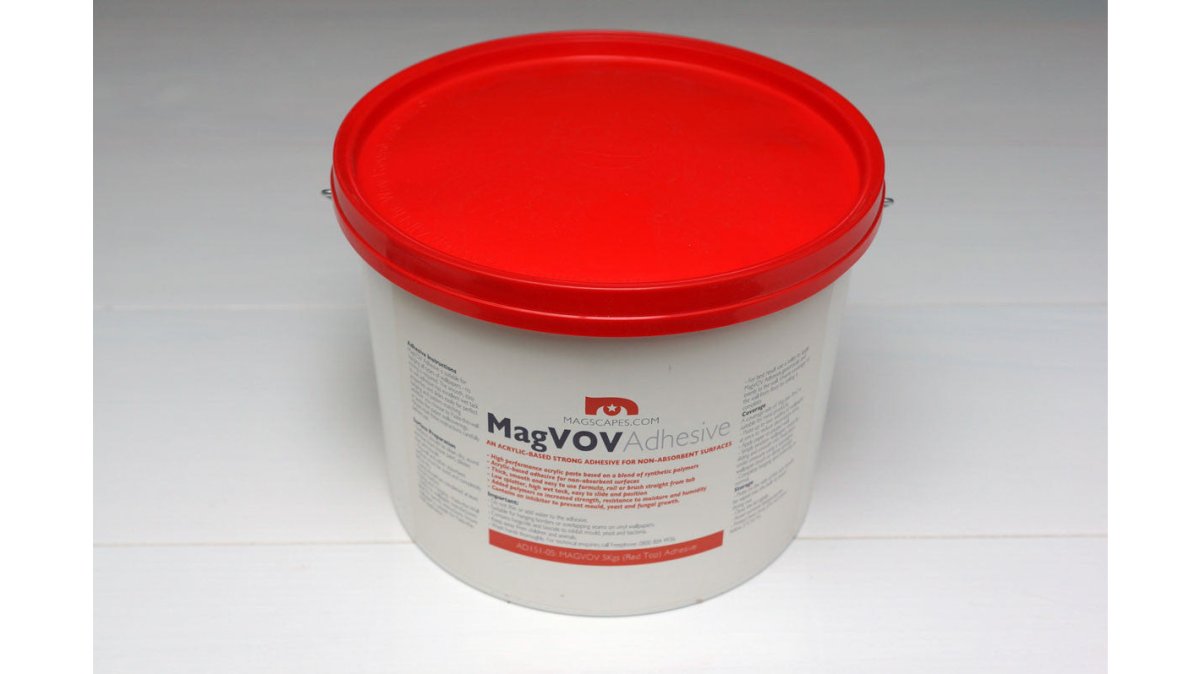
Surface preparation is where projects succeed or fail. Walls need to be clean, dry, sound and free of flaking paint. Absorbent surfaces such as plaster and plasterboard take MagFix™ Wallcovering General Adhesive at £22.00. Sealed or non-absorbent surfaces such as MDF, plywood, Foamex or previously painted walls need MagVOV™ Wallcovering (Vinyl On Vinyl) Adhesive at £33.00. Both are ready-mixed, covering roughly 1kg per 3m².
The 120cm roll width is chosen to minimise seams on standard-height walls. Expect the wall to be ready to write on once the adhesive has fully cured.
Fire Ratings, VOC Levels and Compliance
Fire performance and emissions are the two compliance questions that decide whether a wallcovering can be specified in a commercial building at all. Get either wrong and the product fails at specification stage regardless of how well it performs day to day.
MagScapes ferrous wallcoverings carry a Euroclass B, d0 rating on the dry-erase and chalkboard products, with the paintable range at Euroclass D-s1, d0. The d0 suffix describes smoke production and droplet behaviour, which matters in escape routes and compartmented buildings. For a full explanation of how these classifications are applied, the government guidance on fire safety in non-domestic premises is the reference point specifiers work from.
VOC levels are the second gate. All MagScapes wallcoverings are low VOC with no odour, which means installation can proceed in occupied buildings without extended ventilation. For schools, healthcare settings and offices running a live refurbishment, that is the difference between a weekend fit and a phased shutdown.
Where a project needs formal evidence, the technical data sheets and fire certification are available for the specification pack. Ask for them before the tender goes out, not after.
Cost, Durability and Life-Cycle Considerations
Cost per roll is the wrong metric. The number that matters is cost per square metre per year of service, and that calculation favours a 10-year product every time.
A ferrous wallcovering at £216.00 per roll covers a substantial wall area, and the adhesive adds £22.00 to £33.00 per tub depending on substrate. Set that against replacing whiteboard panels or repainting a magnetic paint system every few years and the arithmetic is straightforward: fewer replacement cycles means less material, less labour and less waste.
Durability is where the specification shows. The 0.6mm ferrous build on MagWrite and MagChalk holds its receptivity across the full surface rather than degrading in patches, and the factory-laminated finish is consistent from roll to roll in a way that site-applied magnetic paint never is. After a year of heavy classroom or meeting-room use, the surface should still erase cleanly and hold magnets at full strength.
Life-cycle assessment thinking pushes the same conclusion. A product that stays on the wall for a decade avoids the extraction, manufacturing and transport emissions of every replacement it displaces. That is the UK guidance on embodied carbon in construction argument applied to interiors, and it is where ferrous wallcoverings outperform paint-based magnetic systems comfortably.
Magnetic Strength Ratings and Acoustic Integration
Magnetic pull force is the specification most buyers forget to check, and it is the one that determines whether the wall is genuinely useful six months in. Receptivity is rated out of five, and the rating is a property of the manufactured ferrous layer rather than the skill of whoever installed it.
MagLiner sits at 5/5, the highest in the range. MagWrite and MagChalk both score 4/5, which holds all magnet types including heavy clip magnets and document holders. MagPaintable alone is 2/5, workable for lightweight discs only, rising to 4/5 when paired with MagLiner. For a team running colour-coded Kanban magnets and heavy printed reference material, anything below 4/5 will frustrate within weeks.
Acoustic integration is the angle most guides miss entirely. Open-plan offices have a noise problem that magnetic walls can help solve, because a ferrous wallcovering adds mass and density to a partition. Where a project needs measurable acoustic performance, specify the wallcovering as part of the acoustic strategy and confirm the contribution with the technical data rather than assuming it.
Removal and Wall Restoration
Removal is the question nobody asks until they are handing back a lease. A paste-the-wall ferrous wallcovering comes away with the same process used to install it: score the surface, apply warm water or a stripping solution, and lift the material away in sheets.
Wall restoration depends on what was underneath. On a sound plaster or plasterboard wall that was properly prepared, the covering lifts cleanly and leaves a surface that needs only a wash and a light fill. On a wall that was already compromised, expect to make good the substrate regardless of what was hung on it.
For tenants in serviced or leased offices, this is the practical argument for wallcovering over magnetic paint. Paint-based systems are effectively permanent; removing them means sanding back to bare plaster. A ferrous wallcovering reverses, which means a 15-person design studio can install it, use it for three years and leave the space as found.
The same logic applies to reinstatement costs in dilapidations negotiations. A reversible system is a materially lower risk than a permanent one, and that belongs in the business case alongside the collaboration benefits.
Specifying magnetic walls for an office means balancing receptivity, fire performance, emissions and reversibility, and most projects get at least one of those wrong on the first pass. MagScapes manufactures ferrous wallcoverings with the ratings to hold every magnet type, Euroclass fire certification for commercial specification, and low VOC, no-odour construction for occupied buildings. The range covers dry-erase, chalkboard, paintable and liner systems, each backed by a 10-year warranty. Get started with MagScapes and turn underused wall area into a surface your teams actually work on.
Frequently Asked Questions
Are magnetic wallcoverings eco-friendly?
The sustainable options use low-VOC, solvent-free and isocyanate-free formulations with no odour, so they can be installed in occupied offices without extended ventilation. Materials such as non-woven polyester backings and low-VOC adhesives reduce indoor air quality impact. Choosing a magnetic wallcovering also avoids the repeated manufacture and disposal of whiteboard panels, which lowers the long-term material footprint of an office fit-out.
Do magnetic wallcoverings meet UK fire safety standards?
Products in this category typically carry a Euroclass fire rating, with some achieving Euroclass B, d0 and others Euroclass C-s1, d0 or D-s1, d0. These classifications are assessed under the European reaction-to-fire standard used in UK building specifications. A higher rating is required for escape routes and higher-risk areas, so check the technical data sheet against your project's building regulations requirements before specifying.
How does magnetic wallcovering compare to traditional whiteboards?
A traditional whiteboard is a fixed panel with a frame, limited to one size and position. Magnetic wallcovering covers the full wall, so the writable and magnetic surface is continuous with no edges or brackets. It also carries a longer warranty, often ten years, and avoids the replacement cycle of panels that scratch, ghost or lose their surface. The trade-off is that installation needs a professional decorator rather than a wall bracket.
Can magnetic wallpaper be recycled or removed later?
Removal is straightforward for a decorator: the wallcovering is stripped in the same way as conventional wallpaper, and the wall can be restored with filler and a fresh paint or paper finish. Recycling routes depend on the material mix, so check with the manufacturer. Some products use post-consumer waste in their construction, and the low-VOC adhesives are water-based, which supports responsible disposal.