


Table of Contents
- What Makes Magnetic Wallpaper Safe for Children's Rooms?
- Magnetic Wallpaper vs. Magnetic Paint: A Safety and Performance Comparison
- Understanding UK Magnetic Wall Safety Standards for Wallcoverings
- Choosing Non-Toxic Magnetic Wall Paint and Finishes for Kids
- Selecting Safe Magnetic Wall Accessories for Toddlers and Older Kids
- Installation, Wall Preparation, and Long-Term Wall Damage Assessment
- A Parent's Safety Audit: Age Guidelines and Magnet Strength Check
- Conclusion
- Frequently Asked Questions
Last Updated: September 6, 2026
When you search for answers on whether is magnetic wallpaper safe for children's rooms, you will find plenty of marketing pages but very little practical, safety-first guidance. As a UK-based manufacturer of magnet-receptive wallcoverings, our team has spent years answering this question from parents and schools. The short answer is yes, provided you choose the right materials, install them correctly, and select age-appropriate magnets.
The key distinction lies between the wall surface itself and the accessories you attach to it. A high-quality magnetic wallcovering is essentially an inert, non-toxic sheet, while the real safety considerations often revolve around the magnets and how you manage them.

What Makes Magnetic Wallpaper Safe for Children's Rooms?
A safe magnetic wallcovering for a child's room is physically inert, chemically non-toxic, and strong enough to withstand years of play. The safest products are manufactured as a solid ferrous sheet rather than painted on, because this manufacturing process controls thickness and density, eliminating the weak spots and application errors that can plague liquid alternatives.
When evaluating safety, look for three credentials: low VOC and odourless certification (no harmful fumes after installation), fire resistance, and a durable, easy-to-clean surface that prevents the build-up of grime and bacteria.
Magnetic Wallpaper vs. Magnetic Paint: A Safety and Performance Comparison
Choosing between a ferrous wallcovering and magnetic paint affects both safety and long-term satisfaction. Magnetic paint often seems simpler, but its performance is inconsistent and typically requires multiple coats for even a modest hold, which can lead to the use of stronger, less safe magnets to compensate.
| Feature | Ferrous Wallcovering (e.g., MagLiner) | Magnetic Paint |
|---|---|---|
| Magnet Receptivity | 5/5, consistent across the whole wall | 2/3 out of 5, varies with application |
| Installation Time | Single session, paste-the-wall | Multiple coats with drying time |
| Surface Durability | High, scratch and scuff resistant | Prone to chipping and uneven wear |
| VOCs & Odour | Low VOC, no odour | Can have strong fumes during application |
| Safety for Play Areas | Yes, certified safe | Generally safe after curing, but weaker hold |
The practical safety implication is significant: a wall with lower receptivity requires stronger magnets to hold items. Stronger magnets, often neodymium, pose a greater ingestion hazard and can pinch small fingers. By choosing a high-receptivity surface, you can use lighter, easier-grip magnets, a safer combination for young children.
Understanding UK Magnetic Wall Safety Standards for Wallcoverings
In the UK, there is no single safety standard solely for magnetic wallpaper, but the product must comply with general construction and toy safety regulations. For the wallcovering itself, the most relevant certifications are fire safety ratings, such as the EuroClass system, and low VOC emissions standards.
For the magnets, regulations are much stricter. Under the UK Toy Safety Regulations, magnets in toys for children under 14 must be either too large to swallow or have a low magnetic flux index if small enough to be ingested (legislation.gov.uk). Standard office magnets should never be used in a child's play area. When selecting accessories for toddlers, look for products explicitly labelled as safe for that age group.
Choosing Non-Toxic Magnetic Wall Paint and Finishes for Kids
When selecting a finish, the priority is to choose materials that are certified non-toxic or can be safely sealed. Many parents ask about non-toxic magnetic wall paint, but a more reliable route is a pre-finished ferrous wallcovering that requires no painting or one that is pre-primed for a standard emulsion topcoat.
If installing a paintable version, allow the adhesive and paint to cure fully, typically a few days, before allowing children near the wall. A surface like the MagScapes MagPaintable is pre-primed and accepts any standard emulsion, so you can achieve your desired colour without needing a specialist, often more toxic, magnetic paint.
Selecting Safe Magnetic Wall Accessories for Toddlers and Older Kids
The rule of thumb for accessories is simple: what is safe for a toddler differs from what is safe for a seven-year-old. For toddlers, the primary risks are choking and ingestion, so only use large, fully-enclosed plastic magnets that cannot be opened or broken. The MagScapes range includes dome and pawn magnets. The dome magnets are explicitly noted as not suitable for children due to their size and strength.

For older children, the focus shifts to magnet strength and the weight of items held. A strong magnet that can hold 18 sheets of paper is useful for displaying schoolwork but can pinch skin if handled carelessly. Establish a rule that only adults attach and remove high-strength magnets, while children move lighter, safer ones.
Installation, Wall Preparation, and Long-Term Wall Damage Assessment
Proper installation is the single biggest factor in preventing long-term wall damage and ensuring the product performs as intended. Most advice stops at 'clean the wall and stick it up,' but a magnetic wallcovering is a heavy, continuous membrane that interacts with your plaster, humidity, and structural limits in ways standard wallpaper does not.
Wall Preparation: The Structural Checklist
The process begins with a structural assessment, not just a wipe-down. The surface must be clean, dry, smooth, and sound. In UK homes, particularly older Victorian or Edwardian terraces, plaster can be friable or have a high lime content. A wallcovering adhered to loose plaster will pull it off on removal, turning a simple installation into a re-plastering job.
Before installation, run this checklist:
- Test for soundness: Press firmly on the wall in several places. If you feel any give or see cracking, the plaster needs repair before you proceed. The weight of the magnetic material over time, especially where items are constantly attached and pulled, will exploit any weakness.
- Check for damp: Use a moisture meter or look for efflorescence (white powdery salts) or dark patches. In a UK climate, a magnetic wallcovering can act as a vapour barrier; if the wall is damp, you are sealing moisture in, which can lead to black mould behind the sheet. If in doubt, apply a damp-proof primer such as a solvent-based stain block (e.g., Zinsser BIN) before installation.
- Prime the surface: For highly absorbent plaster, a standard PVA-based primer or wallpaper primer is essential. This prevents the adhesive from drying out too quickly and failing to bond. Skipping this step is the most common cause of peeling at the edges within the first year.
The Weight Factor: What Your Wall Can Actually Hold
A ferrous wallcovering adds significant weight to a wall. A typical 2.5m x 2.5m wall covered in a product like MagLiner adds roughly 4-5 kg, well within the load capacity of standard plasterboard or solid brick, but not zero (british-gypsum.com). On a plasterboard partition wall, check that the boards are securely fixed to the studs with no flex.
More importantly, consider what you will hang. The wallcovering is not the structural limit; the wall behind it is. A strong magnet holding a heavy wooden toy box or a stack of books exerts a point load on the plaster, which can crush or tear over time. Limit any single magnetic item to 1 kg for plasterboard walls and 2 kg for solid brick or block walls. For anything heavier, use a shelf or picture hook.
The 3-5 Year Damage Assessment: What Actually Happens
Most articles tell you the product is 'removable' and leave it at that. Here is the honest, long-term picture after three to five years of use in a child's room:
- The best case: Installed on a well-primed, sound wall, it peels off cleanly, leaving a faint adhesive residue removable with warm soapy water. The paint underneath may have a slightly different sheen, but a single coat of emulsion will restore the wall.
- The common case: Installed on a wall that was not primed or was slightly porous, the adhesive pulls off the top layer of paint or a thin skim of plaster on removal. You will need to fill small pits and repaint, a cosmetic, not structural, repair.
- The worst case: Installed over a damp or friable wall, or with strong adhesive tapes used on top, the wallcovering may develop bubbles, and removal will tear chunks of plaster away, requiring re-skimming.
Removal and Renter Considerations
For renters, reversibility is a major advantage over paint, but not a zero-damage solution. Remove it slowly, at a low angle, pulling the sheet back on itself rather than away from the wall. Heat from a hairdryer can soften aged adhesive. Expect minor filling and repainting to return the wall to its original condition.
The most common cause of damage is not the product but the use of strong adhesive tapes or screws, which can tear the surface or wall. If you are a renter, document the wall's condition with photos and get written permission from your landlord. Most landlords will accept a magnetic wallcovering if you agree to restore the wall on departure. chemical-free nursery furniture.
A Parent's Safety Audit: Age Guidelines and Magnet Strength Check
Before you let your child loose on their new magnetic wall, run through this simple safety audit to ensure the space is as safe as it is fun. This ten-minute checklist covers the main risks often overlooked in the excitement of creating an interactive play zone.
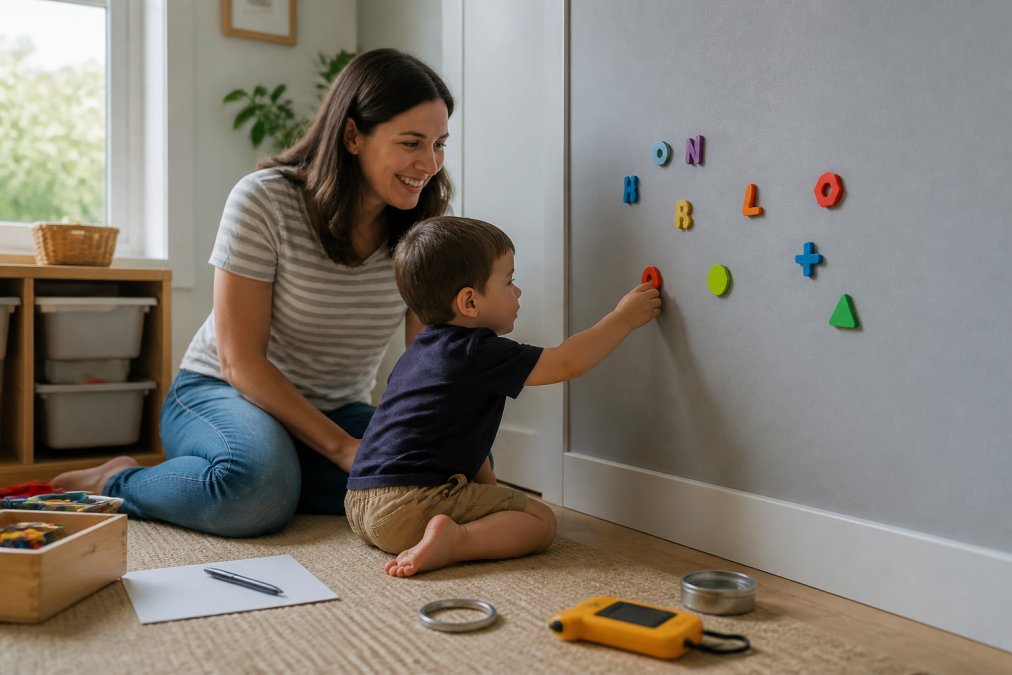
The Hidden Hazard: Neodymium Magnets
The wallcovering itself is inert. The real danger is not the wall, it is the magnets you allow near it. Most commercial blogs recommend 'strong magnets' for a better hold, but they fail to warn you about the specific and severe risk of neodymium magnets.
Neodymium magnets are the small, silver, high-powered magnets often sold for office use or in building toys. They are not a traditional choking hazard, too dense to block an airway easily, but they are a catastrophic ingestion hazard. If a child swallows two or more, they can attract each other through the walls of the intestines, causing perforations, sepsis, and death within hours (PubMed). The UK's Royal College of Emergency Medicine has issued repeated warnings about this exact scenario.
Here is the rule that no other article will tell you: Never, under any circumstances, allow small neodymium magnets (typically 3-10 mm in diameter) anywhere near a magnetic wall in a room used by children under 14. The wall's strong magnetic field makes these magnets particularly attractive to play with, and their small size makes them easy to lose and find later in a child's mouth. Standard office magnets, fridge magnets, or any magnet not explicitly sold as a toy for the child's age group should be banned from the room.
The Magnet Strength Test: A Practical Method
For the magnets you do allow, you need a simple, repeatable strength test. The goal is to find a magnet that holds a piece of paper or lightweight card securely but can be removed by a child with a gentle twist. If you have to pull hard, the magnet is too strong for young children.
A practical method is the 'paper test':
- Place a single sheet of standard 80gsm printer paper on the wall.
- Attach the magnet to the paper.
- Try to remove the magnet with one finger, using a twisting motion.
- If it comes off easily, it is safe for a 3-5 year old. If it requires a firm grip or a pull, it is too strong for that age group.
For older children (8+), you can use stronger magnets, but still avoid anything that can pinch skin. A magnet that can hold 18 sheets of paper will pinch a finger painfully. Establish a rule that only adults attach and remove high-strength magnets, while children move lighter, safer ones.
Age-Segmented Guidelines: The Full Picture
The table below provides a more granular breakdown than the simple 'under 3, no magnets' advice you will find elsewhere, accounting for the developmental stage of the child, not just their age.
| Age Group | Developmental Stage | Safe Magnet Type | Magnet Flux Index (Max) | Recommended Activity | Supervision Level |
|---|---|---|---|---|---|
| 0-18 months | Mouthing everything | None. The wall is for sensory touch only. | N/A | Non-magnetic sensory play (e.g., textured fabric swatches) | Constant, direct |
| 18 months - 3 years | Still mouthing, but starting to understand cause and effect | Large, fully-enclosed plastic magnets, wider than 35mm. Must not fit inside a standard small-parts tester (approx. 31.7mm diameter). | Must be below 50 kA²/m² (the UK Toy Safety limit for small magnets) | Large magnetic letters and shapes, placed at low height | Constant, direct |
| 3-5 years | No longer mouthing, but still impulsive | Large plastic magnets with a smooth, rounded shape. No magnets that can be opened or broken. | Below 50 kA²/m² | Magnetic letters, simple pattern making, sorting games | Direct supervision, but can be left alone for short periods |
| 5-7 years | Developing fine motor skills, understands rules | Medium-strength, enclosed magnets (e.g., dome magnets with a plastic casing). Avoid any magnet with a visible metal core. | Below 50 kA²/m² | Displaying artwork, simple puzzles, creating stories on the wall | Occasional checks |
| 8+ years | Understands consequences, can follow complex rules | Standard strength magnets, but still no small neodymium magnets. | Any, but supervise the first few uses | Project displays, organisational tasks, science experiments | Independent, but discuss the risks of swallowing magnets |
The Reachability and Fall Risk Check
Attach magnets only at a height your child can reach while standing flat-footed, preventing them from climbing furniture to retrieve a magnet, a fall risk. A common pattern in UK homes is to place the wall lower in a toddler's room (starting at skirting board height) and higher in a school-age child's room (starting at waist height). For a shared room, install at the height of the youngest child.
The Final Surface Inspection
Run your hand over the wall to check for sharp edges at the seams or corners. A professional installation should leave a perfectly smooth surface. If you have installed it yourself, pay particular attention to cut edges, as a poorly trimmed edge can leave a sharp lip that can cut a small finger or catch clothing. Sand any rough edges gently with fine-grit sandpaper (P120 or finer) before allowing children near the wall.
:::takeaway The single most important safety decision you will make is not which wallcovering to buy, but which magnets you allow in the room. If you take one thing from this audit, let it be this: ban small neodymium magnets entirely, and test every other magnet with the 'paper test' before letting your child play.
Conclusion
Deciding whether is magnetic wallpaper safe for children's rooms ultimately comes down to the choices you make as a parent. The wallcovering itself, when sourced from a reputable manufacturer, is a safe, non-toxic, and durable surface that can transform a bedroom into an interactive learning environment. The real work is in managing the accessories and setting clear boundaries for how the wall is used.
At MagScapes, we believe a magnetic wall should grow with your child, offering a safe and creative outlet from toddlerhood through their teenage years. Our range of ferrous wallcoverings, including MagLiner for use beneath any wallpaper and MagWrite for a writable surface, are designed with safety certifications, low VOC materials, and fire resistance in mind. Get started with MagScapes and create a wall that is as safe as it is inspiring.
Frequently Asked Questions
Are magnetic walls safe for children's bedrooms?
Yes, magnetic walls are safe for children's bedrooms when installed with safety in mind. Choose a wallcovering that is low-VOC, odourless, and fire-resistant. The wallcovering itself poses no ingestion hazard. The primary risk is from small, loose magnets. Use large, easy-grip magnets that are too big to swallow and keep all magnetic accessories out of reach of children under three. Always supervise younger children during play.
Do magnetic wallcoverings contain harmful chemicals or VOCs?
Quality magnetic wallcoverings are designed to be safe for indoor use. Look for products with low VOC emissions and no odour. For example, MagScapes wallcoverings are low-VOC and odourless, making them suitable for play areas. This is a significant advantage over some magnetic paints, which can have higher VOC levels. Always check the product's technical data sheet for certification and safety information before installation.
How do I ensure magnetic wall accessories are safe for toddlers?
For toddlers, the main safety concern with magnetic wall accessories is the risk of swallowing small magnets. Select accessories that are large enough that they cannot be easily swallowed or choked on. Products like the MagPlus Pawn Magnets are large, easy-grip magnets. Avoid using small neodymium magnets, which are a serious ingestion hazard. Always supervise toddler play and store magnets out of reach when not in use.
Is it safe to use magnetic paint in a child's room instead of wallpaper?
Magnetic paint can be safe, but magnetic wallpaper offers distinct advantages for a child's room. Magnetic paint often requires multiple coats and has weaker magnetic hold. More importantly, its performance can be inconsistent. High-quality magnetic wallpaper, like MagLiner, provides a strong, consistent magnetic surface with 5/5 receptivity. It is also low-VOC and odourless, whereas some paints can emit higher levels of VOCs. For safety and performance, wallpaper can be a strong choice.
What should parents look for when choosing a magnetic wall solution?
Parents should prioritise safety and durability. When choosing a magnetic wall, look for a wallcovering that is fire-resistant, low-VOC, and explicitly safe for use in play areas. Check for a strong magnet receptivity rating to ensure it holds magnets securely, preventing them from falling and becoming a hazard. Also, consider the magnet strength you will use. For young children, always pair the wall with large, easy-grip magnets that are safe if handled.