


Table of Contents
- Magnetic Wallcovering vs Magnetic Paint: Core Differences
- Magnetic Strength and Pull Performance
- Installation Process and Difficulty
- Durability and Long-Term Performance
- Cost Comparison: Magnetic Paint vs Wallcovering
- Surface Preparation and Wall Substrate Requirements
- Aesthetic Finish and Design Flexibility
- Which Solution Is Right for Your Space
Last Updated: August 17, 2026
Magnetic Wallcovering vs Magnetic Paint: Core Differences
When choosing between magnetic wallcovering and magnetic paint, the decision shapes installation time, performance reliability, aesthetic control, and long-term durability. Magnetic paint suspends iron particles in liquid, requiring multiple coats to build sufficient ferrous density for magnet hold. Magnetic wallcovering is a pre-manufactured ferrous sheet applied directly to the wall using standard decorator techniques.
The core distinction is consistency and control. With magnetic paint, performance depends entirely on application skill: coat thickness, drying conditions, substrate preparation, and decorator technique all influence final magnetic strength. Wallcovering performance is engineered at manufacturing and remains consistent across every installation. This consistency matters enormously when a surface must hold documents, display boards, or patient information reliably day after day.
Magnetic Strength and Pull Performance
How Magnetic Paint Strength Limitations Affect Real-World Use
Magnetic paint typically achieves a receptivity rating of 2 to 3 out of 5 under ideal conditions. In practice, many installations fall short. Physics limits iron particle concentration before paint becomes too thick to apply smoothly. Even with five coats, the ferrous layer remains thin and variable across the wall surface.
This limitation shows immediately in use. Lightweight magnets hold adequately. Heavier magnets that secure multiple sheets of paper or hold clip-based document holders either slide or drop. Facilities managers in healthcare settings report particular frustration: patient information boards that need to hold multiple cards reliably simply don't perform with paint-based solutions. Inconsistency across the wall surface compounds the problem, one section might hold magnets firmly while another, just a metre away, struggles with the same magnet.
Wallcovering Magnetic Receptivity and Magnet Compatibility
Magnetic wallcovering products deliver receptivity ratings of 4 to 5 out of 5. This rating reflects real-world performance: all magnet types hold securely across the entire surface with confident grip. The difference between a 2/5 paint rating and a 5/5 wallcovering rating is transformative, not incremental.
MagLiner achieves 5/5 receptivity because its 0.5mm ferrous sheet is manufactured at controlled thickness and density before installation. Every roll performs identically with no weak spots or variation. Lighter neodymium magnets, heavier ferrite magnets, and clip magnets holding stacks of documents all perform with equal reliability. This consistency enables genuine multi-functional use: a classroom wall can hold magnetic letters, clip magnets for student work, and presentation boards simultaneously without questioning whether magnets will hold.

The receptivity difference also affects magnet choice. With wallcovering, specifiers can use the lightest, most elegant magnets available. With paint, they often need heavier, more visible magnets just to achieve reliable hold, an aesthetic compromise that shapes the final appearance significantly.
Installation Process and Difficulty
Magnetic Receptive Wallcovering Installation Methods
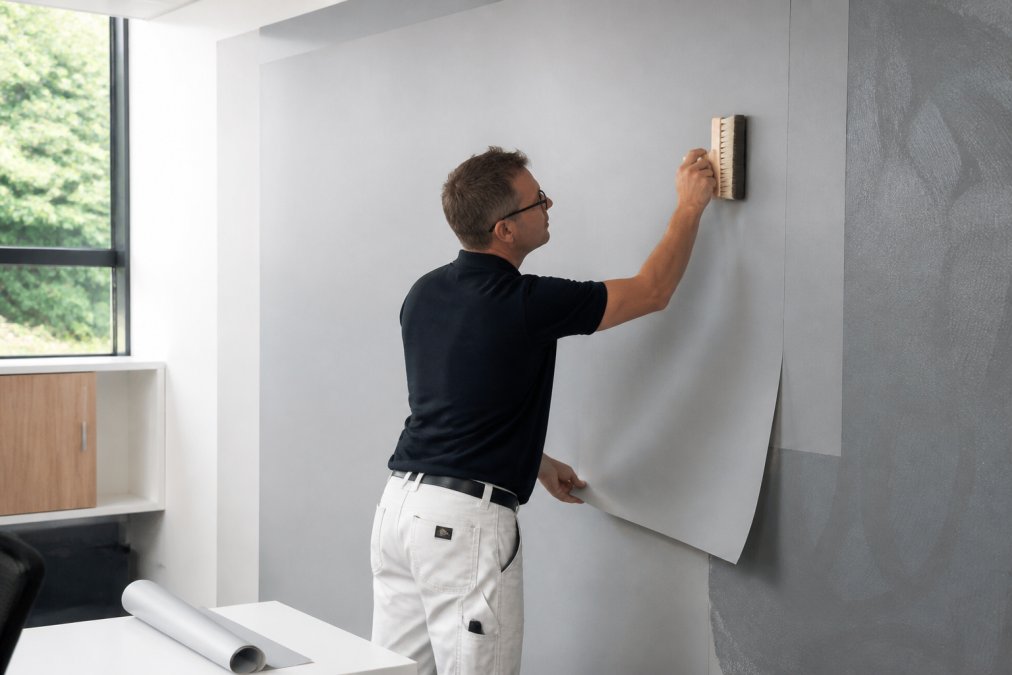
Magnetic wallcovering installs using the paste-the-wall method: adhesive is applied to the prepared wall surface, and the wallcovering is positioned and smoothed into place. This is standard decorator technique, identical to installing premium wallpaper liner. A professional decorator can hang a wall of MagLiner or MagWrite in a single session. The 120cm roll width minimises joins, making the process faster and delivering a cleaner result.
A typical office wall can be fitted, dried, and ready for the next step within a single working day, meaning minimal disruption to operations. Surface preparation is straightforward: fill holes, sand uneven areas, and prime if necessary. MagPaintable comes pre-primed and ready to paint directly. MagLiner accepts paint, wallpaper, or fabric. MagWrite and MagChalk are ready to use immediately after drying. Installation difficulty is low for experienced decorators and moderate for DIY.

Magnetic Paint Application and Time Requirements
Magnetic paint requires multiple coats, typically three to five, with each coat drying fully before the next is applied, usually 4 to 24 hours depending on conditions. A project taking one day with wallcovering stretches across three to five days with paint. The application process is labour-intensive: the wall must be primed, each coat applied, allowed to dry, then inspected for coverage gaps. Uneven coverage is common, requiring touch-up coats.
Environmental conditions significantly affect paint application. Temperature and humidity influence drying time and can cause uneven particle distribution. Cold conditions slow drying dramatically. For large commercial projects, the cumulative labour cost exceeds material cost considerably. Wallcovering, applied in a single session, costs less in labour overall.
Durability and Long-Term Performance
Magnetic wallcovering products are engineered for long-term durability in high-use environments. The ferrous layer is protected by the wallcovering's surface laminate or by paint applied over it, preventing oxidation and maintaining consistent magnetic performance over years of use. MagScapes products carry 10-year warranties. A MagWrite wall installed years ago performs identically to one installed today.
Maintenance is minimal: a damp cloth removes dust, spray cleaner handles marks. The surface never requires reactivation, recoating, or replacement due to magnetic degradation.

Magnetic paint can show degradation within months. The paint surface can chip or scratch, exposing the ferrous layer beneath. Iron particles can settle unevenly over time, creating areas of inconsistent magnetic strength. In high-use environments, facilities managers often find themselves repainting sections within two to three years. This durability difference becomes especially significant in healthcare and educational settings where walls experience intensive daily use.
Cost Comparison: Magnetic Paint vs Wallcovering
Material and Labour Costs
Material cost of magnetic paint is deceptively low but ignores multiple coats required and labour implications. A typical 10-square-metre office wall costs approximately £50-£80 in magnetic paint material for three to five coats. The same wall fitted with MagLiner costs approximately £67 for wallcovering alone.
However, applying magnetic paint requires 12-20 hours of decorator time across multiple days at typical rates of £240-£400 in labour. Installing MagLiner requires 3-5 hours in a single session, costing £60-£100 in labour. Total project cost with wallcovering is £127-£167. Total project cost with paint is £290-£480. Wallcovering costs 40-50% less when labour is included.
For a 50-square-metre classroom wall, paint costs £250-£400 in material but requires 60-100 hours of labour. The same wall fitted with magnetic wallcovering costs approximately £333 in material and 15-25 hours of labour. Total cost with paint: £1,200-£2,000. Total cost with wallcovering: £600-£850. Wallcovering delivers 50-60% cost savings on larger installations.
Long-Term Value and Maintenance Expenses
Magnetic paint often requires repainting within two to three years in high-use environments, repeating the full labour and material cost cycle. A wall painted with magnetic paint might be repainted three times over ten years, accumulating total costs of £900-£1,500. A wallcovering installation with its 10-year warranty and minimal maintenance incurs only occasional cleaning costs of approximately £20-£50 over a decade. The total cost of ownership over ten years strongly favours wallcovering, particularly for facilities managers in commercial and institutional settings.
Surface Preparation and Wall Substrate Requirements
Both magnetic paint and wallcovering require proper surface preparation, but requirements differ slightly. Paint requires a smooth, clean, primed surface. Wallcovering requires a smooth, clean wall but tolerates minor substrate variations better, as the wallcovering itself provides a uniform base layer.
For magnetic paint, any wall imperfections, unevenness, or substrate variation will show through and can affect coverage and magnetic performance. For magnetic wallcovering, the wall should be clean and reasonably smooth, but minor imperfections are accommodated by the wallcovering itself. On absorbent surfaces, MagFix adhesive is used. On non-absorbent surfaces, MagVOV adhesive is specified. In renovation projects with patchy surfaces or substrate irregularities, wallcovering can be installed with minimal additional preparation, while paint would require extensive surface work first.
Aesthetic Finish and Design Flexibility
Magnetic paint is available in limited colours, typically white, black, and occasionally grey. If a different colour is desired, the only option is painting over the magnetic paint with a standard topcoat, adding another application step.
Magnetic wallcovering offers substantially greater design flexibility. MagPaintable is pre-primed white and accepts any emulsion paint in any colour. MagWrite is available in matt or gloss white. MagChalk is matt black. MagLiner is grey and can be painted, wallpapered, or covered with fabric. This flexibility matters significantly in commercial and residential design. A corporate office can specify MagPaintable in exact brand colour, making the magnetic surface visually integrated into the designed interior rather than visually separate.
The surface finish also differs. Magnetic paint typically has a matte finish and can appear slightly textured or uneven. Wallcovering surfaces are precisely engineered: MagWrite's laminate is uniform and consistent, MagChalk's laminate is perfectly smooth, MagPaintable's pre-primed surface is evenly white. This precision translates to a more professional, finished appearance.
Which Solution Is Right for Your Space
Choose magnetic wallcovering if:
- You need strong, reliable magnetic hold across the entire surface (healthcare, education, high-use commercial)
- You want colour or aesthetic control (corporate branding, designed interiors, residential applications)
- You're budgeting for long-term cost of ownership rather than initial material cost
- You need installation completed in one or two days without disruption
- You want a surface that will perform consistently for ten years without maintenance or repainting
Choose magnetic paint if:
- You have an extremely tight material budget and labour is not a constraint
- You're experimenting with a magnetic surface in a low-use residential space
- You don't require strong magnetic hold and lightweight magnets are sufficient
For most professional applications, offices, schools, healthcare facilities, and retail, magnetic wallcovering is the superior choice. The combination of stronger magnetic performance, design flexibility, faster installation, and lower long-term cost makes it the better investment.
MagScapes offers several wallcovering solutions designed for different use cases. MagPaintable™ Matt White Ferrous Rolls (£216.00) is ideal for projects where colour control is essential. MagLiner™ Matt Grey/Brown Ferrous Rolls (£66.64) delivers 4/5 receptivity beneath a fully paintable surface. MagWrite™ Matt White Ferrous Rolls (£248.00) combines writable dry-erase functionality with 4/5 magnetic strength, perfect for collaborative workspaces and classrooms. MagChalk™ Matt Black Ferrous Rolls (£322.56) provides a magnetic chalkboard surface in one product.

The magnetic wall decision is ultimately about performance reliability and long-term value. Magnetic paint promises simplicity but delivers variable results and short lifespan. Magnetic wallcovering delivers consistent performance, design flexibility, and durability that justifies the investment. For facilities managers, educators, designers, and homeowners serious about creating truly functional magnetic surfaces, wallcovering is the proven choice. Get started with MagScapes and transform your walls into high-performance collaborative tools that adapt to your unique needs.
Frequently Asked Questions
Does magnetic paint actually work as well as magnetic wallcovering?
No. Magnetic paint typically achieves 2-3 out of 5 magnetic receptivity, even with multiple coats. Magnetic wallcoverings deliver 4-5 out of 5 receptivity, providing fridge-door-strength hold. Paint requires 3-5 coats with drying time between each, taking 2-3 days total. Wallcovering installs in one session. Paint performance varies with application technique and substrate; wallcovering performance is consistent across every installation.
How many coats of magnetic paint are required for effective results?
Most magnetic paint products require 3-5 coats to achieve adequate magnetic strength. Each coat needs drying time before the next application, extending the project timeline significantly. Even with multiple coats, ferrous particle density remains inconsistent. Magnetic receptive wallcovering achieves superior performance in a single installation without this repetitive process.
What is the cost difference between magnetic paint and magnetic wallcovering?
Magnetic paint costs £15-30 per litre, requiring multiple litres and multiple coats. A typical room might cost £50-150 in materials alone, plus labour. Magnetic wallcovering like MagLiner costs £66.64 for a 61cm × 6m roll, covering significant wall area. For a 10m² wall, wallcovering typically costs £100-200 installed, with superior performance and no recoating needed. Wallcovering offers better long-term value despite higher initial material cost.
Can magnetic wallcovering be installed over existing surfaces without permanent damage?
Yes. Magnetic receptive wallcovering uses paste-the-wall installation, adhering to properly prepared existing surfaces. It can be removed without permanent wall damage if adhesive is applied correctly and removal is done carefully. This makes it ideal for rental spaces. Magnetic paint, by contrast, requires sanding and primer removal, potentially damaging drywall. Wallcovering offers reversibility that paint cannot match.
What are the main limitations of magnetic paint for heavy-use environments?
Magnetic paint strength limitations include inconsistent iron particle density across the surface, weak hold that cannot reliably support heavy clip magnets or documents, performance degradation over time as particles settle, and difficulty achieving even coverage. In classrooms or offices with daily magnetic use, paint often fails to hold items securely. Wallcovering's engineered ferrous layer maintains consistent, reliable performance through intensive daily use without degradation.
This article was written using GrandRanker