


Table of Contents
- What visual magnetics alternatives are available for hospitals
- Infection control wall solutions for clinical environments
- Magnetic receptive wallcovering for healthcare settings
- Comparison of magnetic receptive media and traditional notice boards
- Fire safety and building code compliance
- Lifecycle cost analysis for hospital magnetic systems
- Installation and maintenance in high-traffic clinical areas
Last Updated: August 20, 2026
What visual magnetics alternatives are available for hospitals
Healthcare facilities must choose between traditional cork and pinboard solutions and advanced magnetic receptive wallcoverings. The right choice depends on infection control requirements, durability demands, and long-term cost considerations specific to clinical environments.
MagScapes, the inventor of premium magnetic wallcoverings, has refined solutions specifically for hospitals where sterilisation, durability, and infection control compliance are non-negotiable. Modern magnetic receptive wallcovering systems offer superior infection control properties and seamless integration into clinical design compared to traditional cork boards, fabric pinboards, standard whiteboards, and magnetic paint.
Infection control wall solutions for clinical environments
Infection control is the primary driver behind selecting alternative wall communication systems in hospitals. Unlike traditional cork or fabric surfaces that harbour bacteria and resist sterilisation, infection control wall solutions must support regular cleaning protocols and resist microbial colonisation.
Magnetic receptive wallcoverings designed for healthcare create seamless, non-porous surfaces that withstand hospital-grade disinfectants without degradation. The ferrous backing layer remains protected beneath a hard laminate surface, eliminating crevices where pathogens accumulate. This design fundamentally differs from cork boards, which trap moisture and organic matter, or fabric pinboards, which absorb contaminants and cannot withstand chlorine-based cleaners.
Surfaces must tolerate regular cleaning with quaternary ammonium compounds, sodium hypochlorite solutions, and alcohol-based disinfectants without staining, warping, or losing functionality. Traditional whiteboards often show permanent marking after repeated exposure to these agents. Magnetic wallcovering systems engineered for healthcare maintain their finish through hundreds of cleaning cycles.
The ferrous layer is a passive magnetic substrate sealed beneath the writing surface. Unlike metal pinboards that corrode when exposed to moisture and cleaning chemicals, ferrous wallcoverings remain stable in high-humidity areas like bathrooms and clinical washing zones.
NHS infection prevention guidance emphasises the importance of hard, non-porous surfaces in clinical environments. Magnetic receptive wallcoverings meet these criteria by design.
Magnetic receptive wallcovering for healthcare settings
Magnetic receptive wallcovering represents the most advanced alternative for hospital wall communication systems. This technology combines a hard-wearing writing or display surface with a ferrous backing layer, creating a multi-functional surface that accepts magnets, dry-erase markers, or chalk pens.

The MagWrite™ Matt White Ferrous Rolls deliver a 4 out of 5 magnet receptivity rating, equivalent to a high-quality fridge door. The matt finish eliminates glare in brightly lit clinical areas and remains compatible with projectors used in teaching rounds. The surface achieves an EuroClass B or C-s1, d0 fire rating, meeting strict building code compliance required in healthcare facilities.

Installation uses a paste-the-wall method with recommended adhesives suited to different substrates. MagFix adhesive works on absorbent surfaces, whilst MagVOV handles non-absorbent walls. A 10-year warranty backs the product, reflecting confidence in durability within high-traffic clinical environments. The 120cm roll width minimises visible seams.
Pricing for MagWrite™ Matt White Ferrous Rolls starts at £248.00 per roll (120cm wide by 3m, 6m, or 12m lengths), translating to approximately £0.69-£0.82 per square metre depending on roll length selected.
The surface accepts dry-erase markers for shift notes, patient information, or workflow diagrams. Magnets hold printed materials without adhesive residue. This dual functionality eliminates the need for separate pinboards and whiteboards.
Comparison of magnetic receptive media and traditional notice boards
| Solution Type | Infection Control | Durability | Magnet Support | Ease of Cleaning | Estimated Lifespan |
|---|---|---|---|---|---|
| Cork Pinboards | Poor | 3-5 years | No | Difficult | 3-5 years |
| Fabric Boards | Poor | 2-4 years | No | Very difficult | 2-4 years |
| Standard Whiteboards | Fair | 5-7 years | No | Moderate | 5-7 years |
| Magnetic Paint | Fair | 4-6 years | Yes | Difficult | 4-6 years |
| Magnetic Receptive Wallcovering | Excellent | 10+ years | Yes | Easy | 10+ years |
Cork and fabric pinboards represent the oldest approach to hospital wall communication. Cork absorbs moisture, harbours bacteria in its porous structure, and cannot withstand hospital-grade disinfectants. Fabric boards trap dust, absorb spills, and discolour permanently when exposed to chlorine-based cleaners. Both require frequent replacement, making them expensive despite low initial cost.
Standard whiteboards lack magnetic capability and require frames, creating edges where dust and pathogens accumulate. Cleaning with hospital disinfectants often leaves permanent staining. This deterioration pressures facilities to replace whiteboards every 5-7 years.
Magnetic paint requires multiple coats (3-4 applications) and 2-3 weeks curing time. Uneven application creates inconsistent magnet performance. The ferrous particles can flake or wear through, exposing underlying paint and compromising infection control compliance.
Magnetic receptive wallcovering eliminates these limitations. The ferrous backing is factory-laminated beneath a durable writing surface, ensuring consistent performance throughout the product's lifespan. A 10-year warranty reflects realistic durability.
Cost-per-year analysis favours magnetic receptive wallcovering. A cork board costing £80-120 requires replacement every 3-5 years. Magnetic receptive wallcovering costing £248-322 per roll (covering approximately 3-4 square metres) delivers 10+ years of service. Over a 20-year facility lifecycle, the wallcovering approach reduces replacement cycles from 4-6 iterations to 2, offsetting higher initial material cost through reduced labour and disposal expenses.
Fire safety and building code compliance
Healthcare facilities must meet stringent fire safety standards. Building Regulations Approved Document B specifies fire performance requirements for materials in different building classifications. Hospital wards, corridors, and common areas require surfaces with limited flame spread and smoke production.
Magnetic receptive wallcovering systems carry fire ratings that satisfy these requirements. MagWrite™ products achieve EuroClass C-s1, d0 or EuroClass B, d0 ratings. This certification confirms compliance without requiring additional treatment or primer coats.
Cork pinboards typically carry no fire rating or require flame-retardant treatment. Fabric boards present fire hazards, many fabrics are combustible and generate significant smoke. Magnetic paint introduces additional variables; the paint base must be fire-rated, and ferrous particles can affect fire behaviour unpredictably.
Building Regulations fire safety requirements establishes the framework for material selection in healthcare buildings. Magnetic receptive wallcovering products pre-certified to European fire standards simplify compliance documentation.
The low volatile organic compound (VOC) formulation means installation causes minimal air quality impact. Staff and patients experience no chemical odour during or after installation.
Lifecycle cost analysis for hospital magnetic systems
Evaluating magnetic alternatives requires understanding total cost of ownership over the system's operational life.
A typical hospital ward measuring 40 square metres requires approximately 12-15 rolls of magnetic receptive wallcovering. Material cost ranges from £2,976-£3,630 depending on finish selection. Professional installation adds £1,200-£1,800. Total first-cost: approximately £4,200-£5,400.
Over 10 years, maintenance costs remain minimal. Monthly cleaning with standard hospital disinfectants costs negligible labour, estimated at 2-3 minutes per 40 square metres. Annual maintenance cost: under £200. No replacement cycles occur within the warranty period.
Cork pinboards cost £800-£1,200 initially with £200-£400 installation. However, replacement every 3-5 years due to deterioration means 2-3 cycles over 10 years. Total 10-year cost including labour: £2,400-£4,800. Maintenance labour is higher, requiring gentle cleaning methods.
Standard whiteboards cost £1,200-£1,800 initially. Replacement every 5-7 years means 1-2 cycles over 10 years. Total 10-year cost: £2,400-£3,600. However, whiteboards lack magnetic functionality, requiring separate pinboard systems.
Magnetic paint costs £200-£400 initially with £800-£1,200 application labour. However, durability is poor, ferrous particles wear through within 4-6 years. Reapplication costs £800-£1,200. Total 10-year cost: £1,800-£2,800. The low initial cost masks higher long-term expenses and performance degradation.
Magnetic receptive wallcovering achieves cost parity with inferior alternatives when amortised over 10 years, whilst delivering superior infection control, durability, and functionality.
Installation and maintenance in high-traffic clinical areas
Professional installation requires experienced commercial decorators familiar with paste-the-wall application methods. Surface preparation is critical; walls must be clean, dry, and structurally sound.
The paste-the-wall method applies adhesive directly to the wall rather than to the wallcovering itself. This approach reduces waste, minimises adhesive exposure, and allows precise repositioning during application. MagScapes recommends MagFix adhesive for absorbent surfaces and MagVOV for non-absorbent walls.
Installation typically proceeds at 40-60 square metres per day for experienced decorators. The 120cm roll width minimises visible joins. Edge finishing with WriteTrim decorative trims creates a professional appearance and protects edges from damage.
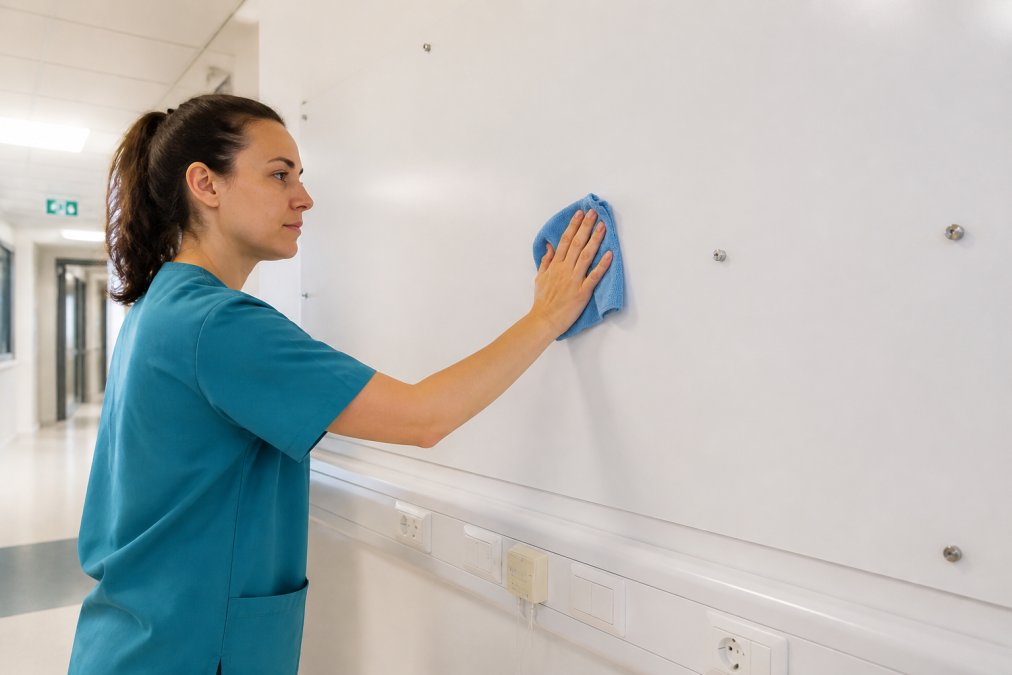
Maintenance in clinical environments is straightforward. Daily or weekly cleaning uses standard hospital disinfectants applied with a microfibre cloth. The hard laminate surface resists staining and chemical degradation. Dry-erase markers erase cleanly without ghosting. Magnets attach and detach without damaging the surface.
High-traffic areas experience heavier wear. The ferrous backing maintains consistent magnet receptivity throughout the product's life. The writing surface resists scratching from normal handling. Accidental impacts rarely cause visible damage due to the 0.6mm thickness and hard laminate composition.
Replacement of worn sections is possible without removing the entire installation. Individual rolls can be carefully removed and replaced if damage occurs in a localised area. Many installations remain fully functional beyond the 10-year warranty period.
Healthcare facilities selecting visual magnetics alternatives face a clear decision: invest in durable, infection-control-compliant systems upfront, or manage the recurring costs and compliance risks of traditional approaches. Magnetic receptive wallcovering systems from MagScapes deliver superior performance in clinical environments, combining ferrous backing technology with hard-wearing writing surfaces that withstand hospital-grade disinfection, fire safety compliance, and 10+ years of intensive use. For facilities prioritising patient safety, staff efficiency, and long-term cost control, magnetic receptive wallcovering represents the evidence-based choice. Explore MagWrite™ Matt White or Gloss White Ferrous Rolls to transform your clinical walls into high-performance communication surfaces that adapt to your operational needs.
Frequently Asked Questions
What makes magnetic receptive wallcovering different from magnetic paint for hospital walls?
Magnetic receptive wallcovering, such as MagWrite™ and MagChalk™, offers consistent magnet receptivity (4/5 rating) across the entire surface without requiring multiple application coats or extended cure times. Unlike magnetic paint, wallcovering installs in a single professional session and is ready to use immediately. It provides superior durability for high-traffic clinical environments, with a hard-wearing laminate surface that resists wear from daily use and maintains its performance throughout a 10-year warranty period.
Are magnetic receptive wallcoverings compatible with hospital infection control standards?
Yes, magnetic receptive wallcoverings like MagWrite™ are specifically designed for healthcare environments. They feature low-VOC, no-odour formulations suitable for occupied buildings, easy-clean surfaces that can be maintained with standard hospital cleaning protocols, and ferrous backing that allows secure attachment of clinical charts and documents without adhesive residue. The smooth laminate surface eliminates crevices where pathogens can harbour, supporting infection control compliance.
How do magnetic receptive systems improve patient communication and wayfinding in hospitals?
Magnetic receptive wallcoverings transform static walls into active communication surfaces. Staff can attach printed wayfinding signage, patient information sheets, and directional graphics using magnets without permanent installation. This flexibility allows hospitals to update signage quickly as departments change, improving patient navigation and reducing confusion. The changeable graphic system supports visual communication strategies that enhance patient experience and reduce staff time spent answering directional questions.
What is the typical cost per square metre for magnetic receptive wallcovering compared to traditional notice boards?
MagWrite™ Matt White Ferrous Rolls cost £248.00 per 3-metre roll (120 cm wide), approximately £68.89 per square metre. MagWrite™ Gloss White costs £216.00 per 3-metre roll (approximately £60.00 per square metre). Traditional notice boards require individual frames, mounting hardware, and periodic replacement, whereas magnetic receptive wallcovering covers large wall areas continuously, reducing overall lifecycle costs when installed across multiple clinical zones.
This article was written using GrandRanker